How Long Does It Take to Build a Website in the UK

Updated: Dec 18, 2025
"So, how long does it take to build a website?" It’s the million-dollar question, isn't it?
The short answer is that a typical business website in the UK takes anywhere from 6 to 14 weeks to go from a bright idea to a live, functioning site. Of course, that timeframe can shrink to just a few weeks for a simple site or stretch out over several months if you’re building something more complex.
Your Quick Guide to Website Build Times
Thinking about building a website is a lot like planning a house build. You wouldn’t expect a garden shed and a multi-storey office block to take the same amount of time, right? The same logic applies here. The final timeline depends entirely on the size and complexity of what you want to create.
A simple brochure-style website with only a handful of pages might be up and running in under a month. On the other hand, a sophisticated e-commerce platform complete with payment gateways and customer accounts is a much bigger beast that requires a far more detailed process.
Understanding the Variables
A few key factors will shape your project’s timeline right from the get-go:
Scope and Complexity: The number of pages, custom features like booking systems, and tricky third-party integrations are the biggest time-consumers.
Content Readiness: Having all your text, images, and branding assets ready to go before the build starts can shave weeks off the project. Seriously.
Feedback and Revisions: How quickly and clearly you provide feedback during the design and development phases plays a massive role.
According to a detailed analysis, building a standard business website in the UK usually takes between 10 and 14 weeks from planning to launch. Simple brochure sites can often be wrapped up in 6-8 weeks, while full-blown e-commerce platforms frequently stretch to 12-14 weeks because of all the moving parts. You can dig into more website creation statistics on Reboot Online to see how different projects stack up.
This guide will break down these timelines even further, giving you a realistic picture of what to expect. Knowing these estimates helps you plan your resources, set achievable launch dates, and keep everyone's expectations in check from day one.
Ready to kick off your project with a clear timeline and some friendly, professional guidance? Get in touch with Baslon Digital today for a free consultation.
What Goes Into Building a Website, Step by Step?
Building a website isn't like flicking a switch; it's more like building a house. You need blueprints, a solid foundation, and a whole lot of careful construction before you're ready to move in. Rushing any of the key stages is a recipe for disaster down the line.
Each phase builds on the last, turning a rough idea into a living, breathing part of your business. Understanding this journey helps set realistic expectations for how long the whole thing will take.
Here’s a quick glance at typical timelines. As you can see, the more you want your website to do, the longer it takes to build.
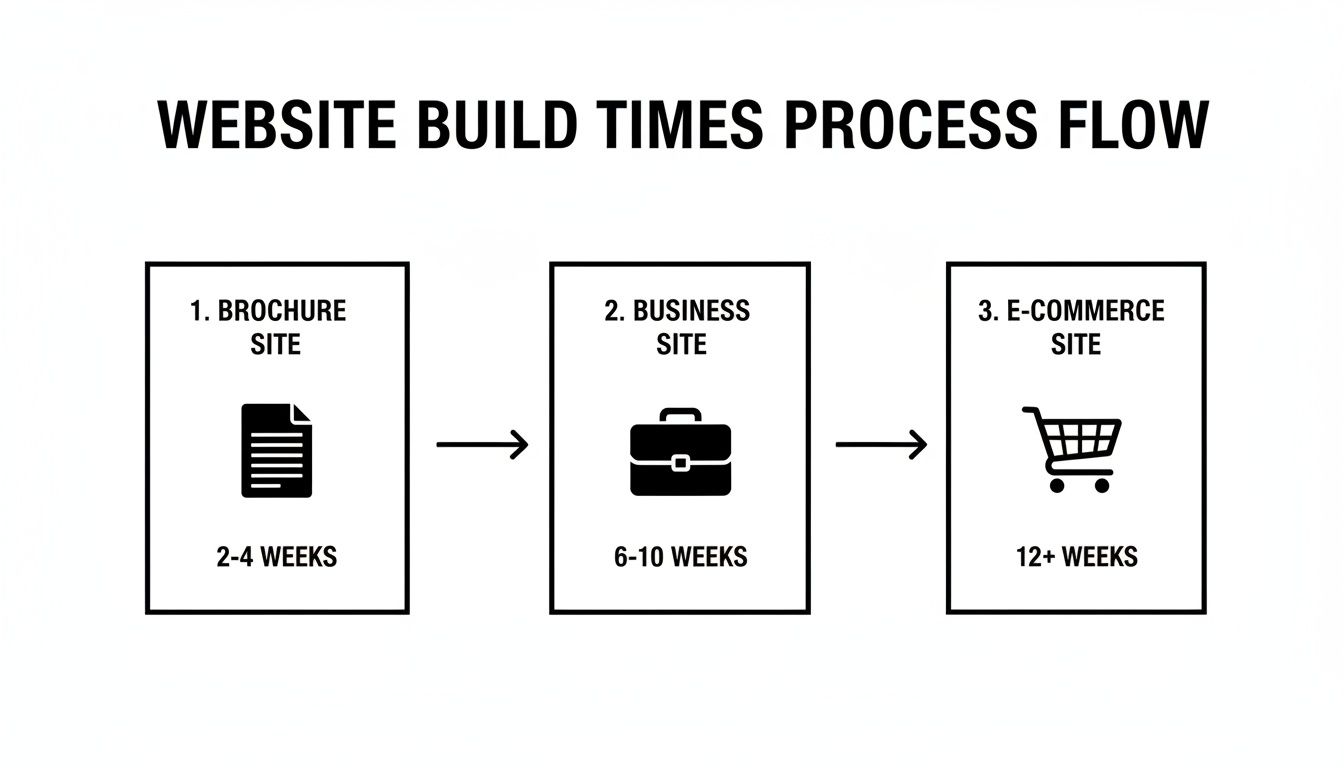
Let's break down exactly what happens at each step of the way.
Phase 1: The Blueprint – Discovery and Planning
This is the most important part of the entire project, and it usually takes about one to two weeks. Think of it as the architectural planning for your house. Without a clear blueprint, the builders would be lost, and you’d end up with a wonky, unusable structure.
This is where we sit down and figure out the 'why' behind your website. We’ll nail down your goals, pinpoint who you’re trying to talk to, and sketch out the site’s basic structure. Skipping this step feels like a shortcut, but it almost always leads to costly detours and changes later. A solid plan is everything.
Phase 2: The Fun Part – Creative Design and Prototyping
With a solid plan locked in, the creative magic begins. This stage typically takes two to four weeks, and it's where your brand’s personality really starts to come alive on the screen. First, designers will create wireframes—think of them as simple, skeletal layouts—to get the structure of each page just right.
Once the wireframes are approved, we move on to detailed mock-ups. These are full-colour designs that show you exactly how the finished website will look and feel, right down to the fonts, colours, and images. It’s a collaborative back-and-forth, with plenty of feedback to make sure the design perfectly matches your vision. To get this right, it's vital to understand the key elements of modern website design that make a site both beautiful and effective.
Your website’s design is its silent salesperson. It's not just about looking pretty; it’s about creating an experience so intuitive that it builds trust and guides visitors exactly where you want them to go from the moment they land.
Phase 3: The Engine Room – Development and Coding
Now it’s time to bring those beautiful designs to life. The development phase is often the longest, taking anywhere from four to six weeks (or more for really complex sites). Here, the developers get to work, writing the code that turns those static pictures into a fully interactive website.
This part is split into two main jobs:
Front-end Development: This is everything your visitors see and click on in their browser.
Back-end Development: This is the behind-the-scenes machinery—the servers, databases, and integrations that make everything work.
For an e-commerce site, the front-end is the slick product page you're browsing. The back-end is the system that’s quietly managing stock levels, processing your payment, and keeping track of customer accounts.
Phase 4: The Final Polish – Testing and Launch
Before popping the champagne, your new site has to go through some serious quality control. This testing phase usually lasts one to two weeks. We put the site through its paces, checking for broken links, glitches, and performance issues across every imaginable device and browser.
Once every bug has been squashed and we get the final green light, it's launch time! We move the website to its live server and point your domain name to it. But the job isn't over. A website is a living thing that needs ongoing care to stay secure, up-to-date, and running smoothly.
Key Factors That Influence Your Website Timeline

Ever wondered why one website launches in a flash while another seems stuck in development forever? It’s not just luck; it’s a collection of key variables that can either hit the accelerator or slam the brakes on your project.
Think of it like planning a road trip. The time it takes depends on your destination (complexity), how many stops you want to make (features), and how quickly you make decisions at each junction (feedback). Getting a handle on these from the get-go helps you avoid unexpected detours and a much longer journey.
Your Project's Scope and Complexity
The single biggest thing dictating how long your website build will take is its scope. A simple, five-page brochure site with static content is like a short drive across town. A custom e-commerce platform with hundreds of products and a slick payment gateway? That’s a cross-country epic.
The more features and custom bits you add, the more time you’ll need. Custom elements that require unique coding will always take longer than using pre-built solutions that are ready to go.
Consider these common additions and their impact on the clock:
E-commerce Functionality: Weaving in shopping carts, payment processing, and inventory management is a seriously complex job.
User Accounts: Building secure login systems for customers or members adds a significant chunk of development hours.
Third-Party Integrations: Hooking your site up to tools like a CRM, booking system, or email platform requires careful setup and a lot of testing.
Custom Animations: While they look amazing, bespoke animations and interactive elements need specialised skills and, you guessed it, more time.
Essentially, every unique function you ask for adds another layer to the build, stretching out the overall timeline.
The Technology Powering Your Site
The platform you choose to build your website on has a massive impact on the schedule. Using a powerful website builder like Wix can seriously cut down development time compared to coding a site from scratch. These platforms offer pre-built components and intuitive editors that remove a lot of the technical heavy lifting.
A custom build, on the other hand, gives you complete freedom but demands far more time for both the front-end (what users see) and back-end (all the server-side wizardry). If you're weighing up your options, our guide on Wix vs WordPress for UK businesses offers a detailed breakdown. It’s the classic trade-off between speed, flexibility, and budget.
The Speed of Your Feedback
This one is so often underestimated, but it can make or break a deadline. How quickly and clearly you provide feedback is absolutely crucial. When a designer sends you a mockup for review, a quick, decisive response keeps the momentum going. A few days of delay here can have a domino effect, pushing back every single phase that follows.
This isn't just a hunch. UK web agencies report that a streamlined project can take as little as 6.4 weeks, partly thanks to efficient platforms. But on the flip side, a whopping 64% of remote teams point to slow client feedback as a primary cause of delays.
A simple tip to keep things moving? Designate a single point of contact for all feedback. This avoids conflicting opinions and ensures the development team gets clear, consolidated instructions, which can honestly shave weeks off your timeline.
Content Readiness and Quality
A website is just an empty shell without content. Having your text, images, videos, and branding assets ready to go before the development phase even begins is one of the best ways to speed up your launch. If designers and developers are sitting around waiting for you to write copy or find the right photos, the project will inevitably stall.
Think of it this way: the developers are building the house, but you’re in charge of the furniture. If the furniture isn't ready on moving day, the house stays empty. High-quality, finalised content allows the team to build the site correctly the first time, avoiding painful rework later on.
To help you get a clearer picture, here’s a quick look at the things that can speed up your project versus those that will almost certainly slow it down.
Timeline Accelerators vs Delays
Factor | How It Accelerates the Timeline | How It Delays the Timeline |
|---|---|---|
Clear Project Brief | A detailed brief with goals and requirements prevents confusion and rework. | A vague or constantly changing brief leads to endless revisions. |
Content Availability | Having all text, images, and videos ready from the start keeps the build flowing. | Waiting for content to be written or created brings the project to a standstill. |
Prompt Feedback | Quick, decisive feedback on designs and drafts allows the team to move forward. | Delayed responses or conflicting feedback from multiple stakeholders creates bottlenecks. |
Pre-built Solutions | Using templates and existing apps (like on Wix) speeds up development significantly. | Demanding custom-coded features for everything adds considerable time and complexity. |
Realistic Scope | A focused scope with essential features ensures a timely launch. | "Feature creep"—adding more and more requirements mid-project—blows the timeline. |
Designated Contact | A single point of contact streamlines communication and decision-making. | Multiple decision-makers providing contradictory feedback causes confusion and delays. |
Managing these factors is key to getting your website live without unnecessary hold-ups. A well-prepared client and a clear plan are the secret ingredients to a smooth and speedy launch.
Realistic Timelines for Different UK Businesses
Theory is great, but let's get down to brass tacks. To really wrap your head around how long it takes to build a website, we need to ditch the abstract phases and look at some real-world examples for UK businesses. Every project has its own unique rhythm, and that’s what shapes the journey from a scribbled idea to launch day.
The world of web development has changed—a lot. Back in 2011, a whopping 76% of websites were coded by hand from scratch, with projects dragging on for an average of 14-20 weeks. Fast forward to today, and that number has plummeted to just 33%. Why? The rise of powerful, user-friendly platforms. This shift has sliced build times by a third, making a snappy 6.4-week project for a simple site a reality, as a guide on UK website design and development from Pleebly points out.
That’s fantastic news for businesses, but it’s crucial your expectations match your specific needs. Let’s break down what this actually looks like for three common types of businesses.
The Local Tradesperson: A Simple 5-Page Site
Picture a plumber in Manchester or a gardener in Bristol. You don't need a massive digital empire; you just need a professional, trustworthy online space that tells people who you are, what you do, and how to reach you. A simple 5-page "brochure" website is the perfect tool for the job.
This kind of project is the most straightforward. Its main goal is to generate leads and build a bit of credibility.
Typical Project Timeline: 4–6 Weeks
Discovery & Planning (Week 1): We'll kick things off with a quick call to nail down your services, the areas you cover, and who your ideal customer is. Then we’ll map out the five essential pages: Home, About, Services, Testimonials, and Contact.
Design & Content (Weeks 2–3): You’ll send over your logo, some photos of your work, and the text for the pages. A designer will then create a clean, professional look that reflects your brand and is dead simple for visitors to navigate.
Development (Week 4): The approved design gets built on a platform like Wix. This just means creating the pages, dropping in the content, and making sure that contact form works perfectly.
Testing & Launch (Week 5–6): We’ll give the site a thorough check on mobiles, tablets, and desktops. After a final look-over from you, we hit the big green button and your site is live!
For a local tradesperson, speed and efficiency are everything. This timeline is totally achievable because the scope is tight and the functionality is simple.
The Creative Professional: A Dynamic Portfolio Website
Now, let's think about a freelance photographer or graphic designer in London. Your website isn't just a business card; it's your entire gallery. It needs to showcase your work in a visually stunning way, with slick galleries, high-resolution images, and maybe even a blog to share your creative process.
This type of project is a bit more complex, which naturally stretches out the timeline.
A portfolio website has to do more than just show off your work—it needs to tell a story. The design itself is part of the portfolio, reflecting your style and professionalism. That means more time is needed for creative exploration and fine-tuning.
Typical Project Timeline: 8–10 Weeks
Discovery & Creative Brief (Weeks 1–2): This stage is much more in-depth. We’ll dive deep into your artistic style, who you want to attract as clients, and exactly how you want to present your work. We'll plan out the structure for multiple galleries and case study pages.
Bespoke Design & Prototyping (Weeks 3–5): A custom design is created to make your visuals the star of the show. This involves more back-and-forth on layouts, fonts, and interactive elements to make sure the user experience is smooth and engaging.
Development & Content Integration (Weeks 6–8): Building custom galleries and optimising massive image files for fast loading takes time. The developer will carefully integrate your portfolio, ensuring every single project looks its absolute best.
Testing & Optimisation (Weeks 9–10): We’ll rigorously test image loading speeds and how the site looks on mobile phones, which are non-negotiable for a visual portfolio. After a few final tweaks, the site is launched.
The Small E-commerce Shop: A Store with 50 Products
Finally, let’s imagine a boutique owner in Brighton selling handmade jewellery online. Your website has to be a secure, reliable, and user-friendly shop. This is the most complex of our three scenarios, as it involves payment gateways, inventory management, and customer accounts.
Here, security and functionality are king, adding a significant amount of time to every single phase.
Typical Project Timeline: 12–14 Weeks
In-Depth Planning (Weeks 1–2): We'll map out the entire customer journey, from browsing products to a successful checkout. We’ll also lock in payment processors and shipping integrations.
Design & UX (Weeks 3–5): The focus is on creating a shopping experience that feels smooth and trustworthy. This means designing clear product pages, a simple shopping cart, and a checkout process that doesn’t make people want to run for the hills.
Full-Stack Development (Weeks 6–10): This is the heaviest lift. Developers will set up the e-commerce platform, integrate payment systems, configure shipping rules, and build the product database. Just importing 50 products with all their descriptions and images is a detailed task on its own.
Rigorous Testing & Launch (Weeks 11–14): End-to-end testing is critical. We'll place test orders, check that inventory updates correctly, and verify every payment goes through. A full security audit is done before the site even thinks about going live.
Understanding these real-world timelines helps you plan your project without pulling your hair out. Ready to figure out the journey for your own business website? Contact Baslon Digital for a personalised consultation.
How to Speed Up Your Website Build Without Sacrificing Quality
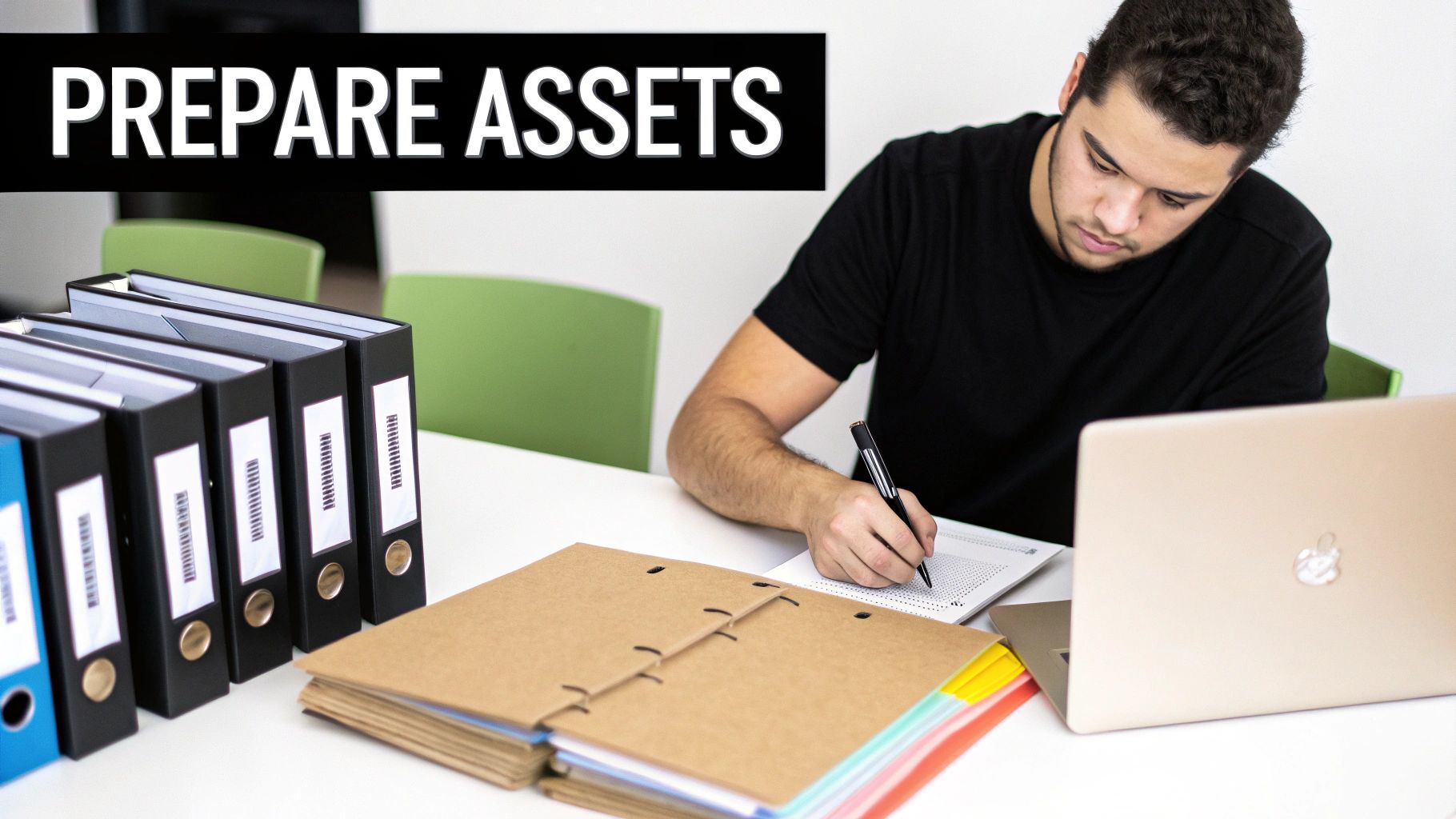
While a proper website build takes time, you're not just a passenger on this journey. Far from it. There are things you can do to keep the project steaming ahead, turning you from a client into a genuine partner in the process. Taking these steps can easily shave weeks off your timeline and make the whole launch feel a lot less stressful.
The idea isn't to rush the important bits, but to get rid of the common roadblocks that cause painful, unnecessary delays. By being prepared and decisive, you give your web design agency the green light to do their best work without hitting frustrating dead ends.
Let’s get into the playbook for becoming the ideal client and getting things done faster.
Prepare All Your Content Upfront
Honestly, the single biggest cause of project delays is waiting for content. A website is just an empty shell without your words, your images, and your brand assets. If your developer has to hit pause while you write the copy for a page or dig around for decent photos, the whole timeline grinds to a halt.
Think of it like a builder finishing a house frame but having to wait weeks for the windows and doors to show up. That’s exactly what happens when the content isn’t ready.
Before the build even kicks off, you should have all your essential bits and pieces organised and good to go. This includes:
Finalised Text: All the copy for your main pages, like Home, About Us, and Services.
High-Resolution Images: Professional photos of your team, your products, or your workplace.
Brand Assets: Your logo in different formats, your exact brand colour codes, and font choices.
Designate a Single Point of Contact
Too many cooks spoil the broth, right? The same goes for website feedback. When half a dozen people are chipping in with conflicting opinions, it just creates chaos and leads to endless, soul-destroying revisions. This back-and-forth can add weeks to the design stage alone.
To dodge this bullet, assign one person from your team to be the sole decision-maker for all feedback and approvals. This person’s job is to gather everyone’s thoughts internally, mash them into one clear set of instructions, and be the only one talking to the agency. It keeps things crystal clear and keeps the momentum going.
"A clear plan and decisive feedback are the secret weapons for a faster launch. When a client knows what they want and communicates it effectively, it removes ambiguity and allows the project to flow without friction, easily saving 20–30% of the total project time."
Trust the Experts and Avoid Scope Creep
You’ve hired a professional agency for a reason—they know what they’re doing. It’s vital to trust their guidance on design and how things should work. While your input is absolutely crucial, constantly second-guessing their recommendations can lead to "analysis paralysis" and bog everything down.
On top of that, you need to watch out for scope creep—the silent timeline killer. This is what happens when new features or pages get tacked onto the project after everyone’s already agreed on the plan. A small tweak might seem harmless, but it can create a domino effect that messes with the whole build.
If you really want to cut down on development time, you could also look into using one of the best no-code website builders, which offer some seriously powerful features without needing custom coding.
For a solid start, no matter which route you take, a detailed project brief is non-negotiable. If you need a hand with that, check out our guide on how to write a website brief to get your project started on the right foot.
Partner with Experts to Bring Your Vision to Life
Deciding between a DIY build and hiring a professional agency is a big moment for any business. While website builders give you incredible tools, there comes a point where your ambition just gets too big for a one-person show. So, when should you call in the experts?
The signs are usually pretty clear. If your dream website involves custom features, tricky integrations with other software, or serious security needs, it’s probably time to team up with an agency. A unique e-commerce shop with complex sales funnels is another classic example of a project that screams for a specialist.
The Hidden Value of an Agency
Hiring pros isn't just about handing off the technical stuff; it’s about getting a strategic partner. A good agency brings way more to the table than just coding. They offer structured project management to keep things on track and provide smart advice to make sure the finished site actually helps you hit your business goals.
That kind of expertise helps you dodge common (and expensive) mistakes, which ends up saving you a ton of time and money. An agency’s real job is to turn your vision into a website that works hard for you, handling everything from the initial idea to a successful launch and beyond. Honestly, it’s often the quickest way to get a complicated website built right the first time.
An agency acts as your project’s architect and builder rolled into one. They don't just follow instructions; they provide the blueprint, manage the construction, and ensure the final structure is sound, secure, and built for growth.
Picking the right partner is everything. If you're thinking about going this route, it’s worth taking a moment to understand how to choose a web design agency that fits your goals and company vibe.
If your project is ambitious and you can’t afford delays, investing in expert help is the most reliable way to get where you want to be. A professional team ensures your website isn't just a pretty face but is also technically solid and strategically smart from day one.
Does your vision require expert execution? Contact Baslon Digital for a consultation to see how we can build your new website efficiently and effectively.
Your Burning Questions Answered
Building a new website throws up a lot of questions, especially around timelines. Let's tackle some of the most common ones we hear from UK businesses to help you get your head around the planning.
Can You Really Build a Website in a Day?
The short answer? Yes. But it’s a bit like asking if you can build a house in a day. You could certainly put up a tent, but you wouldn’t call it a forever home.
Using a template or an AI builder, you can absolutely get a simple, one-page site live in a few hours. It's perfect for a temporary landing page or a digital 'we're opening soon!' sign.
However, a proper business website—the kind with multiple pages, considered content, and useful features like contact forms—is a different beast entirely. That "one-day website" is a digital business card; a multi-page site is your digital headquarters. The real deal involves planning, design tweaks, getting all the content in the right place, and a whole lot of testing. Realistically, that’s a job for several weeks, not several hours.
How Much Time Can I Save by Having My Content Ready?
Honestly? A massive amount. Having all your text, images, and branding assets ready to go before the build kicks off is the single biggest time-saver there is. When a designer has to down tools and wait for you to write a paragraph or find a photo, it’s like hitting every red light on the motorway. The whole project just grinds to a halt.
If you hand everything over upfront, you’re essentially giving the project a clear, open road. This simple bit of prep can easily shave 20-30% off the total timeline. It cuts out the endless back-and-forth and lets the team get into a solid rhythm, moving smoothly from one stage to the next without hitting the brakes.
Scope creep is the silent killer of project timelines. It starts with one small 'could we just add...' request and quickly snowballs, pushing deadlines back and inflating budgets. A clear, agreed-upon plan is your best defence.
What on Earth Is Scope Creep and How Do I Avoid It?
Scope creep is that sneaky thing that happens when a project starts to grow beyond its original plan. It’s the slow, creeping addition of new features and pages after work has already started. Think deciding halfway through the build that you now absolutely need a blog, or asking for a complex booking system that wasn't even mentioned in the initial chats.
Every new addition, no matter how tiny it seems, adds more time for planning, design, building, and testing. To dodge it, you need a super-detailed project plan from day one. Be brutally honest about your "must-haves" versus your "would-be-nices". Once that plan is locked in, stick to it like glue. If a genius new idea pops into your head, fantastic! Just park it for a "Phase 2" update after the main site is live and doing its job.
Ready to kick off your website project with a clear plan and an expert team? At Baslon Digital, we specialise in building stunning, effective websites for UK businesses, making sure your vision comes to life on time and on budget. Get in touch for a free, friendly chat today!
Comments