A Practical Guide to Marketing for Small Businesses

Updated: Dec 8, 2025
Let's be honest, marketing for a small business can feel like trying to solve a Rubik's Cube in the dark. It’s often seen as this complicated, expensive puzzle with way too many moving parts.
With a tight budget and an even tighter schedule, it’s no wonder marketing gets shoved to the bottom of the to-do list. But here’s the thing: marketing isn't just another expense. It's the engine that powers your growth.
Why Marketing Is Your Small Business Growth Engine
Think of your business as a car. Your product or service? That's the shiny chassis and the powerful engine. But marketing? Marketing is the fuel. Without it, even the most incredible car is going absolutely nowhere.
Smart, well-aimed marketing is what connects you with the right people. It’s how you go from being a hidden gem to the go-to destination everyone’s talking about.
Turning Constraints into an Advantage
The very challenges that UK small businesses face—like a shoestring budget—can actually be a secret weapon. When you don't have millions to throw at a campaign, you're forced to get creative and focus only on what truly works.
This means you have to get laser-focused on tactics that genuinely connect with your customers, rather than just shouting generic messages into the void. The first step? Getting to know your customers on a deep level. Creating detailed profiles helps you aim every single pound of your marketing spend where it will have the biggest punch. Check out our guide on how to create user personas that drive results to get this sorted.
The heart of great marketing isn't about having the biggest budget; it's about having the clearest understanding of your customer. When you know who you're talking to, every message becomes more powerful and every marketing pound works harder.
This sharp focus is non-negotiable in today's market. In the UK, small businesses are the lifeblood of the economy, making up around 99% of all businesses. With roughly 5.7 million SMEs employing nearly 17 million people, you have to be smart to stand out—not just loud. To really get a handle on how to make a big impact with small resources, it helps to understand the core principles of leverage, as detailed in this fantastic guide: Leverage Thinking: The Definitive Guide to Finding and Exploiting Leverage Points in Business Systems.
Ready to build a marketing machine that brings in real results? Let's dive into the foundational strategies that will help your business truly thrive.
Building Your Digital Storefront: Your Professional Website
Picture your ideal physical shop. It’s clean, well-lit, and customers can find exactly what they’re looking for without a fuss. Your website is just that, but online—it’s your 24/7 storefront. For most customers, this is the very first time they’ll ever meet your brand.
Think about it: every single marketing effort you make, whether it’s a Google search, a social media post, or an email campaign, is designed to lead people back to one place. Your website. It's the central hub of your entire marketing world, and how it looks and feels can be the difference between a casual browser and a lifelong customer.
Just like a confusing shop layout will send a frustrated customer straight out the door, a clunky, poorly designed website will have them clicking away in seconds. A professional, easy-to-use site isn't just a nice-to-have; it's the absolute foundation for growing your business.
What Makes a Website Work Hard for You
A great website does more than just sit there looking pretty. It needs to be your hardest-working employee—one that guides visitors, answers their questions, and gives them a gentle nudge to take the next step.
Here are the non-negotiables that turn a simple website into a serious business asset:
Intuitive Navigation: Can people find what they’re looking for easily? Your menu should be as simple and logical as clear aisle signs in a supermarket. No guesswork allowed.
Compelling Calls-to-Action (CTAs): Every single page needs a purpose. You have to tell people what to do next with strong, action-focused buttons like "Book a Consultation" or "Shop Our Collection".
Seamless Mobile Experience: Let's be real, a huge chunk of your visitors will be on their phones. Your website absolutely must look and work perfectly on any screen size, or you're throwing business away.
Rapid Loading Times: Online, patience is basically non-existent. If your site takes more than a couple of seconds to load, visitors will be gone before you even get a chance to show them what you offer.
Building Your Site Without the Headache
The idea of building a website can feel totally overwhelming, especially if you're not a tech whiz. In the past, it meant hiring expensive developers for every tiny change, which just isn't realistic for a small business.
Thankfully, modern platforms have completely changed the game. They give you powerful, user-friendly tools that let you create and manage a pro-level website without having to write a single line of code.
Platforms like Wix are built for entrepreneurs. They mix drag-and-drop simplicity with seriously sophisticated features, letting you build a stunning, functional, and reliable digital storefront you can actually be proud of.
This kind of accessibility means you can launch a polished, professional website quickly and without breaking the bank. It gives you a rock-solid foundation from day one and puts you firmly in control of your most important marketing asset. This isn’t just about having an online presence; it’s about owning a digital space that actively helps your business grow.
At Baslon Digital, we specialise in creating custom Wix websites that nail your brand’s personality and deliver real, tangible results. If you’re ready to build a digital storefront that turns visitors into paying customers, get in touch with our team today.
Alright, you’ve got a professional website ready to go. Now what? You can’t just sit back and hope people stumble upon it. It's time to roll out the welcome mat and start inviting them in.
This is where your marketing toolkit comes into play. But hold on—don't try to be everywhere at once. That's a surefire way to burn out. Smart marketing for small businesses starts by picking a few high-impact channels and really nailing them first.
Think of these channels as the main roads leading straight to your digital storefront. We’re going to focus on the big three—the most powerful and cost-effective routes you can build right now: Search Engine Optimisation (SEO), Local SEO, and Content Marketing. Each one has a different job, but they all work together to get your ideal customers to your door.
Before we dive into the details, let's get a bird's-eye view of the main players in the digital marketing world.
Key Digital Marketing Channels for Small Businesses
This table breaks down the most common channels, what they're good for, and what it might cost to get started. It's a handy cheat sheet to help you decide where to focus your energy and budget.
Channel | Primary Goal | Best For | Typical Starting Cost |
|---|---|---|---|
SEO | Organic Visibility | Driving long-term, free traffic from search engines. | £ (DIY with tools) to ££ (Agency) |
Local SEO | Geographic Targeting | Bricks-and-mortar shops or service-area businesses. | Free (Google Business Profile) to £ (Local citations) |
Content Marketing | Building Trust | Becoming a go-to expert and nurturing leads. | £ (Your time) to ££ (Freelancers/tools) |
Social Media | Community Building | Engaging with an audience and building brand personality. | Free (Organic posting) to £££ (Paid ads) |
Email Marketing | Nurturing Leads | Staying in touch with interested prospects and customers. | Free (Basic plans) to ££ (Advanced automation) |
Paid Ads (PPC) | Immediate Traffic | Getting quick visibility and testing offers. | ££ to ££££ (Depends heavily on industry) |
As you can see, you don't need a massive budget to get started. SEO, Local SEO, and Content Marketing are fantastic because you can make a huge impact with a relatively small investment, especially when you're just starting out. Let's dig into those.
Getting Found on Google with SEO
Search Engine Optimisation, or SEO, is the art of charming search engines like Google. It’s not about tricking them; it’s about making your website so helpful and clear that Google wants to show it to people. When someone searches for a product you sell or a problem you solve, you want to be right there on the first page, waving hello.
The absolute foundation of good SEO is figuring out what your customers are actually typing into that search bar. This is called keyword research.
Imagine you run a small bakery in Manchester that makes custom cakes. Your potential customers probably aren't searching for "artisanal confectionery services." No, they're typing in things that sound more human, like:
"birthday cakes Manchester"
"vegan wedding cake near me"
"best cupcakes for kids party"
Once you get inside your customer's head, you can sprinkle these key phrases naturally throughout your website—on your homepage, in your service descriptions, everywhere. This simple act is like putting up a giant neon sign telling Google exactly what you do and who you do it for, making it a no-brainer for them to send the right people your way.
Winning Over Your Neighbours with Local SEO
If you have a physical shop or a defined service area—think plumbers, cafés, or hairdressers—then Local SEO is your secret weapon. It’s a special flavour of SEO that’s all about attracting customers in your immediate neighbourhood. And it’s a big deal. A mind-boggling 46% of all Google searches are from people looking for local information.
Your most important tool here is your Google Business Profile (GBP). It's that free listing that pops up in Google Maps and the "local pack" in search results. Think of it as your business's digital business card, right on Google itself.
A complete and active Google Business Profile is one of the highest-leverage marketing assets a local small business can have. It provides instant credibility, visibility, and a direct line to customers who are actively looking to make a purchase nearby.
To put your profile to work, make sure it’s 100% complete and accurate. We’re talking correct address, phone number, opening hours, and plenty of high-quality photos. Oh, and get your happy customers to leave reviews! Those glowing stars build trust and give your local ranking a serious boost.
Building Trust Through Content Marketing
Content marketing is about playing the long game. It’s where you stop selling and start helping. The idea is to create and share genuinely valuable stuff—like blog posts, guides, or short videos—that solves your customers' problems and proves you know your stuff.
Let's go back to that Manchester bakery. Instead of just spamming Instagram with cake photos, you could write a blog post called "5 Things to Consider When Choosing a Wedding Cake." See the difference? You’re offering real help, which positions you as a trustworthy expert, not just another person trying to make a sale.
This approach is brilliant because it does a few things at once:
It builds authority: You become the go-to source for info in your niche.
It improves SEO: Every helpful blog post is another fishing line in the water, ready to catch customers searching for those keywords.
It nurtures relationships: You're building a connection by giving value away for free, so when they are ready to buy, you're the first person they think of.
Starting with these three foundational channels—SEO, Local SEO, and Content Marketing—gives you a powerful, sustainable engine to drive a steady stream of the right kind of visitors to your website.
Ready to build a website that's perfectly optimised to capture all this new traffic? The team at Baslon Digital designs beautiful, high-performing Wix websites that are built to be found. Reach out today for a free consultation.
Connecting with Customers Through Social Media and Email
Getting new customers to your website is a huge win, but let's be honest, the real magic happens after that first click. This is where you turn initial interest into a lasting relationship. Think of social media and email not as loudspeakers to shout from, but as direct lines for conversation and community.
Attracting a customer is the first handshake; building a connection is what invites them to stay. This is how you transform one-time buyers into loyal fans who rave about your brand.
Choosing Your Social Media Arenas Wisely
It’s tempting to try and be everywhere at once on social media, but this is a classic small business trap. It stretches your time and effort way too thin, leading to burnout and, frankly, mediocre results. The smarter approach? Go where your customers already are.
Instead of creating five different accounts you can barely keep up with, focus on mastering one or two platforms where your target audience genuinely spends their time.
Got a visual brand like a bakery or a florist? Instagram and Pinterest are your best friends. They are built for showing off beautiful products.
Running a B2B service like a consultancy or web design? LinkedIn is the professional playground where you can share industry insights and connect with other businesses.
A community-focused business like a local café or bookshop? Facebook is still a powerhouse for building local groups and promoting events.
There's no denying the role social platforms play. Research shows that 76% of small business marketers use Facebook for promotions, and it’s no surprise given its massive user base. Instagram and LinkedIn are also key players, with adoption rates of 63% and 43% respectively. It just goes to show how important visual content and business networking have become.
Crafting Content That Sparks Conversation
Once you’ve chosen your platforms, the goal is to create content that feels less like an ad and more like a chat with a friend. Every post should aim to do one of three things: educate, entertain, or inspire.
Think about the value you're providing. Instead of just posting "Buy our stuff!", share behind-the-scenes glimpses of your process, helpful tips related to your industry, or stories from happy customers. Ask questions, run polls, and—this is a big one—respond to every comment. This is the stuff that builds a real, loyal community.
Tapping into the Power of Email Marketing
While social media is great for casting a wide net, email marketing is your ace in the hole for direct, personal communication. It’s the only channel you truly own, completely free from the whims of algorithm changes. An email list is a direct line to people who have explicitly said, "Yes, I want to hear from you."
Growing this list should be a top priority. You can offer a small incentive—like a discount, a free guide, or exclusive content—in exchange for an email address on your website.
An email list is more than just a collection of contacts; it's a curated audience of your most engaged prospects and customers. Nurturing this list with valuable, consistent communication is one of the most reliable ways to drive repeat business and build long-term loyalty.
The key to great email marketing is sending newsletters that people actually want to open. That means delivering real value every single time. Share company news, offer exclusive promotions, and provide useful content that makes their lives a little bit better. For a deeper dive, our guide covers specific tactics for email marketing for small businesses that drives growth.
Of course, getting your emails delivered is only half the battle. You also need to get them opened. For practical tips, check out these strategies on how to increase email open rates. By focusing on connection through both social media and email, you create a powerful system for turning casual browsers into dedicated fans.
Ready to build a stunning website that works hand-in-hand with your social media and email marketing? The experts at Baslon Digital can help you create a digital hub designed to build and nurture those all-important customer relationships.
Using Paid Ads and Smart Budgets to Speed Things Up
So far, we've talked about building a solid foundation with organic marketing. Think of that as the slow and steady marathon of building trust and getting noticed over time. But what if you need to run a sprint?
Paid advertising is like pouring petrol on your marketing fire. It’s a direct, powerful way to get your brand in front of the right people, right now.
Organic marketing is like planting an orchard. It takes time, patience, and consistent effort, but eventually, you get a sustainable harvest. Paid ads? That’s like hiring a team to bring a lorry-load of fruit directly to the market today. It costs more upfront, but the results are immediate, and the feedback is priceless.
What on Earth are Paid Ads?
Paid advertising, often called Pay-Per-Click (PPC), is a pretty simple model: you pay a small fee each time someone clicks on your ad. The real magic here is the precision. You’re not just shouting into the void; you’re placing your message directly in the path of people actively looking for what you offer.
For small businesses just starting out, two channels are absolute gold:
Google Ads: These are the ads you see at the very top of Google’s search results. When someone types “emergency plumber in Bristol,” your ad can be the very first thing they see. It’s incredibly effective because you’re catching people at their exact moment of need.
Social Media Ads: Platforms like Facebook and Instagram let you show ads to people based on their interests, age, location, and even their online behaviour. This is perfect for reaching potential customers who might not even know they need you yet but fit your ideal client profile to a tee.
This isn’t about throwing a fortune at the wall and hoping something sticks. Smart marketing for small businesses means being clever and strategic with your money.
Setting a Budget That Actually Works
Forget about pulling some random percentage out of thin air. Your marketing budget should be tied directly to your growth goals. The rule of thumb is simple: start small, test everything, and scale what works.
There’s absolutely no need to commit a massive budget on day one. Instead, think of your initial ad spend as an investment in data. Every click, every view, and every sale tells you something valuable about your customers and which messages actually grab their attention. That feedback loop is worth its weight in gold.
It’s also smart to keep an eye on the bigger financial picture. Financing trends for UK small businesses are always shifting, which affects how businesses can fund their growth. While the number of small businesses seeking external finance dipped to 43% in mid-2024, the total value of finance they accessed actually went up. Gross bank lending to small businesses hit £62 billion in 2024, a 4.5% increase year-on-year. This shows that the money is there for smart investments like marketing. You can dig deeper into these numbers in the British Business Bank's latest report.
Paid advertising isn't an expense; it's an education. It's the fastest way to find out which headlines, images, and offers truly connect with your audience. The lessons you learn can then be applied across your entire marketing strategy.
By treating paid ads like a controlled experiment, you minimise your risk while maximising your potential for rapid growth. You’re not just buying visibility; you’re buying market intelligence that can shape your business for years.
Ready to create a professional website that turns those ad clicks into paying customers?
At Baslon Digital, we design high-converting Wix websites built for growth. Contact us today to see how we can help you get the most from your marketing spend.
Your First 90-Day Marketing Action Plan
Turning a grand marketing strategy into actual, day-to-day tasks can feel like the hardest part. It’s easy to get stuck. To get you moving, we’ve broken it all down into a clear, step-by-step 90-day plan. This roadmap is all about building momentum without the overwhelm, guiding you from day one.
Think of these first three months like building a house. You can't start hanging pictures on the walls before you've poured the concrete and put up the frame. This plan follows that same logic, making sure you build something solid that will last.
To give you a quick overview, here's how the next 90 days break down.
Sample 90-Day Marketing Roadmap
Phase | Focus | Key Actions |
|---|---|---|
Month 1: The Foundation | Building your core online presence. | Launch a professional, mobile-friendly website and fully set up your Google Business Profile. |
Month 2: The Engagement | Attracting an audience and starting conversations. | Pick one social media channel for consistent posting (3-4 times/week) and start an email list. |
Month 3: The Growth | Testing, learning, and accelerating what works. | Run a small, low-budget ad campaign and analyse all your data to refine your strategy. |
Let's dig into what each month looks like in more detail.
Month 1: The Foundation Phase
The first 30 days are all about getting your core assets in place. This is the non-negotiable groundwork that every other bit of marketing will stand on. Get this right, and everything that comes next gets a whole lot easier.
Your mission this month is simple: establish a professional home base where customers can find you, understand what you do, and trust you.
Launch Your Professional Website: Your site is your digital shopfront. Make sure it’s live, looks great on a phone, and clearly explains what you do and who you do it for. Platforms like Wix make this totally achievable, even if you’re not a tech wizard.
Set Up Your Google Business Profile: Honestly, this is your most powerful tool for getting found locally. Fill out every single section with accurate information—your address, hours, services, and plenty of photos. This is what gets you on Google Maps and in those "near me" searches.
Month 2: The Engagement Phase
Okay, your foundation is solid. Now it’s time to start attracting people and actually talking to them. This phase is a shift from setup to active communication. The goal is to create valuable stuff that draws your ideal customers in.
You're now starting the consistent, ongoing work of building a community.
Choose One Social Media Platform and Post Consistently: Don't try to be everywhere at once. It’s a classic rookie mistake. Pick the one platform where your customers hang out and commit to posting 3-4 times per week. Focus on being helpful, not just on selling.
Start Your Email List: Stick a simple sign-up form on your website. Offer a little something to sweeten the deal, like a handy checklist or a 10% discount, to encourage people to subscribe. Your only goal right now is to start collecting those valuable email addresses.
Month 3: The Growth Phase
You've built your space and you're starting to attract an audience. Now you can hit the accelerator a little. This month is all about testing, learning, and using real data to make smarter marketing decisions. You’ll dip your toes into paid ads to get some quick insights.
This simple three-step process is a great way to think about your first paid campaign.
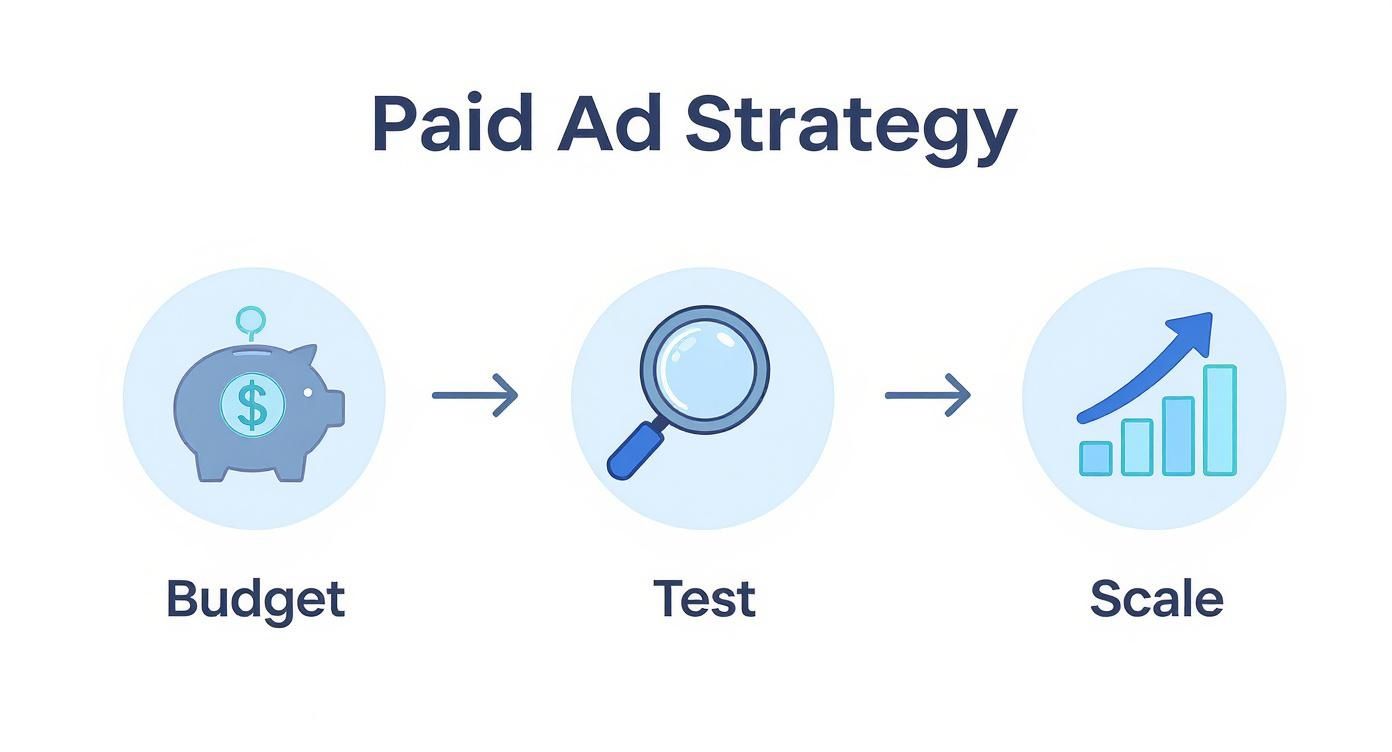
As the graphic shows, you start small with a set budget, test a few different things to see what clicks, and then put more money behind what's actually working.
Launch a Small Test Ad Campaign: Set aside a modest budget—maybe £100-£200—to run a targeted ad on social media or Google. The goal isn't to make thousands of pounds overnight. It's to learn what messages, images, and offers get people to stop scrolling.
Analyse Your Results: At the end of the month, look at the numbers. Which social posts got the most love? What did your little ad campaign teach you? Use these clues to fine-tune your strategy for the next 90 days. For a deeper dive, check out our guide on how to calculate marketing ROI to prove campaign value.
Your first 90 days are not about perfection; they are about progress. Consistent action, even on a small scale, builds the momentum you need for long-term success.
By sticking to this plan, you'll end the quarter with a solid marketing foundation, a growing audience, and real data to guide what you do next. Not bad for three months' work.
Frequently Asked Questions
Jumping into marketing can feel like you've been handed a puzzle with a thousand pieces. It's normal to have questions. Let's tackle some of the most common ones that keep small business owners up at night.
How Much Should I Realistically Spend on Marketing?
There's no magic number here, but a good rule of thumb is to set aside 5-10% of your total revenue for marketing. If you're a new business hungry for growth, pushing that closer to the 10% mark is a pretty smart move.
The most important shift in thinking, though, is to stop seeing this as a 'cost'. It's an investment in learning. Start with a budget you're comfortable with, something that won't make you break out in a cold sweat. Your initial goal isn't world domination; it's to gather data. Test a few channels, see what actually brings in calls or sales, and then pour your profits back into the things that genuinely work for your business.
If I Only Have an Hour a Day, What Should I Focus On?
When time is the one thing you can't buy more of, you have to be ruthless with your focus. Nail the one task that will give you the biggest bang for your buck. For almost every local small business, that task is nurturing your Google Business Profile (GBP).
Use that precious hour to:
Ask for reviews: Make it a habit to ask every single happy customer to leave you a review.
Upload photos: Keep it fresh. Add new pictures of your latest project, your shop looking busy, or your team in action.
Answer questions: Pop into the Q&A section and clear up any queries.
Post updates: Got a special offer? A new product just landed? Share a quick post.
Honestly, a well-cared-for GBP is one of the most powerful free marketing tools you have for pulling in local customers.
Don't mistake being busy for being effective. With limited time, your goal is to find the one or two activities that deliver 80% of your results and focus relentlessly on those. Consistency beats complexity every time.
How Do I Know if My Marketing Is Actually Working?
You need to track the numbers that matter. It's easy to get distracted by "vanity metrics" like how many followers you have, but those don't pay the bills. Instead, focus on the data that’s directly tied to your bank account.
Keep an eye on these simple metrics:
Website Traffic: Are more people finding your site this month compared to last month?
Leads Generated: How many people actually filled out your contact form or signed up for your email list?
Conversion Rate: Of all the people who visited your site, what percentage took the action you wanted them to (like making a purchase)?
Customer Acquisition Cost (CAC): How much marketing money are you spending to get one new paying customer?
These figures tell the real story. Everything else is just noise.
Which Social Media Platform Is Best for My Business?
The best platform isn't the trendiest one; it's the one where your ideal customers are already hanging out. Don't try to be everywhere at once – you'll just burn out. Pick one platform and get really good at it.
Here’s a quick guide:
Got a visual product like a bakery, craft shop, or fashion brand? Instagram or Pinterest are your visual playgrounds.
Offer B2B services like consulting or accounting? LinkedIn is the professional networking hub you can't ignore.
Run a community-based local business like a café or a high-street shop? Facebook is still a powerhouse for connecting with your neighbours.
Do a little digging to find out where your audience lives online, and then show up there consistently with content they'll actually find useful.
Feeling ready to put these marketing strategies into action but need a professional website to be your foundation? The team at Baslon Digital specialises in creating stunning, high-performing Wix websites that turn visitors into loyal customers.
Comments