How Long Does It Take to Build a Website in the UK

Updated: Dec 18, 2025
"So, how long does it take to build a website?" It’s the million-dollar question, isn't it? The honest answer is… it depends. A simple UK site can be up and running in as little as four weeks, but a complex, feature-heavy platform could easily stretch beyond four months. It all boils down to the scope and complexity of what you need.
Your Quick Answer to Website Build Times
Asking how long it takes to build a website is a bit like asking a chef how long it takes to cook a meal. A simple sandwich? Minutes. A three-course gourmet dinner? Hours of prep and precision. Your website’s timeline works the same way—it’s entirely dependent on its ingredients, like the number of pages, custom features, and unique designs you want.
A basic brochure website with just a handful of pages might come together in a few short weeks. But if you’re dreaming of an e-commerce store with hundreds of products, secure payment systems, and customer login areas, you’re naturally looking at a much longer project.
If there's one thing that dictates a website's timeline, it's complexity. Every single feature, from a basic contact form to a full-blown booking system, adds another layer to the process and stretches out the delivery date.
Estimated Website Build Times by Project Type
To help you get a clearer picture and set some realistic expectations from the get-go, we've put together a quick-glance table. It breaks down the typical timelines for different types of website projects here in the UK.
Website Type | Typical UK Timeline | Key Features |
|---|---|---|
Simple Brochure Site | 3 - 5 Weeks | 3-5 pages, contact form, basic branding, mobile responsive. |
Small Business Website | 5 - 7 Weeks | Service pages, blog, lead capture forms, basic SEO setup. |
E-commerce Store | 8 - 12+ Weeks | Product pages, shopping cart, payment gateways, inventory management. |
Large Enterprise Site | 16+ Weeks | Custom integrations, advanced security, user portals, bespoke features. |
This should give you a solid starting point. Of course, these are just estimates, and your project could be faster or slower depending on the specifics.
Ready to see what actually happens during those weeks? Let’s break down the step-by-step journey of building a website. Or, if you’d rather skip the queue and get started with a team of experts, contact Baslon Digital for a personalised quote.
Mapping Out the Website Build Journey
Figuring out how long it takes to build a website is a lot easier when you see it as a journey with distinct stages, not just one big job. Think of it like building a house: you wouldn't dare try to hang the curtains before the walls are even up. Each phase of a website project builds on the last, creating a solid, functional, and frankly, brilliant end result.
Trying to skip a stage or rush through it is a recipe for disaster. It’s like throwing away the blueprints and hoping for the best—you’ll just end up with cracks and expensive fixes later on. So, let’s walk through the six essential phases that take you from a scribbled idea to a live, working website.
Phase 1: Discovery and Planning
This is where every successful project kicks off. Before a single pixel is placed, you have to nail down what the website is actually for. This phase is all about setting clear goals, figuring out who you're trying to talk to (your target audience), and listing all the must-have features. The very first step on this journey often starts with securing your digital address through domain name registration.
Here in the UK, a standard business website typically takes somewhere between 10 and 14 weeks from the first chat to the final launch. A massive chunk of that—around 2-4 weeks—is dedicated just to discovery and planning. This is where we define goals and see what the competition is up to. It’s a step that 76% of UK projects rely on to avoid costly re-dos down the line.
Phase 2: Design and Prototyping
With a rock-solid plan, the creative fun begins. This is where your vision starts to look like a real thing. Designers will first create wireframes, which are like the basic skeleton of each page. They focus purely on structure and how a user will move through the site, without any distracting colours or fonts just yet.
Once the wireframes get the nod, they’re fleshed out into high-fidelity mockups or even interactive prototypes. These are detailed visuals of what the final site will look like, complete with the colour scheme, typography, and images. This stage is all about getting the look, feel, and user experience just right before anyone writes a single line of code.
This design phase isn’t just about making things look pretty. It’s about crafting an intuitive journey for your visitors, ensuring they can find what they need effortlessly. A well-thought-out design directly impacts user engagement and conversion rates.
Phase 3: Development and Coding
Right, this is where the approved designs are brought to life. Developers take the static mockups and turn them into a functional, interactive website. It's usually split into two key parts:
Front-End Development: This is all about building the bits of the website that people actually see and click on—the buttons, menus, and animations. It’s focused on creating a seamless user interface.
Back-End Development: This is the engine under the bonnet. It involves setting up the server, database, and all the logic that makes everything from your contact form to your online checkout actually work.
Phase 4: Content Integration
A beautifully designed website is just an empty shell without compelling content. In this stage, all the written copy, images, videos, and blog posts are carefully slotted into the newly built pages.
Honestly, this step is often the biggest bottleneck in a project if the content isn't ready to go. Having all your text and media prepared in advance can shave a surprising amount of time off the project. If you need a hand getting prepped, check out our walkthrough on how to build a website from scratch: a UK guide.
The image below gives you a quick visual on how timelines can stretch based on what you need your site to do.
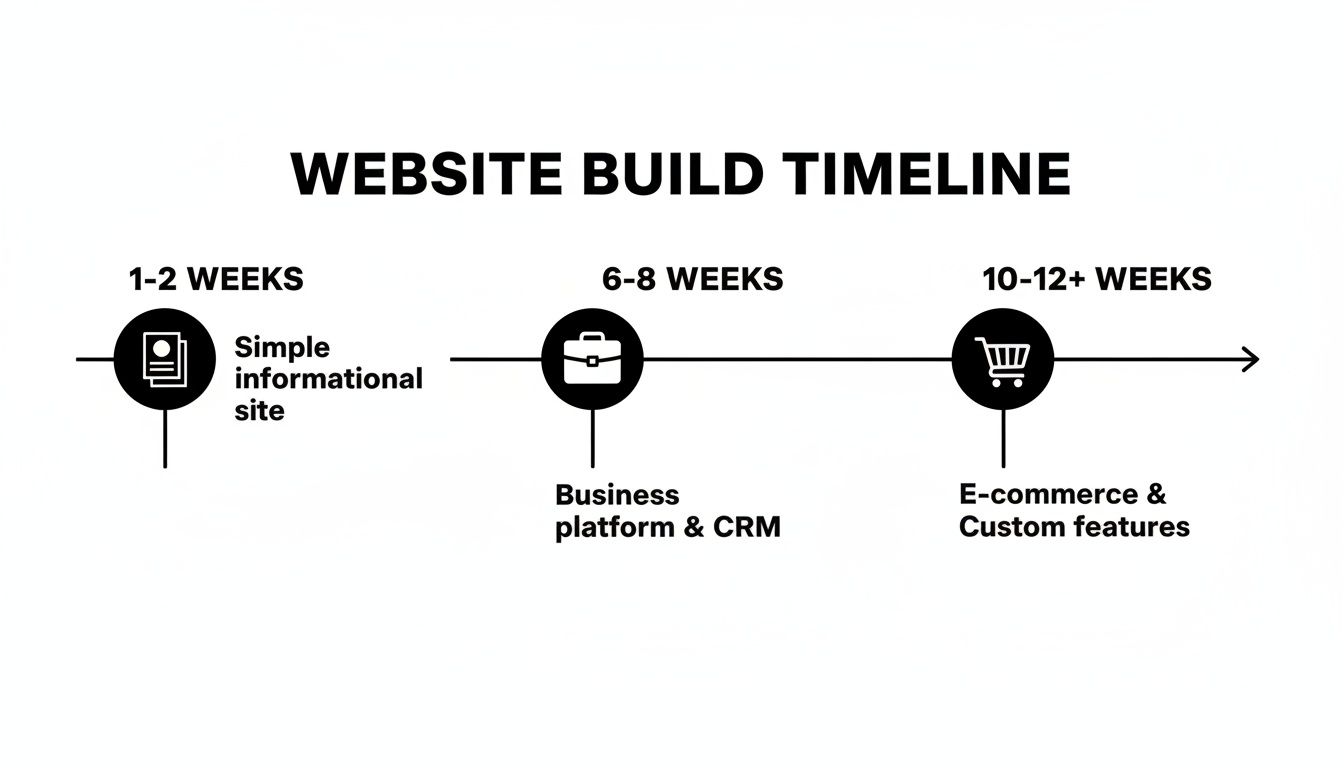
As you can see, the timeline grows quite a bit when you start adding complex features like payment gateways or customer accounts.
Phase 5: Testing and Quality Assurance
Before popping the champagne, the website has to go through some serious testing to make sure everything works perfectly. This quality assurance (QA) phase is absolutely critical for catching bugs, broken links, and any weird layout issues.
Testers will check the site on different browsers (like Chrome, Firefox, and Safari) and on all sorts of devices (desktops, tablets, and mobiles) to make sure every visitor gets a consistent experience. They’ll also test every form, check page load speeds, and verify that all the bells and whistles are ringing and whistling as they should.
Phase 6: Launch and Ongoing Support
Once the site passes every test and gets the final thumbs-up, it’s launch time! This involves moving all the website files to a live server and pointing your domain name to it so the whole world can see your new digital home.
But the work doesn't stop there. Post-launch support and maintenance are vital for keeping the site secure, updated, and running smoothly. This usually involves regular backups, software updates, and keeping an eye on performance.
Each of these stages is a crucial piece of the puzzle. Understanding this journey gives you a much more realistic perspective on what it truly takes to build a website that you can be proud of.
The Hidden Factors That Shape Your Timeline
Ever wondered why one website pops up in a month while another takes the better part of a year? The answer is always in the details—the sneaky little things that often get missed during the initial chats. Beyond just counting pages, several crucial variables can either put your project in the fast lane or bring it to a screeching halt.
Think of it like a relay race. It’s not about one person’s speed; it’s about the seamless handover. If one runner is late or, worse, drops the baton, the whole team’s time takes a hit. Web development is exactly the same—it needs smooth transitions between handling complexity, getting content, receiving feedback, and the technical build.
Project Complexity and Scope Creep
The biggest influence on any timeline, without a doubt, is complexity. A simple, five-page brochure site with static info? Pretty straightforward. But the moment you start adding dynamic features, you're adding layers of work. Each new function is like adding another room to a house—it needs its own plans, construction, and finishing touches.
Then there’s scope creep, the quiet timeline killer. It usually starts with an innocent request, like, "Can we just add a small gallery here?" Before you know it, that snowballs into, "Actually, let's make it a full portfolio with filtering options and user uploads." These little additions might seem minor, but they can easily tack on days, or even weeks, to the schedule.
Here are a few common features that are notorious for extending a project timeline:
E-commerce Functionality: Setting up product pages, payment gateways, and inventory systems is a meticulous process.
User Accounts: Building secure login systems, members-only areas, and customer dashboards involves a hefty amount of back-end work.
Third-Party Integrations: Hooking your site up to external tools like booking systems, CRMs, or marketing platforms can get complicated, fast.
Custom Animations: Those slick, bespoke animations and interactive elements? They require specialist design and coding skills that take time to get just right.
The Critical Role of Content Readiness
One of the most common bottlenecks in any web project is waiting around for content. A developer can build a beautiful, functional website, but without the text, images, and videos to fill it, it’s just an empty shell.
Waiting on content is like a construction crew showing up to a site with no bricks or timber—the whole project just stops. If the copy for the 'About Us' page isn't ready or the product photos haven't been taken, those pages simply can't be finished, tested, or launched. Having all your content prepared before the build phase even starts can slash your timeline dramatically.
A website is a vessel for your message. If the message isn't ready, the vessel can't set sail. Preparing your copy, imagery, and branding assets upfront is the single most effective way a client can help speed up the launch process.
The Feedback Loop and Decision Making
Clear, timely feedback is the fuel that keeps a project moving. A slow or indecisive feedback process, on the other hand, can stretch a timeline out indefinitely. When a design mockup or a test version of the site lands in your inbox, a quick response lets the team make revisions and jump to the next stage.
On the flip side, "design by committee" is a recipe for disaster. When multiple stakeholders have to sign off on every little decision, you often get conflicting feedback and an endless cycle of revisions. This can trap a project in the design or testing phase for weeks longer than planned.
To keep things on track, it's best to:
Appoint a single point of contact who has the final say on all decisions.
Provide consolidated, actionable feedback instead of scattered notes from different people.
Stick to the agreed-upon review deadlines to avoid holding up the whole process.
By keeping an eye on these hidden factors, you can manage your project proactively, see potential delays coming, and work with your design team to ensure a much smoother, faster launch.
Ready to navigate these factors with an expert team? Contact Baslon Digital today for a consultation and a clear project plan.
Putting Timelines into a Real World Context
Theory is great, but let's be honest, you want to know how long your website is going to take, right? To get a real feel for it, we need to look at actual projects. Knowing the difference between a simple online business card and a full-blown online shop is the key to setting expectations that don't end in disappointment.
So, let's walk through four common types of website projects we see here in the UK. Each one has a different scope, a unique set of features, and, you guessed it, a different timeline. This will give you a much clearer picture of where your own project might land.
The Simple Brochure Website
Think of a brochure website as your digital handshake. Its job is to look professional, provide the absolute essentials, and give people a way to get in touch. It’s the perfect launchpad for new businesses, consultants, or local tradespeople.
Estimated Timeline: 3-5 Weeks
Typical Features: Usually 3-5 pages (Home, About, Services, Contact), a basic contact form, and a design that works on mobile.
Why this timeframe? With just a handful of pages and no fancy bells and whistles, the design and build are pretty quick. The content doesn't change much, so there's less complex coding needed.
The Small Business Website
This is a definite step up. It's built for businesses that want to do more than just exist online—they want to generate leads. It’s more dynamic and includes features to keep people coming back, making it ideal for service-based businesses like marketing agencies or local builders.
This is a super common project for UK businesses. In fact, UK web agencies report an average project turnaround of just 6.4 weeks, which shows how much faster things have become. This speed is partly thanks to a 72% rise in demand for custom work and 48% of firms using AI to help with design. You can dig into more UK web design statistics if you're curious.
Estimated Timeline: 5-7 Weeks
Typical Features: Everything from the brochure site, but with a blog, dedicated pages for each service, and forms to capture leads (like a newsletter sign-up).
Why this timeframe? That extra time is for building out the blog, designing more page layouts, and plugging in tools to help you find new customers.
The E-commerce Store
When you want to sell products online, you've officially entered e-commerce territory. This is where things get a lot more complex. Your website has to handle money, track stock, and provide a totally secure shopping experience.
Building an e-commerce site isn't just about designing a shop window; it's about building the entire shop. You need a stockroom (inventory management), a till (payment gateway), and security cameras (SSL certificates) all working together perfectly.
Estimated Timeline: 8-12+ Weeks
Typical Features: A secure shopping cart, payment options like Stripe or PayPal, product pages, an inventory system, and customer accounts.
Why this timeframe? The complexity skyrockets here. Hooking up secure payment systems, setting up product databases, and testing the entire checkout process from start to finish is a meticulous job. There are no shortcuts.
The Large-Scale Enterprise Website
This is the big league. We're talking about large organisations with unique, complex needs that a standard website just can't handle. These projects often involve connecting to a company's internal systems, building custom tools, and meeting very strict security standards.
Estimated Timeline: 16+ Weeks
Typical Features: Custom integrations with CRMs or other software, advanced user portals with different access levels, bespoke calculators or interactive tools, and top-tier security.
Why this timeframe? This is pure custom work. Every feature has to be designed, coded, and tested from scratch. It’s a huge undertaking that involves a lot of specialist collaboration.
Figuring out which of these categories your project falls into will give you a much more realistic idea of the time it's going to take.
Ready to pin down a timeline for your specific project? Get in touch with Baslon Digital for a detailed, no-obligation quote.
How Modern Tools Are Shrinking Build Times
Not too long ago, building a website meant a developer would painstakingly hand-code every single line from scratch. It was a lengthy, meticulous process that often felt like building a house brick by brick. Thankfully, those days are pretty much behind us. Today’s technology has completely flipped the script on the "how long does it take to build a website?" question.
Modern tools act like power tools for developers, slashing build times without sacrificing quality. Instead of starting from a blank page, we now begin with powerful foundations that do most of the heavy lifting. This shift means a professional, feature-rich site can get up and running faster than ever before.

The Power of Content Management Systems
One of the biggest game-changers has been the rise of the Content Management System (CMS). Platforms like WordPress provide a robust back-end framework right out of the box. Think of it like using a prefabricated frame for a house instead of cutting and joining every piece of timber yourself.
A CMS handles all the core stuff like user management, content organisation, and security updates. This frees up developers to focus their energy on what really matters: designing a unique front-end experience and building the custom features that make your business special. The arrival of specialised site builders has also made a massive difference, with resources like the best website builders for vacation rentals offering slick solutions for niche markets.
The impact here in the UK has been huge. Back in 2011, when an estimated 76% of sites were hand-coded, a standard project could easily take over 20 weeks. Fast forward to today, with CMS platforms dominating the scene, that timeline has often been cut in half, dropping to between 6-14 weeks for similar projects.
The Rise of No-Code and Visual Development
Another massive leap forward has come from no-code and low-code platforms. These tools, including the really powerful website builders out there, let designers build complex, responsive layouts through a visual interface. You're essentially "drawing" the website instead of typing out endless lines of code.
This visual approach has a few brilliant advantages for shrinking timelines:
Rapid Prototyping: We can mock up and test ideas in hours, not days.
Fewer Handovers: The gap between the designer's vision and the developer's execution all but disappears, which means fewer misunderstandings.
Client Collaboration: You can see changes happen in real-time, making the feedback loop way faster and more efficient.
If you’re curious about what’s out there, you might want to check out our guide on the 12 best website builder platforms for UK businesses in 2025.
By removing the need to manually code standard elements, modern tools free up developers to innovate. This means less time spent on routine tasks and more time dedicated to creating a truly exceptional user experience that drives results for your business.
Ultimately, these tools don’t replace skilled professionals; they empower them. By automating the repetitive bits of web development, agencies can deliver high-quality, custom websites in a fraction of the time it once took.
Planning Your Website Build for Success
Knowing the typical timelines is a great start, but it’s proactive planning that will stop your project from going off the rails. Here’s the big secret: the answer to “how long does it take to build a website?” often has more to do with your preparation than how fast a developer can code.
Think of it this way: walking into a project prepared is like giving your web designer a detailed map instead of a vague destination. It cuts out all the guesswork and saves everyone from frustrating delays down the line.
Your Pre-Launch Checklist
Before you even think about emailing a web design agency, getting your ducks in a row will save an incredible amount of time. A little prep work makes that first conversation productive and gets the project started on the right foot.
Here’s a simple checklist to get you started:
Define Your Goal: What’s the #1 thing you want visitors to do? Is it to book a service, buy something, or just get in touch? Nail this down first.
Know Your Audience: Who are you actually trying to talk to? Figuring this out will shape every single design choice and word on the page.
List Your Must-Haves: Make a list of non-negotiable features. Do you absolutely need a blog, an online booking system, or a slick portfolio gallery?
Gather Your Content: Start pulling together your text, images, and brand assets (like your logo). Even having rough drafts ready is a massive head start.
Proper planning transforms the web design process from a chaotic scramble into a structured, efficient journey. When you define your goals and prepare your assets upfront, you become an active partner in your project's success, not just a spectator.
When you’re ready to find that perfect partner, knowing what to look for is half the battle. Our guide on how to choose a web design agency can help you sort the pros from the amateurs.
If your project demands a bit more strategic expertise and a flawless result, it might be time to bring in the professionals who get what you’re trying to do.
Ready to bring your project to life with a team that values your time? Contact Baslon Digital for a personalised consultation today.
Frequently Asked Questions
Even with a timeline in hand, you’ve probably still got a few questions rattling around. That’s normal. Getting these sorted will help you set realistic expectations for the road ahead. Let's clear up some of the most common head-scratchers about website timelines.
Can a Website Really Be Built in a Week?
Technically, yes. But should it be? Probably not. A one-week website is usually just a pre-made template with your content hastily dropped in. It assumes you have every single word, image, and branding element ready to go on day one.
The reality is, that kind of speed cuts major corners. There’s no time for proper strategy, user experience planning, or real testing. It's the difference between a microwave meal and a chef-cooked dinner; one gets the job done fast, but the other is crafted for a far better result. You get an online presence, sure, but it won’t be a powerhouse for your business.
How Much Does a Small Business Website Cost in the UK?
This one’s simple: the cost is directly linked to the time it takes to build. Think of it like a builder’s day rate. More time means more investment.
A basic brochure site, taking around 3-5 weeks, might start from £1,000 - £3,000. If you want more features—like a blog, detailed service pages, and lead capture forms—you’re looking at a 5-7 week project, and the cost typically moves into the £3,000 - £7,000 range.
For bigger jobs like e-commerce stores, which often take over eight weeks, the cost can easily push past £7,000. The more custom design, development, and integrations you need, the more hours it takes, and the higher the final price tag.
Think of your website budget as an investment in time. The more you invest, the more dedicated hours a professional can spend on strategy, design, and development to build a site that truly works for your business.
Does Redesigning an Existing Website Take Less Time?
Ah, the classic misconception. You'd think a redesign is just a quick facelift, but it’s often just as long—if not longer—than building from scratch. Why? Because you’re not just building; you’re renovating.
A redesign involves all the same stages: discovery, design, development, and testing. But you also have the added fun of migrating old content, trying to preserve SEO rankings, and sometimes untangling a mess of old, clunky code. It's often cleaner and more efficient to just start fresh instead of trying to patch up a crumbling foundation.
Now that you have the full picture, are you ready to work with a team that gets it? Baslon Digital specialises in building stunning, high-performance websites without the fluff, respecting your time and your goals.
Comments