Web Designer vs Web Developer: Which Is Right for Your Project?

When you’re trying to build a website, figuring out who to hire can feel like a head-scratcher. Do you need a web designer or a web developer? It really boils down to one simple question: are you more worried about how your site looks and feels, or how it works behind the scenes?
Think of a web designer as your visual guru. They’re obsessed with the user experience (UX) and making sure your site is a beautiful, engaging reflection of your brand. A web developer, on the other hand, is the technical mastermind who uses code to build the site’s engine and any custom features you need.
Understanding the Fundamental Difference
It’s easy to get these two roles mixed up, but they serve completely different purposes. Let's use a house-building analogy. The designer is like your architect—they draw up the blueprints, map out the floor plan for a great flow, and pick out the colours and finishes that give the house its personality.
The developer is your builder. They take those plans and pour the foundation, put up the walls, and install all the plumbing and electricals to make it a functional, liveable home. One focuses on the human experience—how a visitor feels when they interact with your brand online. The other focuses on the tech—the code that makes it all run smoothly.
At a Glance Role Comparison
For most small businesses, getting your head around these core differences is the first step to hiring smart. A great website needs both fantastic design and rock-solid functionality, but who you bring on board first depends entirely on what you’re trying to achieve.
In short, a designer shapes the user's journey, while a developer builds the road they travel on. One isn’t better than the other; their value is all about what your project needs, right here, right now.
This little table breaks down the main distinctions between these two crucial roles.
Aspect | Web Designer | Web Developer |
|---|---|---|
Primary Goal | To shape the look, feel, and user experience (UX/UI) of the site. | To build a functional, responsive, and technically sound website from the ground up. |
Main Focus | Visuals, branding, usability, and visitor journey. | Code, functionality, server performance, and database management. |
Core Tools | Figma, Adobe XD, Sketch, Photoshop, and other visual design software. | Code editors (like VS Code), programming languages (HTML, CSS, JavaScript), and frameworks. |
For a lot of small businesses, especially those using powerful platforms like Wix, a talented web designer is often the key to getting a professional and effective site off the ground. They can usually handle both the aesthetics and the functional setup within the Wix ecosystem. This guide will help you pinpoint exactly what kind of expertise you really need.
Ready to build a website that not only looks amazing but also helps your business grow? Get in touch with our team today for a chat, and let's turn your vision into a reality.
Comparing Core Roles and Responsibilities
To make the right hire, you've got to look past the job titles. What do these people actually do all day? The whole web designer vs web developer debate isn't about which one is more important; it's about figuring out whose skills match what your project needs right now.
Think of them as two different specialists working towards the same goal: making a brilliant website.
A web designer's world revolves entirely around your customer. Their main job is to map out the journey someone takes from the second they land on your site until they hand over their email or buy something. And trust me, it's a lot more than just picking pretty colours and cool fonts.
The Web Designer's Focus: The User Experience
A web designer is your brand's visual storyteller. They take your business goals and turn them into a visual language that speaks to your audience, gently nudging them where you want them to go. It’s a pretty big deal, considering one study found 75% of consumers judge a company’s credibility based on its website design. A good designer builds trust.
Here’s what they typically handle:
User Experience (UX) Design: This is the detective work. They dig into who your target audience is, what they need, and what frustrates them. Then they create a site structure and navigation that feels totally intuitive.
User Interface (UI) Design: This is the hands-on visual part. They craft the look and feel of every button, menu, and form to make sure everything is clear, easy, and even enjoyable to use.
Creating Wireframes and Prototypes: First, they build simple blueprints (wireframes) to map out where everything goes. Then they create detailed, clickable mock-ups (prototypes) so you can feel what the final website will be like.
Branding and Visual Identity: They ensure the website’s colours, fonts, and images all scream your brand. It's all about consistency and personality.
A web designer essentially builds the 'feeling' of your website. They're responsible for that crucial first impression, the ease of use, and the emotional gut-check a visitor has with your business online.
The Web Developer's Focus: Functional Construction
So, while the designer draws up the blueprint, the developer is the one who actually builds the house. Their job is to take those static designs and turn them into a live, working website. They're the tech wizards writing the code that makes it all happen behind the curtains.
Developers usually fall into three camps, and knowing the difference is key when you're deciding between a web designer vs web developer. You might need a very specific type of builder.
1. Front-End Developers These folks work on the "client-side"—everything a user actually sees and clicks on in their browser. They use languages like HTML, CSS, and JavaScript to bring the designer's vision to life. They make sure the buttons work and the animations are slick. They're the bridge between design and function.
2. Back-End Developers Working on the "server-side," back-end developers build the engine of the website. You never see their work, but you'd definitely notice if it was missing. They manage databases, make user logins work, and process payments using languages like PHP, Python, or Node.js.
3. Full-Stack Developers A full-stack developer is a jack-of-all-trades, comfortable working on both the front and back end. They get the whole picture, from coding the pretty bits to managing the server that powers it all.
Ultimately, a designer defines what the user experience should be, and a developer builds the technology to deliver it. For many small businesses, a good designer who knows their way around a platform like Wix can handle both the look and the setup. But for anything that needs custom code, a developer is non-negotiable.
Ready to find the right expert to bring your website vision to life? Contact Baslon Digital today for a consultation on creating a stunning and effective website for your business.
Essential Skills and Tools of the Trade
When you hire a professional, you're not just paying for their time. You're investing in years of expertise and the seriously powerful tools they’ve mastered. The whole web designer vs web developer debate gets a lot clearer when you peek inside their toolkits.
Frankly, their arsenals couldn't be more different, and that's a good thing. It reflects just how unique their roles are in bringing a website to life.
A web designer's world is visual, creative, and plugged directly into human psychology. They use software that lets them sculpt the user's experience with artistic precision. On the flip side, a web developer’s domain is all about logic and structure. They work with code—the raw building blocks of the web—to construct something that actually works.
The Designer’s Creative Toolkit
Web designers live at the crossroads of art and usability. Their job is to create a visual language that screams your brand and gently (or not-so-gently) guides users toward a goal, like clicking "buy now" or booking a call.
Their primary weapons of choice are sophisticated design and prototyping apps.
Figma, Sketch, and Adobe XD: These are the big three in the UI/UX world. Designers use them to create pixel-perfect mock-ups, interactive prototypes, and entire design systems that keep your brand looking sharp across every single page. Think of them as the digital drawing boards where your site's soul is born.
Adobe Creative Suite (Photoshop, Illustrator): While you won't see many designers building a full website layout in Photoshop these days, these tools are still non-negotiable for creating custom graphics, editing photos, and designing unique brand assets like logos and icons that stop people from scrolling.
But beyond the software, a designer's most valuable skills are the ones you can't download. They need a rock-solid grasp of user psychology to know what makes people tick and a sharp eye for conversion rate optimisation (CRO) to design layouts that turn casual visitors into paying customers. You can get a better sense of the options out there by exploring these top-tier website design software choices.
A great designer doesn't just make things look pretty; they strategically craft a visual journey that builds trust and drives business results. Their expertise lies in understanding how colour, typography, and layout influence human behaviour.
The Developer’s Technical Arsenal
While the designer hands over a beautiful blueprint, the developer pulls out a completely different set of tools to actually build the thing. Their skills are technical, precise, and grounded in the cold, hard logic of programming.
Developers write the instructions that tell a web browser how to display a website and tell a server how to handle all the data behind the scenes.
Here’s a quick look at their core skills:
Programming Languages: These are the fundamentals. HTML is the skeleton that structures the content, CSS is the wardrobe that styles it (fonts, colours, layout), and JavaScript adds the personality—things like pop-up forms or slick animated sliders.
Frameworks and Libraries: To build complex sites without reinventing the wheel every time, developers use pre-written bundles of code. For the front end (what users see), that means tools like React, Angular, or Vue.js. For the back end (the server-side stuff), frameworks like Node.js or Django provide the heavy-lifting foundation.
Database Management: If your site stores any kind of user info—like an e-commerce shop or a membership portal—you need a developer who can manage databases. They use systems like MySQL, PostgreSQL, or MongoDB to store, retrieve, and lock down that critical data.
Skillset and Toolkit: A Head-to-Head Comparison
To really see the difference, let’s put their skills and tools side-by-side. It becomes immediately obvious that while their goals are aligned (build an amazing website), their day-to-day work happens in totally different worlds.
Category | Web Designer | Web Developer |
|---|---|---|
Primary Software | Figma, Sketch, Adobe XD, Adobe Creative Suite (Photoshop, Illustrator), Prototyping tools (e.g., InVision) | Code Editors (VS Code, Sublime Text), Git/GitHub for version control, Command Line Interface, Browsers' Developer Tools |
Key Languages | None required (focus is on visual design) | Front-End: HTML, CSS, JavaScriptBack-End: Python, PHP, Ruby, Java, Node.js |
Frameworks/Libraries | Design system frameworks, UI kits | Front-End: React, Angular, Vue.jsBack-End: Django, Ruby on Rails, Express.js |
Core Skills | UI/UX design, visual hierarchy, typography, colour theory, wireframing, prototyping, user research, CRO principles | Problem-solving, logic, front-end development, back-end development, database management, API integration, server management |
Main Goal | Craft the look, feel, and usability of the website. | Build a functional, responsive, and secure website from the design mockups. |
As you can see, there's very little overlap. A developer's ability to write clean code is just as vital as a designer's eye for a balanced layout. For developers, a huge part of the job is translating those design mockups into living, breathing code. This often involves a detailed Figma to React workflow to make sure the final product is a perfect match for the designer's vision.
Their job is one of immense precision, turning a static image into an interactive digital experience. Understanding these wildly different skill sets is the key to figuring out who you need to hire and when.
Understanding the Hiring Costs in the UK
When you're trying to budget for a new website, getting your head around the money side of the web designer vs. web developer debate is a big deal. In the UK, there’s a pretty clear cost difference between the two, whether you’re hiring a freelancer or a full-time employee. This gap isn't random; it's all down to the market demand for their very different, highly specialised skills.
As a general rule, web developers cost more. This really boils down to the technical nuts and bolts of their work—writing clean, efficient code to build a site's engine, wrangling databases, and making sure everything is secure and running smoothly. The demand for great coders who can build solid digital platforms often outweighs the supply, which naturally pushes their prices up.
Freelance Rates and Full-Time Salaries
For most small businesses, bringing a freelancer on board is the most sensible route. Here in the UK, you can expect to pay a freelance web designer anywhere from £30 to £70 per hour, depending on how experienced they are and what you need them to do. A freelance web developer, on the other hand, will usually set you back £50 to £100+ per hour, especially if they’re a specialist in back-end systems or popular frameworks like React.
It’s a similar story when you look at full-time salaries. The data from the UK job market shows developers earn quite a bit more than designers. The median annual salary for a web developer is £40,000 UK-wide, climbing to around £55,000 for roles in London. Compare that to the average for web designers, which sits at about £27,097, and you can see there's a hefty premium for those hardcore coding skills.
The key takeaway for your budget is simple: custom coding costs more than visual design. A project that needs bespoke functionality built from the ground up will always have a higher price tag than one focused on branding and user experience on an existing platform.
To set a realistic budget and make a competitive offer, it’s a good idea to understand what is salary benchmarking and how it works. It helps you make sure you’re paying a fair market rate for the exact skills you're after.
The Cost-Effective Alternative for Small Businesses
For a lot of small businesses, the high price of custom development is a total showstopper. But the good news is, it's often not even necessary. This is where platforms like Wix, in the hands of a talented designer, offer a brilliant, budget-friendly solution.
A professional Wix designer can build you a stunning, high-performing website without writing a single line of custom code. They can take care of:
Bespoke visual design that perfectly captures your brand's personality.
Full e-commerce setup, including payment systems and product catalogues.
Booking and scheduling systems for service-based businesses.
On-page SEO setup to help you start climbing the Google ranks.
This approach gives you a high-end, custom look without the custom development bill. You're putting your money into expert design and strategy—the stuff that actually grabs your visitors' attention and encourages them to convert—instead of paying a premium for the technical foundation that a platform like Wix already provides. If you're mapping out your spending, you might want to check out our guide on the cost of making a website in the UK for a more detailed breakdown.
By going for a design-led approach on a powerful platform, small businesses can use their budget much more smartly, focusing on the visual and strategic bits that really move the needle. It’s the perfect middle ground between a generic template and an eye-wateringly expensive custom build.
When to Hire a Designer vs a Developer
Deciding between a web designer and a web developer isn't just a technical choice; it's a strategic one. It all boils down to your main goal. Are you trying to tell a visual story and connect with your audience, or do you need something completely custom built from the ground up?
This simple decision tree can help you figure out where to start.
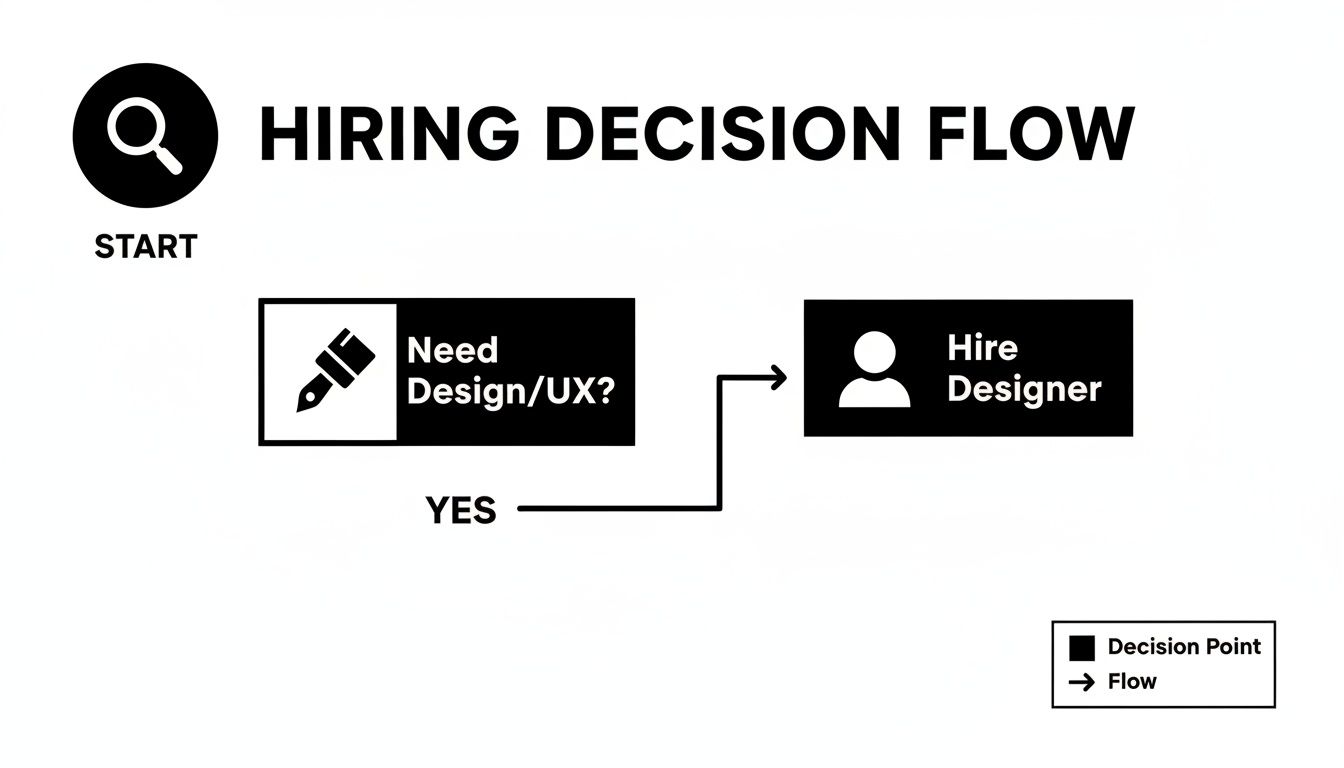
As you can see, if the whole point of your project is tied to the look, feel, and how a user moves through your site, a designer should be your first call.
Scenarios to Hire a Web Designer
You should always lean towards hiring a web designer when your project is all about how people perceive and interact with your brand online. Their skills are non-negotiable when that first impression is everything.
Think of a designer as your go-to expert in these situations:
Launching a New Business Website: If you're a small business, a consultant, or a freelancer, your website is basically your digital shopfront. A designer will focus on creating a visually compelling site that nails your brand's value, builds trust, and gently nudges visitors to do something, like book a service or get in touch.
Redesigning an Outdated Site: Is your current website looking a bit tired or just not converting visitors? A designer will dig into user behaviour, give the site a modern facelift, and reorganise everything to improve the user experience (UX) and get people to stick around.
Building on a Platform like Wix: When you're using a powerful website builder, a designer's touch is what makes it shine. They can take a platform like Wix and craft a completely bespoke, professional-looking site that stands out, without ever needing a developer to meddle with the underlying code.
A web designer is your strategic partner for projects where the main goal is to influence how users feel and act through slick visuals and intuitive navigation. Their work has a direct impact on how credible and professional your business looks.
Scenarios to Hire a Web Developer
A web developer becomes absolutely essential when your project needs to do more than just look pretty and perform standard tasks. Their job is to build custom technical solutions from scratch.
You definitely need a developer in these cases:
Building a Custom Web Application: If you’re creating something that does a specific, unique job—like a project management tool, a social networking platform, or a custom analytics dashboard—you need a developer. They’re the ones who write the complex code that makes this kind of functionality possible.
Complex Third-Party API Integrations: Need your website to talk to other software in a very specific way, like a custom inventory system or a specialised CRM? A developer is needed to build and manage these tricky data connections.
Developing a Bespoke E-commerce Platform: While platforms like Wix have great e-commerce tools, you might need something unique, like a custom product configurator or a specialised subscription model. A developer can build that kind of unique feature from the ground up.
The career paths and earning potential for these roles also tell a story. Experience levels show a clear split, with developers often seeing a steeper salary increase because of their specialised skills in backend logic and databases. Data shows that while entry-level pay is similar, a top-earning developer in the UK can make up to £46,000, whereas senior designers tend to plateau sooner at around £36,678—often less than a mid-career developer.
Getting your head around these scenarios is the key to making a smart decision. If you're struggling to figure out the best path for your project, it’s always a good idea to get some professional advice. Check out our guide on how to choose a web design agency that fits your needs.
Making the Right Choice for Your Business
So, how do you finally choose between a web designer and a web developer? Forget the technical jargon for a minute. The real answer comes down to what you need your website to do for your business. Your decision should be guided by your goals, plain and simple.
For most small businesses I talk to, the mission is pretty clear: they want to build a solid brand, give visitors a fantastic experience, and get their site live without waiting forever. If that sounds like you, a design-first approach on a powerful platform is almost always the smartest, most budget-friendly move. It puts the focus squarely on what influences your customers and gets them to convert.
Bridging the Gap for Small Businesses
There’s a common myth floating around that a truly professional website needs to be built with piles of custom code. Honestly, that’s just not the case anymore. Platforms like Wix have evolved so much that you can get incredible, high-end results without the huge expense and long timelines of a full-blown development project.
The real challenge isn't building a website from scratch; it's translating your unique brand vision into a digital experience that captivates your audience and drives growth. That’s a design and strategy challenge, not a coding one.
This is exactly where we come in. Our specialty is creating stunning, high-performing Wix websites that give small businesses a serious competitive edge. We deliver top-tier design and smart functionality, all without needing to write a single line of custom code from the ground up.
We obsess over your brand: We make sure your website is a genuine reflection of who you are.
We live and breathe user experience: Every button, image, and line of text is crafted to guide your visitors where you want them to go.
We focus on what works: Our sites are built to be seen, to engage, and most importantly, to get results.
By mastering expert design within the Wix ecosystem, we give you a sophisticated online presence that meets the needs of most businesses, letting you sidestep the hefty costs of custom development. This frees up your budget to invest in what truly matters: brilliant design and clear messaging that actually works.
If you’re ready to build a site that grabs your audience’s attention and helps your business grow, we’re here for it.
Ready to translate your vision into a website that gets results? Connect with our team today for a consultation and let's start building your future online.
Frequently Asked Questions
Alright, let's tackle the questions that probably keep you up at night when you're staring at the ceiling, wondering who on earth to hire. Getting these answers straight is the final piece of the puzzle. It’s the difference between a confident handshake and a panic-scroll through freelance websites at 2 AM.
Let's clear the air on the whole web designer vs. web developer thing.
Do I Need to Hire Both a Designer and a Developer?
For most small businesses, the answer is a big, resounding no. Honestly, it's overkill.
If you're building your website on a solid, all-in-one platform like Wix, a good web designer or a specialised agency can handle everything. They've got the design chops and the technical skills to build the site from the ground up. The idea of hiring two separate people usually only comes into play for massive, custom-coded projects—think enterprise-level web apps with features so unique they haven't been invented yet. For your average (and even not-so-average) business website, one skilled pro is more than enough.
The modern web designer, especially one who lives and breathes platforms like Wix, is a hybrid. They’re part artist, part technician, making the old-school need for two separate hires totally unnecessary for most projects.
Can a Web Designer Actually Build a Functional Website?
Absolutely. Let's bust this myth right now. A modern web designer, particularly one who specialises in a platform like Wix, isn't just handing you a pretty picture of a website. They are building the real, clickable, fully functioning thing.
These pros are experts at putting together websites that are not only beautiful but also responsive, SEO-friendly, and ready for business. From setting up the layout to integrating e-commerce shops, booking systems, or member areas, they do it all. Think of them as both the architect and the builder.
How Do I Know If My Project Is Too Complex for a Designer?
You'll know it's time to call in a developer when your needs go beyond what looks good and works smoothly, and into the territory of truly unique, behind-the-scenes, server-level wizardry. This is the clearest line in the sand.
Ask yourself if your project involves any of these:
A completely new, from-scratch feature that doesn’t exist anywhere else, like a custom-built social media feed or a weirdly specific user-matching algorithm.
Deep, complex integration with a private, internal database or some obscure third-party system that needs a custom API built just for it.
Special server-side logic that has to process data in a way that's totally unique to how your business operates.
If you're nodding along to any of those, you're officially in developer territory. If not, a talented web designer can almost certainly bring your vision to life.
Now that you know the difference between a web designer and a web developer, are you ready to take the next step? At Baslon Digital, we specialize in creating stunning, high-performing websites that make an impact. Let us handle the complexities so you can focus on your business.
Comments