A UK Guide to Marketing a Small Business for Growth

Effective marketing isn't about throwing random tactics at a wall and hoping something sticks. It's about building a solid foundation first. Think of it this way: before you spend a single pound on ads, you need to be crystal clear on what you want to achieve and who you're talking to. This strategic blueprint is the difference between marketing that costs you money and marketing that makes you money.
Building Your Marketing Foundation
Jumping straight into creating social media posts or launching a Google Ads campaign without a plan is like building a house on sand. It might look okay for a minute, but it's doomed to collapse. A strong foundation ensures your message actually connects, your budget is spent wisely, and your business grows in a way that doesn't keep you up at night.
This whole foundational stage boils down to two simple but incredibly powerful questions: "What do I really want to achieve?" and "Who am I trying to reach?" Getting these right will guide every single decision you make from here on out.
Defining Your Business Goals
Let's be blunt: vague goals like "get more customers" are completely useless. Your objectives need to be specific, measurable, and tied directly to the health of your business. What does success actually look like for you in the next few months?
For a Service Business (e.g., a local plumber): A solid goal isn't just "more calls." It’s something like, "increase qualified leads by 20% over the next quarter" by driving more quote requests through the website.
For a Product Business (e.g., an online candle shop): A tangible target could be to "achieve an average of 50 online sales per month" within the first six months of launching.
See the difference? Setting clear targets like these turns your marketing from a hopeful expense into a strategic investment.
Your marketing goals are the compass for your entire strategy. Without them, you're just sailing blind, hoping to land somewhere profitable. With them, every decision has a purpose.
This visual breaks down the process perfectly. You start with your goals, figure out your customer, and then build your strategy.
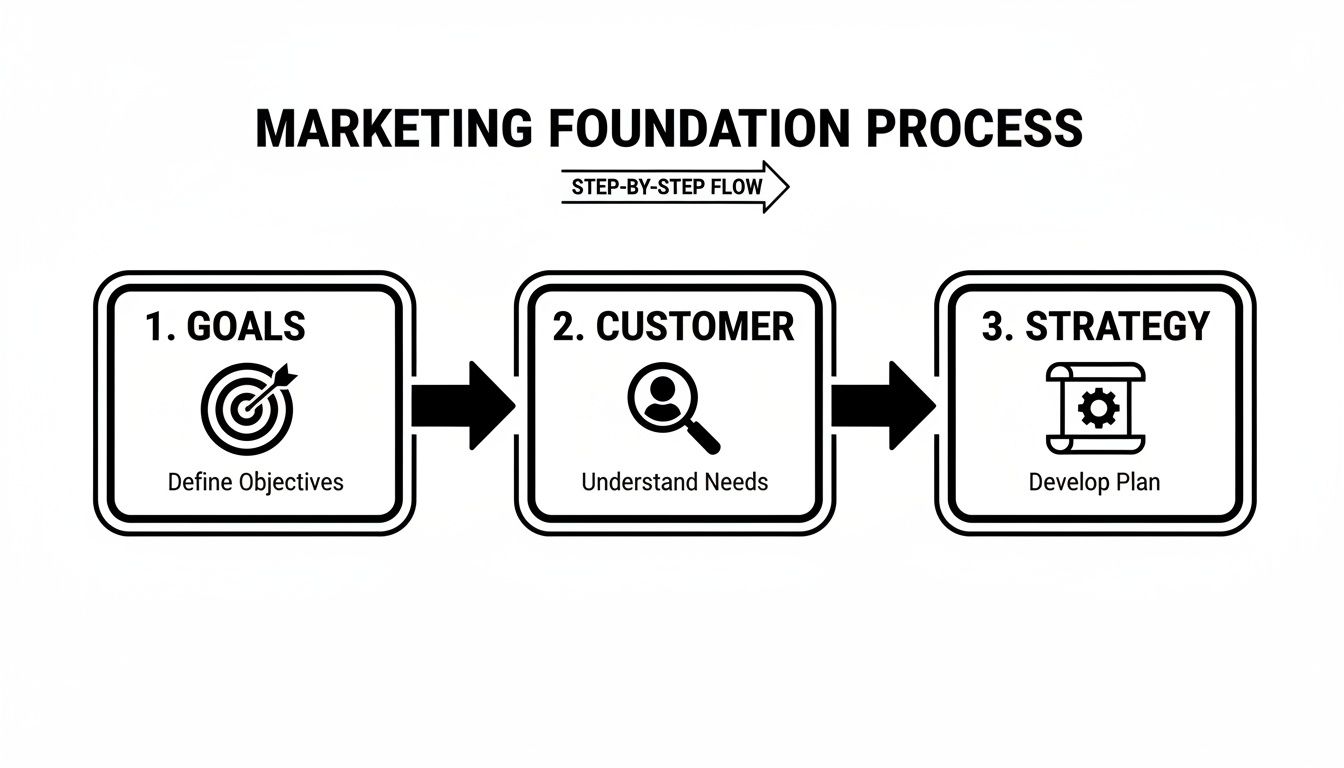
That middle step—understanding your customer—is the critical bridge connecting your big business ambitions to your day-to-day marketing tasks.
Identifying Your Ideal Customer
Once you know where you're going, you need to figure out who you’re taking with you. Spoiler alert: it's not "everyone." Trying to sell to the entire world is the fastest way to sell to no one.
Instead, get laser-focused on a specific group of people whose problems you are uniquely brilliant at solving. This is your ideal customer. Go deeper than just age and location. What keeps them up at night? Where do they hang out online looking for answers? What words do they use when they're searching on Google? Nailing this is central to building a practical small business SEO strategy that actually works.
UK businesses are already putting their money where their mouth is on this. On average, they allocate around 7.7% of their total revenue to marketing. For a typical SME, that could mean a budget of over £22,000. You can't afford to waste that kind of cash spraying and praying. You need to spend it reaching the right people.
Your Initial Marketing Strategy Checklist
To pull this all together, here’s a quick checklist. Answering these questions gives you the core of your marketing foundation.
Strategy Component | Key Question to Answer | Example for a Service Business (e.g., Plumber) | Example for a Product Business (e.g., Online Candle Shop) |
|---|---|---|---|
Business Goal | What specific, measurable result do I want in the next 3-6 months? | Increase online bookings for boiler servicing by 15% this quarter. | Achieve £2,000 in monthly online sales by the end of the year. |
Ideal Customer | Who am I helping, and what is their primary problem? | Homeowners in South London who need reliable, emergency plumbing without being overcharged. | Eco-conscious millennials who want hand-poured, vegan candles for their home. |
Unique Selling Point (USP) | Why should they choose me over anyone else? | We offer a 24/7 call-out service with transparent, fixed-price quotes. No surprises. | Our candles use 100% soy wax and unique scent blends not found in high-street shops. |
Core Marketing Message | What is the one key thing I want my ideal customer to know? | "Fast, fair, and reliable plumbing when you need it most." | "Beautifully scented, ethically made candles that make your home a sanctuary." |
With a clear picture of your goals and your customer, you have the essential building blocks for a marketing plan that will get you results. You're ready for the next step.
Your Website as Your Digital Hub
Think of your website as the single most important marketing asset you have. It's not just some online brochure; it's your digital shopfront, your top salesperson, and your hardest-working employee—clocking in 24/7. In the world of small business marketing, every road you build—whether through social media, local search, or email—should lead right back here.
This is the one piece of online real estate you completely own and control. It's where you get to tell your story without fighting against algorithms or shouting over competitor noise. A professional, slick, and well-optimised website is the engine that will power your growth.
Core Elements of a High-Performing Website
To turn your website from a passive placeholder into an active lead-generating machine, it needs to be built with your customer's journey firmly in mind. A beautiful design is great, but functionality that actually drives action is what really counts.
Three core elements separate a website that just exists from one that delivers results:
Clear and intuitive navigation is completely non-negotiable. If someone lands on your site and can't find what they need in a few seconds, they're gone. Keep your menu simple and use words your customers would actually use, not internal jargon.
Your site needs persuasive, customer-focused copy. Don't just list what you do; explain how you solve your ideal customer's specific problem. Speak directly to their pain points and what they hope to achieve.
Every single page must have strategically placed calls-to-action (CTAs). These are the signposts telling visitors what to do next, whether it’s "Book a Consultation," "Shop Now," or "Download Our Guide." Without clear CTAs, even the most interested visitor might drift away, unsure of the next step.
Translating Your Brand into a Functional Design
Your website is the digital expression of your brand. It’s where your unique story, values, and visual identity all come together to create an experience for your visitors.
For instance, a local artisan bakery's website should feel warm and inviting, using earthy colours and authentic photos, with obvious CTAs like "View Our Menu" or "Order for Collection." A B2B tech consultant’s site, on the other hand, should project professionalism and expertise. That probably means a clean, modern design, case studies showing off results, and prominent CTAs like "Request a Demo."
The goal is to build a functional online experience that not only looks the part but also works tirelessly to hit your business goals. Our guide on small business website design offers a practical roadmap for planning and launching a site that does exactly that.
A great website answers your customer's questions before they even think to ask them. It anticipates their needs, guides them effortlessly, and makes it incredibly easy for them to say 'yes' to your business.
Why a Professional Website is a Smart Investment
In the current economic climate, investing in your digital presence isn't a luxury; it's a strategic necessity. For 35% of UK SMEs, digital transformation is a top priority as they face rising costs and tougher competition.
With a staggering 89,515 new businesses launching in the UK in the first quarter of 2025 alone, standing out is more critical than ever. A professional website is your key weapon in this battle, especially when evidence shows that getting external advice on digital strategy can lift productivity by 22%.
A platform like Wix offers a powerful yet user-friendly foundation for small businesses. It lets you build a visually stunning site that’s already optimised for search engines and mobile devices—both absolutely essential for capturing today's customers. When professionally designed, a Wix website becomes the ultimate tool for marketing a small business effectively.
Winning Customers with Local SEO
For most small UK businesses, your best customers aren't miles away; they're right around the corner, searching for exactly what you offer on their phones. This is where local search engine optimisation (SEO) becomes your secret weapon for growth. It’s all about making sure your business is the first one they see when they search.
Get your local SEO right, and you stop chasing customers. Instead, they find you at the very moment they need your help. It’s less about some dark art of technical wizardry and more about giving Google clear, consistent, and helpful information about who you are, what you do, and where you do it.
Master Your Google Business Profile
Your Google Business Profile (or GBP) is the absolute cornerstone of your local marketing. It’s that free, incredibly powerful listing that shows up in Google Maps and the local search results. Just claiming it and walking away isn’t enough. You need to treat it like a mini-website that you’re constantly feeding with fresh information.
A properly optimised profile gives potential customers everything they need to know at a glance, making it a no-brainer for them to choose you over the competition next door. And we're talking about much more than just your address and phone number.
An optimised Google Business Profile is your digital handshake. It’s often the very first interaction a potential customer has with your business, so it needs to be firm, confident, and informative.
Think about the difference. A basic, forgotten profile is like a dusty business card. One that's actively managed? That's a dynamic, interactive storefront that brings people in.
Google Business Profile Optimisation Levels
It's amazing how much of a difference a little effort can make. Most businesses do the bare minimum, but going the extra mile is what gets you noticed.
Feature | Basic Profile (What most do) | Optimised Profile (What you should do) |
|---|---|---|
Services | Lists one or two main services. | Lists every specific service offered with detailed descriptions and pricing. |
Photos | Has a few photos, maybe just the exterior. | Features dozens of high-quality, tagged photos of the team, work, and premises. |
Posts | Never uses the Posts feature. | Regularly shares updates, offers, and news using Google Posts. |
Q&A | Leaves the Questions & Answers section empty or unanswered. | Proactively adds and answers common questions to control the narrative. |
As you can see, the optimised profile is alive and actively helping customers, which is exactly what Google wants to see.
Optimise Your Website for Local Searches
While your GBP is critical, it needs to work hand-in-hand with your website. Your Wix site should be screaming to Google that you are the local authority in your field. This means weaving location-specific keywords naturally throughout your content.
A personal trainer in Manchester shouldn't just be targeting "personal trainer." That's way too broad. They should be aiming for phrases like "personal training in Didsbury" or "best personal trainer Manchester city centre."
Here's how you can do that:
Mention your location on key pages: Make sure your town, city, or service area is clearly stated on your homepage, service pages, and contact page. It sounds obvious, but you'd be surprised how many forget.
Create location-specific service pages: If you serve multiple towns—say, a plumber working across Cheshire—consider creating a separate page for each one. This helps you capture those super-specific searches.
Build local citations: These are simply mentions of your business Name, Address, and Phone number (NAP) on other sites like Yell, Thomson Local, and industry directories. Consistency across all of them is absolutely key.
The Power of Customer Reviews
Reviews are the lifeblood of local SEO. Simple as that.
They are a huge ranking factor for Google, but more importantly, they are a massive trust signal for real people. A steady stream of positive, recent reviews tells both search engines and potential customers that your business is active, reputable, and genuinely valued by the community.
Get into the habit of asking every happy customer for a review. You can do this with a simple follow-up email that includes a direct link to your GBP review page. And make sure you respond to every single review—good and bad. It shows you're engaged and that you care.
Mastering this is a massive leap forward in your local marketing. For a deeper dive, you can boost your business with local SEO for small businesses by following a more detailed strategy.
Engaging Your Audience with Content and Social Media
If your website is the digital headquarters for your business, think of your content and social media as the conversations happening inside. Proper small business marketing isn't about shouting into a megaphone; it's about building genuine relationships. Content is how you kick those conversations off and invite people into your world.
This isn't about morphing into a full-time influencer or frantically posting five times a day. Nope. It's about a smart, focused strategy that actually connects with the right people in the right online spaces, turning casual scrollers into a loyal community that trusts you enough to buy from you.
Choose Your Platforms Wisely
Honestly, the biggest mistake I see small businesses make is trying to be everywhere at once. Spreading yourself thin across Facebook, Instagram, LinkedIn, TikTok, and X (formerly Twitter) is a fast track to burnout and pretty mediocre results. You've got to choose your battlefield.
Where do your ideal customers actually hang out online?
Running a local cafe or a handmade jewellery shop? The visual, community-driven vibe of Instagram and Facebook is almost certainly your sweet spot.
A B2B consultant or a freelance copywriter? Your audience is probably networking and looking for professional nuggets of wisdom on LinkedIn.
Pick one, maybe two, platforms and commit to doing them well. It’s so much better to build a strong, engaged following in one place than to have a weak, neglected presence in five.
Create Content That Genuinely Connects
Once you know where you’re posting, the next question is what to post. Let's be real: people don’t follow business accounts just to be sold to. They follow for value, for entertainment, or for a sense of connection. Your content has to deliver on at least one of these.
Your content's job is to answer your customer's questions, solve their small problems, and give them a reason to trust you before they're ready to buy. It builds equity that you can cash in later.
Think about your content in three simple buckets:
Educate and Inform: Share genuinely helpful tips, answer frequently asked questions, or write a short blog post that shows off your expertise. A local dog groomer could post a quick video on "Three Simple Tricks for Brushing Your Cockapoo at Home."
Show the 'Behind the Scenes': People connect with people. Show the messy, human process of how you make your product, introduce a team member, or share a quick story about a recent customer success. It brings your brand to life.
Promote and Sell (Sparingly!): This is where you talk about your offers, new products, or special deals. Try to keep this to a minimum. A good rule of thumb is that promotional posts should only make up about 20% of your content.
This approach builds a relationship first, so when you do post a sales message, it feels natural, not forced.
The Power of Video and Social Proof
In the UK, social media is a huge part of the small business marketing puzzle. Research shows that over three-quarters (76%) of small businesses use Facebook, 63% are on Instagram, and 43% are tapping into LinkedIn. For the nation's 5.5 million SMEs, this digital-first approach is essential to stand out.
Video, in particular, is massive, with 77% of marketers now using it on social platforms. Simple "how-to" guides or branded stories can make a huge impact, especially if your website is ready to capture and convert that interest. You can read more about these trends and discover insights into UK content marketing statistics.
You don't need a film studio, either. Your smartphone is more than enough. In fact, 8 out of 10 people say they’d rather watch a video than read text when looking into products. A simple, authentic video tour of your workshop or a quick client testimonial can be incredibly persuasive.
Don’t just tell people you’re great; show them. Share customer reviews, testimonials, and user-generated content (with their permission, of course!). This kind of social proof is one of the most powerful tools you have—it builds trust far more effectively than any sales pitch ever could.
Ready to put these strategies into action? A professionally designed Wix website from Baslon Digital provides the perfect platform to showcase your content, integrate your social feeds, and turn your audience into customers. Get in touch today to discuss your project.
Driving Growth with Email and Paid Ads
While SEO and content are your long-game champs, sometimes you just need to get your message out there now. This is where email marketing and paid ads come into play. Think of them as your proactive channels—they don’t wait for people to find you; they go straight to them, whether it's in their inbox or on their social feed.
Don't let the jargon scare you off. At its heart, this is all about delivering the right message to the right people. With a smart, focused approach, any small business can use these tools to fire up growth without needing a bottomless budget.
Nurturing Leads with Email Marketing
Email marketing is far from dead. In fact, it's one of the most powerful ways to build real relationships with people who are actually interested in what you do. This isn't about spamming inboxes with endless sales pitches. It’s about creating a direct line of communication with a warm audience.
Your Wix website is the perfect place to start growing that audience. It’s simple to add a sign-up form, maybe offer a 10% discount for new subscribers, or give away a handy checklist in exchange for an email address. The goal is to build a list of people who want to hear from you.
Once they've subscribed, it's all about providing value.
Share useful tips: A local accountant could send out a monthly email with "Top 3 Tax Tips for Freelancers." It's simple, helpful, and establishes authority.
Offer exclusive content: An online shop might give subscribers a sneak peek at new products before anyone else. Who doesn't love feeling like a VIP?
Tell a story: A service-based business could share a quick case study or customer success story that shows their expertise in action.
The aim is to build trust and stay top-of-mind. That way, when a subscriber is finally ready to buy, your business is the first one they think of. For a deeper dive, check out our guide on email marketing for small businesses that drives growth.
A Straightforward Introduction to Paid Ads
Paid advertising on platforms like Google and Meta (that’s Facebook and Instagram) is essentially paying for visibility. It’s an incredibly powerful way to reach a very specific audience, especially when you need to get leads in the door quickly. The trick for small businesses? Start small and be laser-focused.
You don't need a massive budget. Honestly, even £5-£10 per day can start bringing targeted traffic to your site. The real magic is in the targeting options. You can show your ads to people based on:
Location: Target users within a specific radius of your shop or service area. Perfect for local businesses.
Interests: Reach people who have shown an interest in topics directly related to what you sell.
Demographics: Filter by age, gender, and other personal details to hone in on your ideal customer.
For example, a wedding photographer in Bristol could run a Facebook ad campaign targeting people aged 25-35, located within 20 miles of Bristol, who are interested in "wedding planning" or "engagement rings." That’s precision.
Paid ads are like turning on a tap for traffic. They offer immediate results and invaluable data on what messages resonate with your audience, which you can use to refine all your other marketing efforts.
Measuring What Matters
The best part about paid ads? You don't have to guess if they're working. The platforms give you clear, simple metrics. To begin with, just focus on these three:
Click-Through Rate (CTR): The percentage of people who saw your ad and actually clicked it. A high CTR means your ad is hitting the mark.
Cost Per Click (CPC): Exactly how much you're paying for each click. This helps you keep your budget in check.
Conversion Rate: The percentage of people who took the action you wanted after clicking (like filling out a form or buying a product). This is the ultimate measure of success.
As you scale, integrating Marketing Automation tools can be a game-changer. These systems help you automatically follow up with leads from your ads, nurturing them without you having to lift a finger and making your marketing spend go even further.
Ready to build a website that can capture and convert leads from every channel? A professionally designed Wix website from Baslon Digital is the perfect hub for your marketing campaigns. Contact us today to get started.
Measuring Your Marketing and Planning Ahead
Let's be honest, marketing your small business without checking the results is like driving with your eyes closed. Sure, you feel like you're moving, but you have no clue if you're actually heading in the right direction. To really grow, you need to get a handle on what’s working, what’s a total flop, and where to put your precious time and money next.
This isn’t about getting lost in massive spreadsheets or complicated data. It's about focusing on a few key numbers that tell you the real story. Once you get a simple feedback loop going, you can stop guessing and start making smart decisions that actually lead to growth.
Identifying Your Key Performance Indicators
Forget tracking every vanity metric under the sun. For most small businesses, a handful of Key Performance Indicators (KPIs) will tell you 90% of what you need to know. These are the numbers directly tied to the health and pulse of your business.
Start by zeroing in on these essentials:
Website Traffic: Simple enough. How many people are actually visiting your website? Look for trends over time. Is your traffic growing steadily, or has it flatlined?
Lead Generation: How many visitors are taking a real action, like filling out a contact form, picking up the phone, or signing up for your newsletter? This is the number that tells you if your website is actually persuasive.
Customer Acquisition Cost (CAC): How much marketing money does it cost you to land one new paying customer? This is a critical metric for figuring out if what you're spending is actually profitable.
Using Free Tools to Track Success
You don't need to shell out for expensive software to get started. The tools you need are probably already at your fingertips, and they're completely free. They’ll give you all the essential data to see what’s driving real results.
Your Wix dashboard, for example, has built-in analytics that show you where your traffic is coming from and which pages are the most popular. For a much deeper dive, setting up a free Google Analytics account is an absolute must. It lets you track how people behave on your site, see which marketing channels are sending you the most visitors, and measure your conversion rates.
Measuring your marketing isn't about judging what you did wrong in the past; it's about making smarter decisions for the future. Data gives you the confidence to double down on what works and ditch what doesn't.
By checking these simple dashboards regularly—maybe for just 30 minutes each month—you’ll start to spot patterns. You might discover that your blog posts are bringing in tons of traffic, but it's your Facebook ads that are generating the most valuable leads. That insight is gold. It allows you to tweak your strategy and invest your budget where it’ll make the biggest impact. This constant cycle of measure, learn, and iterate is the real engine of effective small business marketing.
Ready to put these strategies into action on a platform built for growth? A professionally designed Wix website is the perfect hub to build, manage, and scale all your marketing efforts.
Got Questions? We've Got Answers
Diving into the world of marketing can feel like you've opened a can of worms, especially when you're running the whole show yourself. Let's tackle some of the most common questions we hear from UK small business owners.
How Much Should a Small Business in the UK Actually Budget for Marketing?
Look, there's no single magic number here. But a good rule of thumb is to aim for 5-10% of your revenue. Industry research shows the UK average is hovering around 7.7%, so you're in the right ballpark.
If you're just starting out, you might need to push that percentage a bit higher to make some noise and get your name out there. The key is to start with a figure you’re comfortable with. Focus on the high-impact, low-cost stuff first—like getting your local SEO sorted—and then, as the money starts coming in, you can scale up your spending.
I Have Zero Time. Which Marketing Tasks Give the Best Bang for My Buck?
If time is your most precious commodity, you need to focus on the assets that do the hard work for you, 24/7. First up: get your Google Business Profile completely filled out and optimised. Seriously. It’s a one-and-done setup that can deliver a steady stream of local leads without you lifting another finger.
Next, give your website the attention it deserves. A clean, professional Wix website with solid SEO and clear calls-to-action is your best salesperson. Finally, don't spread yourself thin on social media. Pick just one platform where you know your customers hang out and be consistent there. That's it.
How Long Until I Actually See Results from All This Marketing Stuff?
This is the million-dollar question, and the answer really depends on where you're putting your effort. It's smart to have a mix of fast and slow strategies.
Paid ads on Google or Facebook can bring in leads almost overnight, but the moment you stop paying, the traffic dries up. SEO and content marketing are more like a slow-burn romance; it can take a good 3-6 months to see real traction. The upside? The results are sustainable and build genuine, long-term value for your business.
The smartest play is to use both. Run some paid ads for quick wins and to learn what resonates with your audience, while you build your SEO and content foundation for that sweet, long-term organic growth.
At the end of the day, a powerful, professionally designed website is the hub where all your marketing efforts connect. Here at Baslon Digital, we build stunning, results-driven Wix websites that help small businesses just like yours grow. We've seen firsthand how a strategic approach, powered by the right digital tools, can transform a business.
If you're ready to stop guessing and start growing, we're here to help. Let's build a marketing foundation that works as hard as you do.
Comments