UK Website Development Costing A Realistic Small Business Guide

Thinking about the cost of a new website is a bit like buying a car. The final price tag depends entirely on what you need it to do. Are you after a reliable run-around, or a high-performance machine with all the bells and whistles?
In the UK, a simple brochure website might start from around £1,500, but a complex e-commerce shop with custom features can easily climb past £10,000. There's no single magic number, but getting your head around the key factors is the first step to setting a realistic budget.
How Much Should a UK Small Business Website Cost?
Figuring out the right budget for your website is a massive decision. For most small businesses, it’s your most important marketing asset—it’s your digital shop front, your lead-generating machine, and the heart of your online brand. The trouble is, quotes can be all over the place, varying wildly between freelancers, agencies, and those DIY platforms.
The truth is, you're not just paying for a collection of pages and pictures. You're investing in a strategic tool built to hit specific business goals.
A local plumber needs a site that gets the phone ringing with local enquiries. A freelance photographer needs a stunning portfolio that stops potential clients in their tracks. Each has completely different needs, and that’s what directly shapes the final cost.
Benchmarking Your Project Costs
To get a clearer picture, it helps to think in terms of scale. The price grows with complexity and how much custom work is involved. We can break down the typical investment into a few simple brackets to help you see where your project might fit.
Here’s a rough guide to what UK small businesses can expect to invest:
Simple Brochure Website (£1,500 - £3,000): Perfect for showcasing your services and getting enquiries. This usually covers a handful of essential pages like Home, About, Services, and a Contact form.
Small E-commerce Site (£4,000 - £8,000): For businesses ready to sell online. This includes all the essentials: product pages, a shopping cart, and secure payment gateways to get you trading.
Advanced or Custom Website (£8,000+): This is for sites that need something special. Think booking systems, members-only areas, or unique integrations with other software.
Just remember, these figures are a starting point. Your final website development costing will always come down to the specific details of your project and the partner you choose to build it. For more tips, check out our practical guide to website design on a budget for UK startups.
Ready to get a clear, no-obligation quote that’s actually tailored to your business? Contact Baslon Digital today for a free consultation and let's have a chat about your project.
What Actually Drives the Cost of a Website?
Trying to figure out your final website quote can feel like you're looking under the bonnet of a car with no idea what you're looking at. The total cost isn't some mysterious number plucked from thin air; it's the sum of a bunch of different parts. Every choice you make, from the design to the features, adds another piece to the puzzle and directly shapes the final investment.
Think of it like building a house. You can start with a basic blueprint, but every upgrade—whether it’s marble worktops or a fancy smart home system—adds to the final bill. It’s the exact same logic with websites. The more complex and custom you go, the higher the budget climbs.
Website Development Cost Factors Breakdown
To make this crystal clear, let's break down the key factors that influence website costs and see how they can scale the price from a simple setup to something much more advanced.
Cost Factor | Basic (Lower Cost) | Advanced (Higher Cost) |
|---|---|---|
Design | Template-based design with minor tweaks | Fully custom, bespoke design from scratch |
Functionality | Informational pages, contact form, basic blog | E-commerce, booking systems, client portals |
Content | You provide all text and images | Professional copywriting, custom photography |
SEO | Basic on-page setup | Comprehensive SEO strategy and implementation |
Pages | 5-10 pages | 20+ pages with complex layouts |
Maintenance | DIY updates | Ongoing professional support and updates |
As you can see, the path you choose for each of these factors has a big impact on the final price tag.
Design and User Experience
First up is how your website looks and feels to a visitor. This is way more than just picking a few colours you like; it’s about creating a smooth, intuitive journey that nudges people towards doing what you want them to do, like buying something or filling out a form. In fact, a whopping 75% of consumers admit to judging a company’s credibility based on its website design alone.
You’ve got two main roads you can go down here:
Template-Based Design: This is your most budget-friendly option. It means taking a professionally built template and customising it to fit your brand. It’s quick and costs less, but you don't get as much creative freedom.
Custom Design: This is the bespoke, tailored suit of the website world. A designer builds a unique site from the ground up, perfectly moulded to your brand and your audience. The result is a knockout, but it naturally requires a bigger investment in both time and cash.
Functionality and Custom Features
Next, we need to think about what your website actually does. A simple "digital brochure" site that just gives out information is a world away from building a site with interactive features. The more your site needs to do, the more development work is involved, and that pushes the cost up.
Custom features are any special functions your site needs to serve your customers or make your life easier. These are often the biggest price drivers because they demand specialised coding and tricky integrations.
A website's functionality is the engine that drives your business. Investing in the right features—like an online booking system or a secure client portal—can pay for itself a hundred times over by automating tasks and making your customers happy.
Here are a few common bits of functionality that can affect your quote:
E-commerce capabilities: If you want to sell products online, you'll need a secure shopping cart, payment gateway integration (think Stripe or PayPal), and a way to manage your stock. A simple shop with a handful of products is much cheaper than a huge store with complicated shipping rules.
Booking and scheduling systems: If you run a service-based business, letting clients book appointments directly on your site is a game-changer. Adding a calendar and payment system will add to the development cost, but it's often worth it.
Membership or client portals: Creating a private, password-protected area for members or clients to log in and get exclusive content requires some pretty sophisticated user management and security.
Content Creation and Integration
A stunning website with nothing on it is like an empty shop. You need compelling content—text, images, and videos—to grab your audience's attention and show them what you're all about. The cost here really depends on how much you can supply yourself versus what needs to be created from scratch.
This part of the budget often covers:
Professional Copywriting: Hiring someone to write persuasive, SEO-friendly text that speaks directly to your ideal customer. A pro copywriter can charge anywhere from £50 to £500 per page.
Photography and Videography: Custom photos and videos make your brand feel real and authentic. While professional shoots are a significant investment, they can lift your site head and shoulders above competitors who are just using generic stock photos.
Content Management System (CMS) Setup: This is the backend system that lets you update your website content without needing to call a developer. While platforms like Wix make this pretty straightforward, setting up complex content structures or moving everything over from an old site takes time and expertise.
Getting your head around these different pieces empowers you to have a much better conversation with a web design agency. You’ll be able to see exactly where your budget is going and make smart decisions about what’s essential for launch day and what can wait until your business grows.
Ready to see how all this applies to your project? Get in touch with Baslon Digital for a free, detailed quote that breaks down every single part of your website development cost.
Real-World Website Budgets for UK Businesses
Let's be honest, abstract numbers and vague price ranges don't really help. To get a proper feel for website development costs, it’s much better to look at real-world situations. It helps you see where your own business fits into the picture and understand that the right website isn't an expense—it's an engine for growth.
So, let's ditch the theory and walk through four common budget scenarios for UK businesses, from a solo creative to a growing online shop.
The Freelance Photographer Portfolio
Picture a freelance photographer in Manchester. Their goal is simple but crucial: showcase their incredible work to land high-end wedding and commercial gigs. They need a website that's visually stunning, clean, and loads high-resolution images in a flash.
For a project like this, you're typically looking at a budget between £1,500 and £3,000.
What does that get you? This covers a beautiful, gallery-focused design with 5-7 key pages (Home, Portfolio, About, Services, Contact). It also includes a simple contact form, basic on-page SEO to hit local searches like "Manchester wedding photographer," and a design that looks pixel-perfect on any device.
The real value: This isn't just an online gallery; it's a 24/7 sales pitch. A professional portfolio site instantly positions the photographer as a premium expert, helping them justify higher rates and filter out time-wasters. It elevates their brand from just another social media feed to a dedicated, professional hub.
The Local Plumber Website
Now, think about a local plumbing business in Bristol. Their website has one job: generate leads. When a pipe bursts, people need a reliable plumber, and they need one now. The website must scream "trustworthy," be dead simple to navigate, and show up for "near me" searches.
This kind of service-based website usually costs between £2,000 and £4,000.
What does that get you? This budget covers a clean, professional design that builds instant trust. You’ll get prominent contact details, clear calls-to-action ("Get a Free Quote!"), a detailed list of services, and a gallery of completed jobs. Most importantly, it includes solid local SEO to get them ranking for terms like "plumber in Bristol."
The real value: A well-optimised website can easily become their main source of new customers, meaning they can stop relying on expensive directory listings. By hitting the first page of Google, the plumber grabs urgent, high-intent customers right when they need help. The return on investment here can be massive.
This infographic breaks down the three main things that shape your final project cost: the design, the features, and the content.
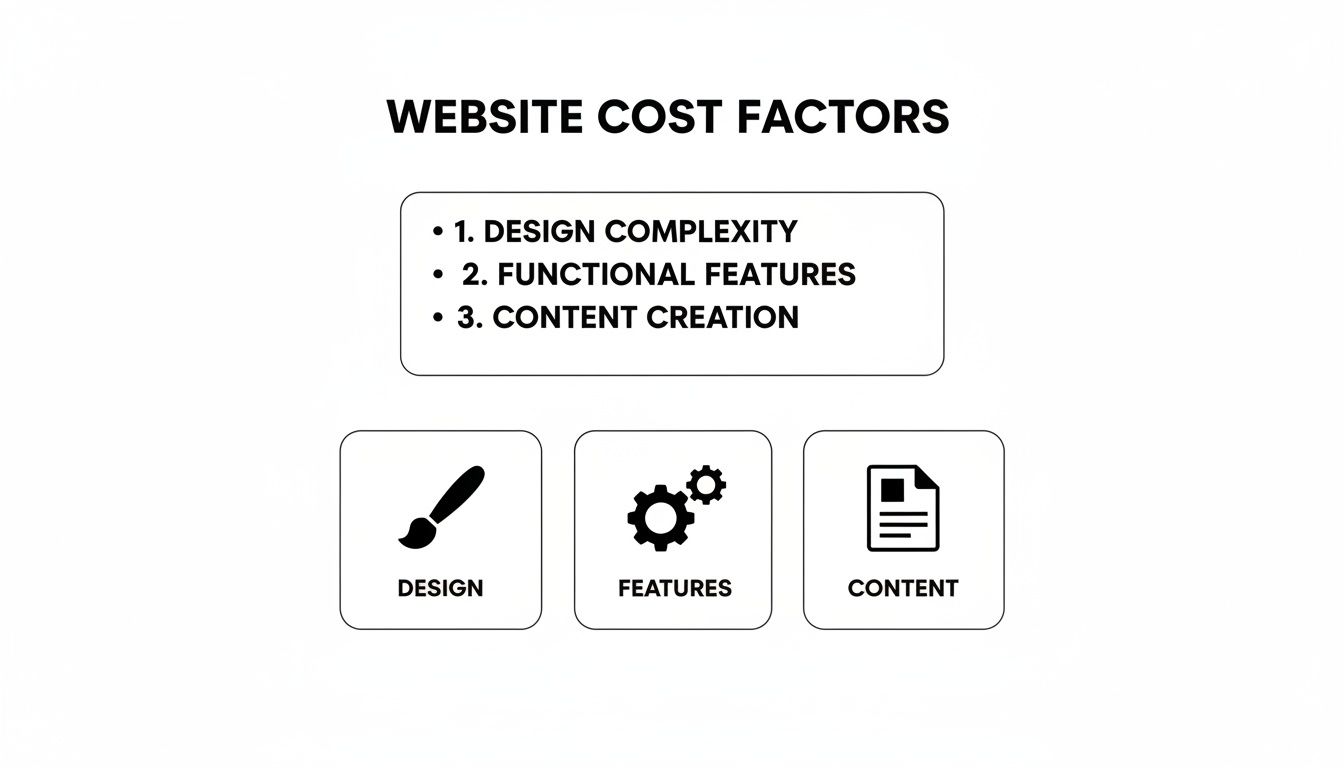
Knowing how each piece contributes helps you put your money where it'll make the biggest difference.
The Startup E-commerce Shop
Imagine a London-based startup selling handmade candles. They need an e-commerce site that not only looks gorgeous but also makes buying from them a smooth, secure experience. Their entire business hinges on turning website visitors into paying customers.
A small e-commerce site like this typically falls in the £4,000 to £8,000 range. It’s a bigger investment, and for good reason—selling online is a whole different ball game.
Building an e-commerce site is a bit like setting up a physical shop. You need attractive displays (product pages), a secure till (payment gateway), and an organised stockroom (inventory management). Each part adds to the cost but is absolutely vital to actually doing business.
For a startup, this budget would typically secure:
A custom-branded storefront design.
Secure payment integration with services like Stripe or PayPal.
Setup for the first 20-50 products, complete with great descriptions and images.
Must-have e-commerce features like stock management, shipping options, and customer accounts.
The Advanced Custom Website
Finally, let's consider an established consultancy firm in Birmingham. They need more than a simple brochure site. They're after a platform with advanced features, like a secure client portal for sharing documents and a slick booking system for appointments with different consultants.
A project this complex often starts at £8,000 and can easily go higher. While pricing guides for 2026 suggest a typical 5-10 page site for a small business costs £1,200 to £3,500, adding custom features like a client portal pushes the budget up. This kind of work requires specialist development to get the security and user experience just right.
What does that get you? This investment covers everything from initial strategy and bespoke design to the complex back-end development. We're talking user accounts, secure logins, calendar integrations, and automated email notifications.
The real value: These custom features streamline the business, saving huge amounts of admin time. They also deliver a premium, professional experience for clients, reinforcing the firm’s expert reputation and justifying its high-end fees. To see how a platform like Wix can handle these kinds of features, you might find our guide on how the cost of a Wix website is determined in the UK useful.
Ready to figure out where your business fits in and get a clear, itemised quote? Contact Baslon Digital today for a no-obligation chat about your vision.
Upfront Investment Versus Ongoing Website Costs
One of the biggest mistakes we see new business owners make is thinking of a website as a one-off purchase. It’s not. A great website is a living, breathing asset for your business—not a static brochure you print once and then stuff in a drawer.
To really get your budget right, you have to draw a clear line in the sand between the initial build cost and the essential running costs that keep it alive and kicking. Many people get caught out by recurring fees, but planning for them from the get-go saves you from nasty financial surprises and keeps your digital shopfront in top shape.
Your Initial One-Time Investment
This is the big number you'll see on your first quote. It covers the entire creative and technical journey of building your website, from a rough idea scribbled on a napkin to the moment it goes live for the world to see. Think of it as the cost of designing and constructing your digital headquarters.
This one-time investment usually wraps up:
Discovery and Strategy: This is the kick-off phase where we get to know you, your goals, and your audience. It's all about planning before we build.
Website Design: We're talking wireframes, mock-ups, and the final visual design that gives your site its unique personality and feel.
Website Development: The real nuts and bolts. Our developers turn the beautiful designs into a fully functional, interactive website. This means coding, setting up the content management system (CMS), and plugging in all the key features.
Content Integration: We’ll take your initial text, images, and videos and carefully place them onto the newly built pages.
Initial SEO Setup: This is the foundational work to make sure search engines like Google can find, understand, and start ranking your site from day one.
Essential Ongoing Website Costs
Right, your website is live. High-five! But the work doesn’t stop there. A few recurring costs are non-negotiable if you want to keep your site online, secure, and running smoothly. These aren't just "nice-to-haves"; they are the fundamental operational expenses of owning a professional website.
Failing to budget for ongoing maintenance is like buying a new car and never setting aside money for petrol, insurance, or an MOT. Sooner or later, you'll find yourself broken down on the side of the road.
These recurring fees are your website’s life support system. They ensure it keeps working hard for your business long after the launch party is over and are a core part of any realistic website development costing plan.
Breaking Down Recurring Expenses
So, what exactly are you paying for every month or year? It boils down to a few key areas that are vital for your site's health and security.
Domain Name Renewal: This is the annual fee to keep your web address (like ). It’s usually a small cost, around £10-£20 per year, but if you forget to pay it, you lose your address. Simple as that.
Web Hosting: This is the plot of land on the internet where your website lives. Hosting costs vary a lot, from £80 to £300+ annually, depending on how much speed and security you need.
SSL Certificate: This little certificate encrypts data between your site and its visitors, showing a padlock in the browser bar. It's essential for security and for visitors to trust you. Some hosting includes one, but you might need to renew it separately.
Website Maintenance Plan: Honestly, this is the most critical ongoing cost. A maintenance plan covers all the boring-but-vital stuff: regular software updates, security scans, performance checks, and backups. Skipping this leaves your site wide open to hackers and performance problems. To get the full picture, check out our deep dive into UK website maintenance costs in our detailed article.
Getting your head around both upfront and ongoing costs means you can build a digital strategy that lasts. It protects your initial investment and ensures your website continues to be a powerful tool for years to come.
Ready to plan a website budget with no hidden surprises? Contact Baslon Digital today for a transparent quote that covers everything you need for success.
How to Get an Accurate Website Quote You Can Trust
Asking a web developer for a price without a clear plan is a bit like asking a builder, "How much for a house?" without mentioning how many rooms you need. You'll get a vague, unhelpful number that leaves you more confused than when you started. A detailed brief is your best defence against scope creep and those dreaded unexpected bills.
Nailing down a precise and reliable quote isn’t about luck; it’s about preparation. When you do your homework, you give an agency everything they need to give you a number that actually reflects what you want, meaning no nasty surprises down the line. It ensures you and your chosen partner are on the same page from day one.
Before we dive in, it’s super important to know the difference between a quote and an estimate. This great article on What’s The Difference Between A Quote and An Estimate? explains it well: a quote is a fixed, solid price, whereas an estimate is more of a ballpark figure that can change. Aim for a quote!
Prepare Your Project Brief
Before you even think about talking to a designer, you need to get your vision down on paper. A well-thought-out project brief is the single most important tool for getting an accurate quote. It doesn’t need to be a formal document, but it should clearly answer some key questions about what you’re trying to build.
Start by organising your thoughts into these key areas:
Define Your Core Business Goals: What is the number one thing this website absolutely must achieve? Is it to generate phone calls, sell products directly, or just build your professional credibility? Be specific.
Identify Your Target Audience: Who are you actually trying to talk to? A website for teenagers will look and feel completely different from one aimed at corporate executives.
List Your "Must-Have" Features: This is where you get into the non-negotiable stuff. Do you absolutely need a booking system, a private client login area, or a gallery to show off your work?
Outline Your "Nice-to-Have" Features: What features would be amazing but aren't essential for launch day? Listing these helps agencies provide tiered pricing options, which is always useful.
Gather Your Inspiration
Designers aren't mind readers. The best way to communicate the look and feel you're after is by showing them examples. Spend a bit of time browsing the web and collect a list of websites you admire—even if they're from totally different industries.
When gathering inspiration, don't just focus on what you like; also make a note of what you don't like. Knowing what to avoid is just as valuable for a designer as knowing what to include.
For each website you save, jot down a few notes about what specifically caught your eye. Was it the clean layout, the bold colour scheme, or the super-smooth navigation? This kind of visual direction is priceless for a creative team.
Key Questions to Ask Any Agency
Once your brief is ready, you can start having conversations. The questions you ask a potential partner will reveal a lot about their process, transparency, and expertise. Don't be afraid to dig deep; a good agency will welcome detailed questions.
Here are a few essential questions to have on your list:
What is your revision and feedback process? You need to understand how many rounds of changes are included to prevent disagreements later on.
How is SEO integrated from the start? SEO shouldn't be an afterthought you tack on at the end; it needs to be baked in from the very beginning.
What ongoing support and maintenance do you offer after launch? This clarifies long-term costs and what happens if something breaks.
Who will be my main point of contact throughout the project? Clear, consistent communication is vital for a smooth process.
Equipped with a solid brief and the right questions, you can confidently approach any agency and get a website development costing quote that you can truly trust.
Ready to turn your preparation into a clear, actionable plan? Contact Baslon Digital for a no-obligation consultation, and let's build a precise quote for your vision.
So, Ready to Build a Website That Actually Works for You?
Investing in a proper website isn't just another expense—it's a direct investment in the future of your business. Hopefully, this guide has given you a much clearer picture of what goes into website costs, from the big-ticket items down to the small but crucial details of long-term upkeep. Now, it's time to put that knowledge into action.
A great website doesn’t just sit there looking pretty; it’s out there pulling its weight, bringing in new customers and making your life easier. As you start thinking about the kind of site you want, a key step is understanding your potential return on investment (ROI) for what you spend. This changes the whole conversation from "How much does it cost?" to "What can this investment do for my business?"
A well-built website should be your hardest-working employee, capturing leads and making sales 24/7. The initial cost is the price of hiring that perfect digital team member.
If you’re ready to get a stunning, high-performing Wix website that truly nails your brand and turns visitors into die-hard fans, our team is here to help. We specialise in building powerful digital presences for UK businesses, making sure every pound you invest is working hard to hit your goals.
Your vision deserves to be brought to life professionally. Contact Baslon Digital today for a no-obligation chat, and let's talk about building a website that drives real results for your business.
Website Cost FAQs: Your Burning Questions Answered
When it comes to figuring out website costs, a few questions pop up time and time again. Let's tackle the big ones we hear from business owners across the UK so you can get some straight answers.
Can I Get a Professional Website for Under £1000?
Technically? Yes. Should you? Probably not. It's a classic case of getting what you pay for. A sub-£1000 price tag usually means you're getting a rigid, cookie-cutter template with next to no professional input and zero room to grow. It'll get you online, but that's about it.
Think of it this way: you could buy a flat-pack shelf, or you could hire a carpenter to build a custom cabinet. Both hold your stuff, but one is designed specifically for your space, built to last, and actually adds value. An agency-built site includes the strategy, custom design, and SEO groundwork that those budget options just can't afford to touch.
How Long Does It Take to Build a Small Business Website?
There's no single answer, but for a standard 5-10 page small business website, you're typically looking at four to eight weeks from our first chat to launch day.
But that timeline can stretch or shrink depending on a few things:
Fancy Features: Need e-commerce, a booking system, or a members-only area? That adds time to the build.
Your Content: If you have all your text, images, and branding ready to go, things move much faster.
Feedback Loop: The project timeline lives and dies by your feedback. Quick decisions and approvals keep the momentum going!
Why Choose a Wix Agency Over a Freelancer?
This really boils down to what you're looking for. A freelancer can often seem cheaper upfront, but hiring a specialised Wix agency like Baslon Digital is a completely different ball game.
With an agency, you're not just hiring one person; you're getting a whole team. You've got a designer, an SEO expert, a project manager—all working together on your site. It’s a structured, proven process designed to deliver a high-quality product with reliable support long after you go live. It’s the difference between hiring a lone handyman versus a full construction crew with a foreman.
Ready to stop guessing and start building something brilliant? At Baslon Digital, we build stunning Wix websites that get real results for UK businesses, with clear, upfront pricing every step of the way.
Comments