Selling Products Online: A Practical UK Guide for 2026

You've got a product people like, a few sales through Instagram or a marketplace, and a spreadsheet that says you're making money. Then postage rises, a customer asks for a refund, a marketplace fee appears, and the profit disappears. That's the reality of selling products online in the UK. The shop itself is the easy part. The hard part is choosing the right route, protecting conversion, pricing the full cost stack, and meeting UK consumer rules without creating friction.
Table of Contents
Why Selling Products Online in the UK Is Worth It in 2026 - The practical reasons to start
Building Product Pages and Checkout That Actually Convert - Make the decision easy
Payments, Shipping and Inventory on a Wix Store - Keep stock honest
UK Legal Basics Every Online Seller Must Get Right - Publish information customers can keep
Marketing, SEO and Your Next Steps With Baslon Digital - Use a 90-day launch sequence
Why Selling Products Online in the UK Is Worth It in 2026
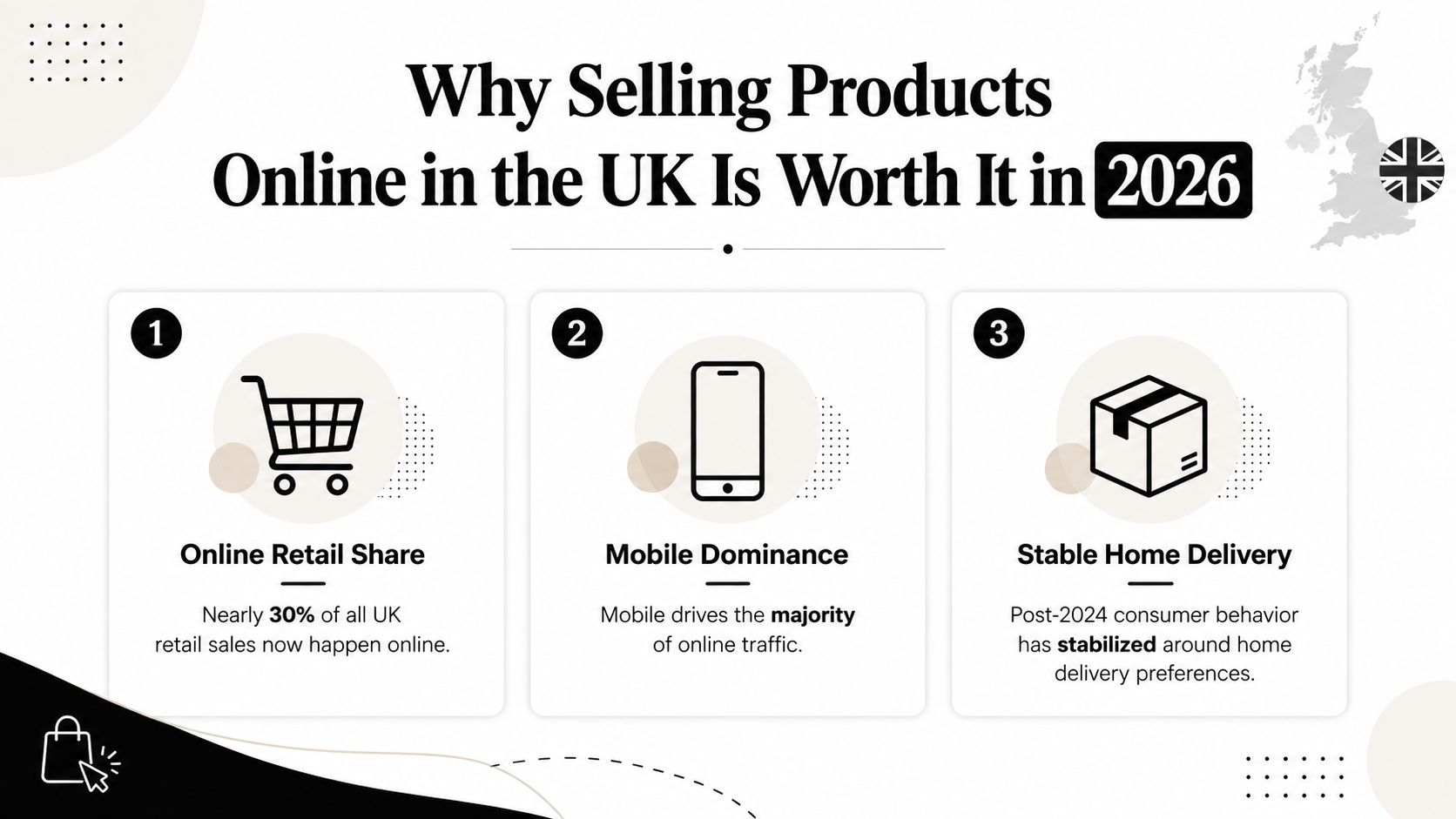
UK ecommerce is no longer a side channel for established retailers. Online retail sales reached £127.41 billion in 2024, up from £123.3 billion in 2023, according to Office for National Statistics retail data. Online purchases represented about 30% of total UK retail sales in 2024, compared with 21.6% in 2019, meaning nearly one in three retail pounds was spent online.
That shift matters to a small business owner because customers already expect digital product discovery, mobile-friendly browsing, home delivery and online payment. The question isn't whether people buy online. They do. The question is whether your margin can support the work required to win and serve them.
The practical reasons to start
An online store can give you access to customers without the fixed overhead of a high-street shop. You still have costs, including stock, packaging, software, delivery, payment processing and marketing, but you can test demand without committing to a large physical retail operation.
You also get a clearer view of buyer behaviour. Your website can show which products attract clicks, where shoppers leave, which search terms bring visitors and whether customers return. A marketplace can provide useful demand, but it controls much of the relationship. An own-site strategy gives you more control over the customer journey and the data you collect lawfully.
Practical rule: Don't judge an online idea by sales alone. Judge it by contribution margin after product cost, fulfilment, platform charges, refunds, advertising and your time.
This guide helps you make four decisions:
Platform: Decide whether your own Wix store, Etsy, eBay, Amazon, Depop or a combination fits the product.
Conversion: Build product pages and checkout around the way UK customers shop.
Compliance: Make prices, delivery, cancellation rights and ordering steps explicit before taking payment.
Growth: Use SEO, social content, analytics and paid traffic in an organised sequence.
The opportunity is real, but it won't reward a vague product page and a hopeful launch. Treat the store as a commercial system, not an online brochure.
Choosing Where to Sell Without Getting Burned by Fees
There are five realistic routes for a small UK seller. Wix gives you control over branding, customer relationships and the checkout. Etsy suits handmade, personalised and design-led products. eBay works well for products shoppers already search for, including second-hand, collectible and price-led goods. Amazon, including Handmade and fulfilment services, offers reach but brings a more demanding fee and operational structure. Depop and Vinted are useful for fashion and resale, where discovery happens through feeds and marketplace communities.
The mistake is comparing listing fees in isolation. Platform economics include payment processing, advertising, fulfilment, refunds, packaging, storage, currency conversion and the cost of acquiring attention. This UK eBay fee breakdown is useful because it shows why the headline fee rarely represents the full commercial cost.
The requested working scenario is 200 orders a month at a £30 average order value, creating £6,000 in monthly sales before refunds, product costs, shipping and tax. The table below is a decision framework, not a fee quotation. Exact charges vary by account, category, fulfilment method and optional promotion.
Platform | Monthly Volume | Headline Fees | Payment Processing | Effective Take Rate | Best For |
|---|---|---|---|---|---|
Own Wix store | 200 orders | Website plan and platform costs | Depends on selected provider | Must be calculated from your complete stack | Brand-led products and repeat customers |
Etsy | 200 orders | Transaction, listing, payment and regulatory operating fees | Included in payment-related charges where applicable | Can reach double digits once platform and promotional costs are combined | Handmade, personalised and design-led goods |
eBay | 200 orders | Final value charges may apply, with optional promoted listings | Depends on the account and payment arrangement | Varies sharply by category and advertising use | Search-led, collectible and price-sensitive products |
Amazon | 200 orders | Referral charges, with extra costs for fulfilment services | Built into the marketplace payment structure | Higher when pick-and-pack, storage and fulfilment are added | Standardised products with strong demand |
Depop or Vinted | 200 orders | Platform and selling charges vary by service | Payment processing may apply | Depends on seller terms, shipping and optional promotion | Fashion, resale and impulse discovery |
The best choice is usually a portfolio, not a single platform. Use a marketplace to test demand and capture existing intent, then build an own-site destination for products with a clear brand, repeat potential or higher margin. Marketplaces bring traffic, but they also rent you access to customers. Wix gives you more control, but you must create the demand through content, search, partnerships, email and advertising.
For niche SKUs and brand-led products, prioritise your own store. For commodity products and impulse purchases, marketplace visibility may matter more. Keep a margin sheet for every channel before you add stock.
Building Product Pages and Checkout That Actually Convert
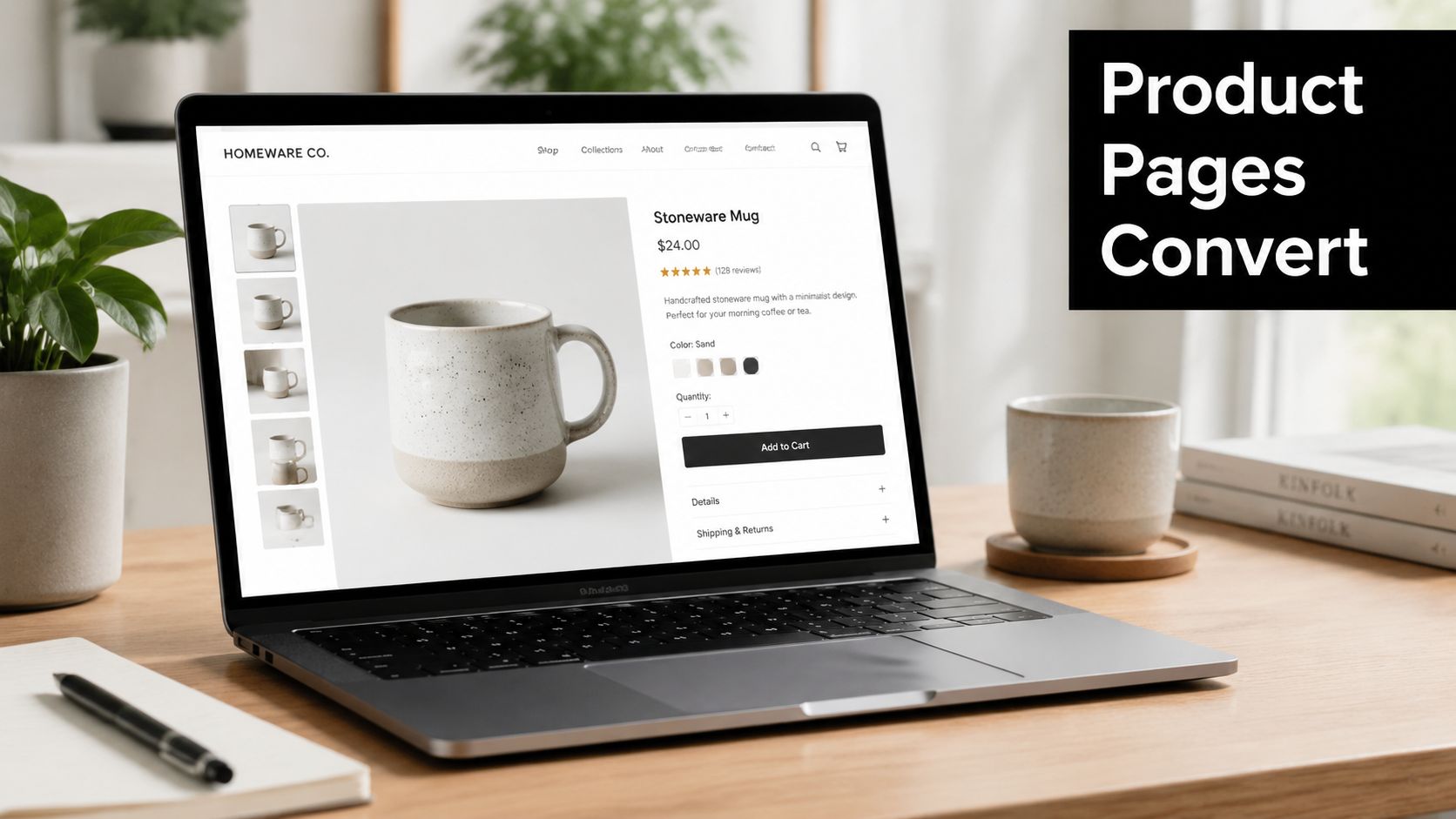
A product page shouldn't read like a catalogue description written for someone who already wants the item. It should answer the buyer's questions quickly. Put the main benefit in the first sentence, then give specifications, dimensions, materials, compatibility, care details and delivery information.
Show one strong hero image first. Add supporting images that demonstrate scale, texture, packaging and use, then include a lifestyle image that helps the shopper understand the product in context. Don't rely on decorative photography to explain a product that needs evidence.
Make the decision easy
Use one clear price and show the VAT-inclusive total where applicable. UK shoppers shouldn't have to calculate the amount at the point of purchase. Put delivery expectations, returns information and payment reassurance close to the buy button, not buried in a footer.
A practical product page includes:
Benefit-led opening: Explain what the product does for the customer before listing technical detail.
Visible evidence: Use reviews, clear images, dimensions and material information to remove uncertainty.
Single primary action: Make the purchase button more prominent than secondary links.
Useful reassurance: State the delivery promise and returns window beside the buying decision.
Mobile-first layout: Keep key information, price and the call-to-action visible without excessive scrolling.
Checkout deserves separate attention. Novuna reported that 74% of UK baskets created in Q4 2024 did not become completed orders, with abandonment at 76% on mobile and 67% on computers in its UK checkout abandonment study. That makes mobile friction a commercial problem, not a design detail.
Allow guest checkout, enable Apple Pay and Google Pay where supported, and remove fields you don't need. Keep the sequence short, show total costs early and make errors easy to correct. The guide to checkout as a guest is worth using when reviewing whether account creation is blocking first purchases.
A recognisable payment logo beside the purchase button helps, but it won't rescue a confusing checkout. Test the complete journey on a phone, including product selection, delivery choice, payment, confirmation email and refund handling.
Payments, Shipping and Inventory on a Wix Store
Your payment setup affects more than whether a card is accepted. It determines whether customers leave the site, how quickly you receive funds, which fraud checks are available and how easily you reconcile refunds.
Use Wix Payments where supported if it fits your business and product category. It can keep the checkout within your site and avoids sending customers through an unfamiliar third-party redirect. Stripe and Square are sensible alternatives, but compare their complete charges rather than choosing from brand familiarity alone. Turn on Apple Pay and Google Pay, and consider Klarna only when the product price and customer profile justify the extra operational complexity.
Provider | Per-Transaction Fee | Payout Speed | Apple Pay / Google Pay |
|---|---|---|---|
Wix Payments | Check the current UK account terms | Check your account settings and settlement schedule | Availability depends on configuration and eligibility |
Stripe | Check current UK pricing for your account | Depends on payout settings and account history | Supported where enabled and eligible |
Square | Check current UK pricing for your account | Depends on settlement arrangements | Availability depends on the payment setup |
Shipping should be simple enough for a customer to understand and accurate enough for you to survive. Create UK shipping zones based on weight, order value or product type. Offer a dependable tracked option such as Royal Mail Tracked, then add a courier upgrade where the product value or urgency supports it.
Don't promise free delivery by instinct. Calculate the expensive version of the delivery journey, including packaging, failed delivery, replacement orders and returns. If you absorb every cost, include it in the product price. If you charge separately, show the amount before the customer commits to pay.
Keep stock honest
Wix Inventory or a connected point-of-sale system can act as the stock record, but only if every channel feeds into it properly. Set low-stock alerts, use consistent SKU names and pause listings as soon as an item reaches zero. Overselling creates avoidable refunds and damages trust.
Reconcile payouts against orders every week. Check payment deductions, refunds, shipping charges and currency conversion costs, then update your margin sheet. A £30 order isn't a £30 contribution. Your useful figure is what remains after the entire transaction is settled.
UK Legal Basics Every Online Seller Must Get Right
Legal compliance starts before the product page goes live. UK sellers must make the buying process explicit by showing the business name, contact details, address, product description, total price including taxes, payment methods, delivery arrangements and costs, plus the steps involved in placing an order. The GOV.UK guidance for online and distance selling sets out these requirements in practical terms.
Make it obvious that the customer is committing to pay. Use a button such as Pay Now or another equally clear label, and give the buyer a way to correct errors before the order is placed. Don't hide the delivery charge until the final screen or use vague wording such as “continue” when the action creates a payment obligation.
Publish information customers can keep
Before purchase, provide the pre-contract details in a clear format. The customer should receive a written record that can be stored and reproduced, usually through an order confirmation email or downloadable document. Include your email address, VAT number if you're registered, and any additional phone-line charges above the basic rate.
Optional extras need active consent. A pre-ticked add-on for insurance, packaging or another service is poor practice and can create compliance problems. The GOV.UK online selling requirements also cover the information customers must receive and the treatment of optional additions.
Most online consumers have a 14-day cancellation period under UK distance-selling rules, as explained by Coventry Trading Standards. If a seller doesn't deliver within the agreed timeframe or within 30 days, the buyer can usually cancel and receive a refund.
Your site should therefore contain:
Business identity: Name, address and contact details that customers can find without hunting.
Complete pricing: Total price, taxes and delivery charges before payment.
Delivery terms: Dispatch expectations, delivery arrangements and what happens when delays occur.
Cancellation information: The cancellation process, relevant exclusions and return instructions.
Order records: A confirmation that customers can store and reproduce.
Privacy information: A clear privacy notice and suitable cookie controls for the data your site collects.
Get a solicitor or qualified adviser to review your terms where your products carry sector-specific obligations. A template can help you start, but it can't understand your fulfilment model, product risks or customer promises.
Handling Returns, Refunds and Fraud Like a Profit Centre
Returns belong in your profit-and-loss calculation. They create postage, packaging, inspection, handling, restocking and customer-service work, even when the product comes back in saleable condition. Treating returns as a friendly afterthought leads to prices that look competitive but don't support the business.
Write one plain-English policy that separates faulty goods, unwanted goods and changed-mind cancellations. Publish it on product pages, in the footer and in order confirmations so customers can find the rule before and after buying. Keep the wording consistent with the cancellation rights that apply to your sale.
For cancelled contracts, refund through the original payment gateway within the legally required period, and explain whether the customer pays return postage where the rules allow you to do so. Don't make customers guess whether they need to use a particular courier, include a form or return the original packaging.
Margin rule: Price the expected handling of returns before launch. A generous policy can support conversion, but an unpriced policy can quietly turn popular products into loss-makers.
Fraud controls should be practical rather than hostile. Enable 3D Secure through your payment provider, use address and security-code checks where available, and route unusual orders for manual review. Useful warning signs include a billing and shipping mismatch, an unusually large first order, repeated payment attempts, rushed delivery requests or several orders using related details.
Manual review doesn't mean rejecting every unfamiliar customer. It means pausing the orders that don't fit your normal pattern until you can verify them. Keep evidence for disputes, including order records, delivery tracking, customer communications and refund decisions.
Track fraud and refund losses as separate lines. Review the pattern monthly, identify which products and channels create the most exposure, and tighten rules when the losses become material. Don't punish every customer because of a few suspicious orders, but don't let customer-service goodwill remove commercial discipline.
Marketing, SEO and Your Next Steps With Baslon Digital
Start with the page you want Google and customers to understand. Map one useful search phrase to each product, write a descriptive title, use a scannable description, add accurate image alt text and link from relevant category pages to your strongest products. Add Product schema so search engines can interpret price and availability.
The SEO guide for small business websites is a useful reference for the foundations. Don't publish dozens of thin product pages and expect volume to solve the problem. Improve the pages that match genuine demand, answer buyer objections and provide a clear route to purchase.
Traffic channels should match the product:
Short-form video: Use demonstrations, comparisons, packing clips and customer use cases for visually explainable products.
Pinterest: Build visual discovery around homeware, fashion, gifts, food and design-led products.
Google Shopping: Wait until your tracking and conversion data are clean enough to tell you which products deserve paid visibility.
Email: Capture consent and use post-purchase messages to support reviews, replenishment and repeat orders.
Social commerce: For a broader view of how social channels can contribute to direct-to-consumer sales, read this practical DTC social media revenue guide.
Keep paid social testing modest and controlled. The plan isn't to spend heavily on unproven creative. Test a small set of messages, audiences and product angles, then keep the combinations that produce profitable orders after fulfilment and refunds.
Use a 90-day launch sequence
Weeks 1 to 4: Build the store, finalise product information, test checkout, publish legal pages and submit the site for indexing.
Weeks 5 to 8: Collect genuine reviews, improve weak product pages, check search queries in Search Console and fix tracking gaps.
Weeks 9 to 12: Introduce paid traffic only after the site can show which landing pages and products convert. Compare blended revenue against product, fulfilment, platform and advertising costs.
Measure with four simple tools:
Google Search Console: Find the queries that bring impressions and clicks.
GA4: Review landing-page behaviour and the paths customers take.
Platform analytics: Monitor orders, product performance and repeat-buyer behaviour.
A margin spreadsheet: Record blended return on ad spend after the costs that platforms don't show in headline reports.
Baslon Digital can handle a Wix ecommerce build, product-page structure, technical SEO, schema and tracking setup for a small UK seller. If your store is already live, start with a conversion and margin audit rather than commissioning a cosmetic redesign.
Baslon Digital can build or improve your Wix store, organise the product journey, set up SEO and tracking, and remove the checkout friction that costs UK sellers orders. Visit Baslon Digital to discuss your products, platform mix and the practical work needed to sell online profitably.
Comments