Marketing Strategy for Small Business: A Practical Growth Guide

A solid marketing strategy isn't just a list of things to do. It's a proper plan that maps out exactly how you'll find your ideal customers and hit your business goals. It’s the difference between throwing spaghetti at the wall and actually cooking a decent meal.
We’re moving beyond random acts of marketing here. We’re focusing on specific objectives, getting to know your audience like they’re your best mates, and taking a good, hard look at what you’ve already got.
Building Your Foundational Marketing Plan
Before you spend a single pound on ads or schedule a month of social media posts, you need a plan that actually works. A decent marketing strategy starts with clarity, not complexity. It's about setting a clear starting line for your business's growth so that every bit of effort has a purpose.
Getting this foundation right prevents you from wasting time and money. Without it, marketing can feel like shouting into the void—you’re making noise, but you have no idea if anyone is listening or why they should care.
Set Tangible and Measurable Goals
First things first: what does success actually look like for you? And please, don't just say "get more sales." That's far too vague. You need real, tangible goals you can actually measure. This turns a wish into a proper business objective. Think about what you really want to achieve in the next three or six months.
Maybe your goals look something like this:
Increase local web traffic from Google by 20% in the next quarter.
Generate 15 solid leads a month through your website's contact form.
Grow your email list by 100 new subscribers in the next 90 days.
Get repeat customers to buy 10% more often this year.
Setting specific targets like these gives you a benchmark. It’s the only way you’ll know if your efforts are paying off or if you need to switch things up.
Truly Understand Your Ideal Customers
Forget those generic customer avatars you see online. The best insights come from building realistic personas based on your actual best customers. Who are the people who already love what you do? What do they all have in common?
A deep understanding of your audience is the bedrock of all successful marketing. It informs your messaging, your choice of channels, and your content, ensuring you connect with people who genuinely need what you offer.
You need to dive deep into their world. What are the real problems and frustrations your business solves for them? Where do they hang out online? Are they scrolling Instagram, looking for professional advice on LinkedIn, or chatting in local Facebook groups? Figuring out what makes them tick is critical. To get this spot on, you can find detailed guidance on how to create user personas that drive results.
Conduct an Honest Audit of Your Assets
The final piece of your foundation is taking an honest look at what you already have. This isn't about ticking boxes; it's about evaluating your current marketing tools with a critical eye. What’s working, what isn’t, and what's completely missing?
Start with your website. Is it easy and intuitive to use? Does it scream what you do and who you do it for? A stunning site that’s a nightmare to navigate is useless—it won’t turn visitors into customers.
Next, have a look at your social media. Are people just 'liking' posts, or are they actually commenting, sharing, and asking questions? If engagement is low, it’s a big sign that your content isn't hitting the mark. To make sure your efforts aren't wasted, learn how to develop a modern social media content strategy that lines up with your business goals. This audit gives you a clear snapshot of your strengths and weaknesses, showing you where you can make quick wins before you invest in anything new.
Ready to turn this foundation into a powerful growth engine? Let's get into choosing the right channels to reach those ideal customers.
Choosing Smart Marketing Channels for Your UK Business
Alright, you’ve got your goals pinned down and you know exactly who you’re trying to talk to. The next big question is: where are you going to have that conversation? It’s tempting to jump on every new platform, but for a small business, that’s a recipe for burnout. Spreading yourself too thin is a classic mistake.
Strategic focus will always win over a scattergun approach.
Think of it this way: a local bakery in Manchester is going to hit the jackpot with hyper-local SEO and a drool-worthy Instagram feed. But a B2B tech consultant in London? They’ll likely find all their leads through sharp LinkedIn networking and a killer email list. The channels are completely different because their customers and goals are worlds apart.
Match the Channel to the Customer
Let your customer personas be your north star here. Where do your ideal clients actually hang out online? If you’re selling bespoke furniture to homeowners in their 30s and 40s, Pinterest and Instagram are visual goldmines you can't ignore. But if you’re offering accounting services to other small businesses, LinkedIn is where they’ll be, scrolling with a business mindset.
Don't just guess. Look at what the data tells us. UK small businesses lean into certain channels for a reason. Recent stats show 76% of small businesses use Facebook for marketing, 63% are on Instagram, and 43% use LinkedIn. Video is also a huge deal, with around 77% of marketers using social video in their campaigns.
Choosing the right platform is all about slotting your business into these existing behaviours.
To help you visualise this thought process, here’s a simple decision tree. It maps out how to narrow down your options based on your unique business needs.
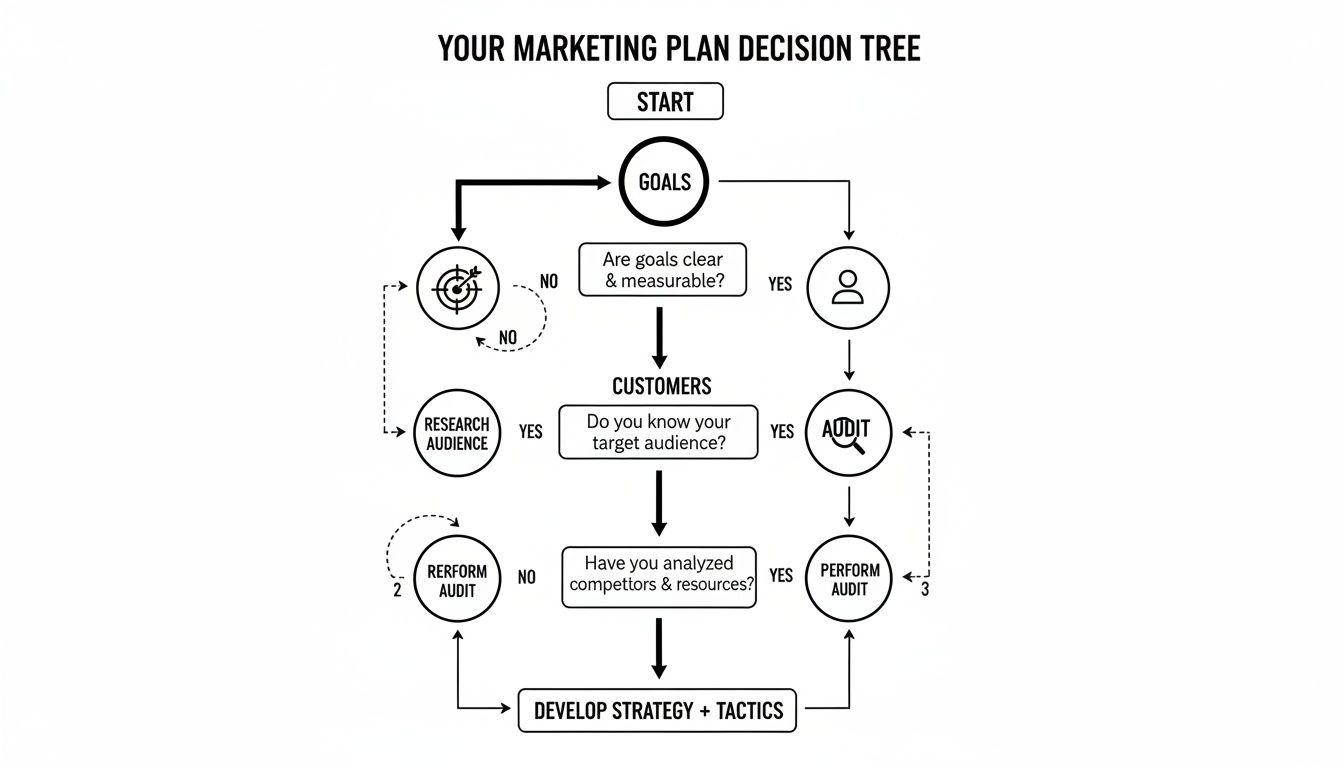
This just reinforces the idea that your channel selection should flow directly from your goals and a deep understanding of who you’re selling to.
Compare the True Costs and Benefits
Every single channel demands an investment. It’s either your time or your money, and most of the time, it's a bit of both. You have to be brutally honest about what you can realistically commit to.
To help you decide, we've put together a quick comparison of the most popular channels for UK small businesses.
Marketing Channel Comparison for Small Businesses
This table breaks down some of the most effective marketing channels, showing you what they're best for and what kind of resources you'll need to make them work.
Channel | Best For | Typical UK Audience | Effort/Cost Level |
|---|---|---|---|
Local SEO (GBP) | Driving local footfall & service enquiries | Customers searching for local businesses | Low effort, high return |
Content/SEO | Building authority & attracting organic traffic | Information-seekers & researchers | Medium to high effort, long-term payoff |
Social Media | Brand building, community engagement | Varies by platform (e.g., younger on TikTok, professionals on LinkedIn) | Low to medium effort (organic), scalable cost (paid) |
Email Marketing | Nurturing leads & customer retention | Existing contacts & subscribers | Low cost, medium effort |
Paid Ads (PPC) | Immediate traffic & lead generation | Highly targeted, specific demographics | High cost, medium effort |
This table should give you a clearer picture of where your time and money might be best spent. For instance, if you have more time than money, content marketing and local SEO are fantastic starting points. If you need results yesterday, paid ads might be the answer, provided you have the budget.
Here’s a closer look at a few favourites:
Local SEO (Google Business Profile): This is non-negotiable for any business with a physical address or service area. Optimising your profile is free, and it puts you directly in front of people actively looking for what you do. The return on the time you invest here can be massive for getting people through the door.
Content Marketing (Blogging): Writing genuinely helpful articles builds trust and positions you as an expert. Sure, it takes time, but one fantastic blog post can pull in organic traffic for years. It's a powerful long-term asset. For more ideas, check out our comprehensive guide to marketing a website in the UK.
Social Media (Instagram, Facebook, LinkedIn): These platforms are brilliant for building a community and showing off your brand's personality. The cost can be low if you stick to organic posts, but you must be consistent. Paid ads can speed things up, but they require a dedicated budget.
The smartest marketing strategy for a small business is to pick one or two core channels and absolutely nail them. It’s far better to be exceptional on one platform than to be painfully average on five.
Focus on Mastery, Not Quantity
Once you’ve weighed up the options, pick your primary channel—the one with the best shot at reaching your ideal customer. Then, choose a secondary channel that complements it. For example, a coffee shop might use Local SEO as its primary tool for attracting new customers and Instagram as its secondary channel for building loyalty and community.
This focused approach turns your marketing budget into a strategic investment, not just a scattered expense. You can pour your resources into creating brilliant content and engaging properly on the platforms that actually move the needle for your business.
Creating a Realistic Budget and Content Calendar
A brilliant marketing strategy without any money or time behind it is basically just a wish. For any small business owner, the two most precious resources are always the budget and the clock. Nailing down a realistic financial plan and a manageable content schedule is what turns your great ideas into an actual, actionable roadmap.
This isn't about finding a huge pot of cash or suddenly needing to work 20-hour days. It's about being smart and intentional with what you've already got. Let's look at how to dish out your funds based on your actual revenue and build a flexible content calendar that keeps you consistent without becoming a soul-crushing chore.

How to Set a Practical Marketing Budget
Let's demystify the whole marketing budget thing. There's no single magic number, but there are some very sensible ways to approach it. Instead of just pulling a figure out of thin air, grounding your budget in your actual business performance is the only way to make it sustainable.
A common—and sane—starting point is the percentage-of-revenue model. This just means you dedicate a fixed percentage of your total income to marketing. It’s wonderfully simple and it scales right along with your business—when you earn more, you can afford to invest more. Simple.
So, what’s a realistic percentage? An industry synthesis reported that UK firms spend about 7.7% of their revenue on marketing, on average. For a microbusiness with a median turnover of around £295,000, this would mean setting aside roughly £22,700–£23,000 a year for all marketing stuff. This really highlights how the same percentage can mean wildly different budgets for paid ads or content creation depending on your turnover. You can explore more UK small business statistics to see how you stack up.
Breaking Down Your Budget Allocation
Once you have your total marketing pot, the next job is deciding where that money actually goes. A simple way to get a handle on this is to sort your spending into a few key categories.
Essential Tools & Software: This is the non-negotiable stuff. Think costs for your Wix website hosting, an email platform like Mailchimp, and any scheduling tools you use (like Buffer or Later).
Content Creation: Are you hiring a photographer for product shots? Paying a freelance writer for a blog post? Buying stock images? Even if you DIY most of it, set aside a small amount for quality assets. Trust me, it makes a difference.
Paid Advertising: This is your budget for Google Ads, Facebook boosts, or LinkedIn campaigns. This slice of the pie should be flexible. Start small, test what works, and only increase the spend on campaigns that are giving you a clear return.
Contingency Fund: This is my pro tip. Always, always keep 10-15% of your budget on the side for unexpected opportunities. A last-minute chance to sponsor a local event might pop up, or a new ad platform you want to test, and you’ll be ready for it.
Your first marketing budget won't be perfect. It never is. Treat it as a living document. Check in on it every quarter, see what's working, and don't be afraid to shift funds from a channel that's doing nothing to one that's actually delivering results.
Building a Simple and Effective Content Calendar
A content calendar is your secret weapon against that last-minute, "Oh god, I need to post something!" panic. It doesn't need to be some fancy, complicated piece of software; a simple spreadsheet is often all you need. The goal is just to create a rhythm that keeps your marketing consistent.
Start by mapping out your core content "pillars." These are simply the main topics your audience actually cares about—the ones you figured out when you were creating your customer personas. For a London-based graphic designer, the pillars might be "Branding Tips," "Client Spotlights," and "Design Process Insights."
Then, plan your posting frequency. Be brutally realistic here.
Weekly: One Instagram post and a few Stories.
Bi-Weekly: A short, helpful email newsletter.
Monthly: One in-depth blog post on your Wix site.
This simple structure immediately gives you a manageable plan. A basic calendar in a spreadsheet could have columns for: , (e.g., Blog, Instagram), , , and (e.g., Idea, In Progress, Published). This clarity stops you from getting overwhelmed and keeps you focused on creating genuinely valuable content, consistently.
Ready to put these plans into motion? A clear budget and a solid calendar are the scaffolding for a successful marketing strategy for your small business. If you need help turning this framework into a stunning online presence, our team specialises in creating Wix websites that get results.
Explore our Wix design services to see how we can bring your strategy to life.
Right, you've got a brilliant marketing plan sketched out. But let's be honest, a plan is just a pretty document until you actually do something with it.
Strategy is the 'what' and the 'why'. Tactics are the 'how'. Now's the time to roll up your sleeves and turn those big ideas into real-world actions that start making noise from day one.
The trick is to go for the quick wins first. I’m not talking about launching some massive, complicated campaign that’ll have you pulling your hair out. Nope. We’re focusing on simple, powerful moves you can make this week to get the ball rolling and see a bit of magic happen.

Think of it as creating a series of small victories. Ticking a few things off the list builds confidence and gives you the buzz you need to tackle the bigger, more time-consuming stuff later on.
Your First-Week Wins Checklist
To get you started, here’s a super practical checklist of high-impact tasks perfect for busy entrepreneurs. Aim to get these done in your first week. They’re foundational, they work, and they cost next to nothing.
Give Your Google Business Profile Some Serious Love This is, without a doubt, the most powerful free marketing tool for any local business. Don't just claim your profile; properly sort it out. Add at least ten new, high-quality photos of your products, your team, and your place of business. Make sure every single service you offer is listed, and write compelling, keyword-rich descriptions for each one. Seriously, don't skip this.
Make a Few Crucial On-Page SEO Tweaks You don't need to be an SEO genius to make a difference here. Log in to your Wix website and zero in on your homepage and main service pages. Are your page titles and meta descriptions actually describing what you do? Do they include your main keywords? For instance, change a generic "Home" title to something like "Bespoke Carpentry Services in Bristol | Your Business Name". It’s a tiny change that Google absolutely loves.
Set Up a Basic Welcome Email What happens when someone signs up for your newsletter? For most small businesses, the answer is a deafening silence. Let's change that. Set up a simple, automated welcome email. Thank them for joining, give them a quick reminder of who you are, and maybe even offer a little something, like 10% off their first order. This is how you start building a proper relationship from the get-go.
These three actions alone can give your online visibility and customer engagement a serious boost without you spending a penny on ads. It's the very definition of working smarter, not harder.
Creating Genuinely Useful Content
The word "content" can feel a bit daunting, especially when you're a one-person show. The secret? Stop thinking about "creating content" and start thinking about "answering questions."
Your customers have problems. They have questions. Your content should be the answer.
The most effective content doesn’t just sell; it serves. When you genuinely help your audience solve a problem or learn something new, you build trust and authority that advertising simply can't buy.
Start with what you already know. You're the expert here. What are the top five questions customers always ask you? Every single one of those is a perfect topic for a blog post, a short video, or a few social media tips.
For example, a local accountant could easily write a blog post titled, "5 Common Tax Deductions UK Small Businesses Miss." That's incredibly valuable to their target audience, makes them look like they know their stuff, and can pull in free traffic for years. Easy.
Exploring Modern High-Impact Tactics
As you get into the swing of things, keep an eye out for newer tactics that can give you an edge. You could explore using AI to help brainstorm content ideas or check out emerging platforms. One area that's getting a lot of buzz is affiliate marketing on social media. If it fits your business, resources like A Modern Guide to AI Affiliate Writing for TikTok Shop can offer a framework for these newer channels. The goal is just to stay aware of what's out there and what your audience is paying attention to.
Remember, this whole thing is an ongoing process. The tactics that work wonders today might need a refresh in six months. The important part is to just start. Take that first step and turn your ideas into actual marketing that gets you results.
A solid plan starts with small, consistent actions. Focus on these first-week wins, and you’ll be building a rock-solid foundation for long-term growth.
Ready to turn that strategic plan into a stunning, high-performing website? Our team lives and breathes Wix, creating custom sites that not only look fantastic but are built from the ground up to turn visitors into loyal customers.
Contact Baslon Digital today for a free consultation and let's start bringing your vision to life.
Measuring What Matters and Adapting Your Strategy
You’ve built a brilliant plan and put some high-impact tactics into action. Fantastic. But how do you actually know if any of it is working? The answer is learning to measure the right things—and having the guts to ignore the rest.
A great marketing strategy isn't something you "set and forget." Think of it as a living, breathing thing that needs constant attention. It’s all about testing, learning, and tweaking based on what the real performance data is telling you. This is where you swap guesswork for genuine insight.
Identify Your Key Performance Indicators
Forget getting lost in a sea of data. Honestly, you don't need to track every metric under the sun. Instead, zero in on a handful of Key Performance Indicators (KPIs) that directly signal the health of your business and tie back to the goals you set earlier.
These are the numbers that truly matter. They tell you if you're actually getting closer to your objectives or just spinning your wheels.
Here’s what I mean when I talk about meaningful KPIs versus distracting "vanity metrics":
Website Goal: Instead of obsessing over raw Website Traffic, focus on your Conversion Rate. It doesn't matter if you get 10,000 visitors if not a single one fills out your contact form or buys a product.
Email Marketing Goal: Don't get hung up on Open Rates. The real prize is the Click-Through Rate (CTR), which shows you how many people were engaged enough to actually take action.
Social Media Goal: Likes are nice for the ego, but the Engagement Rate (comments, shares, saves) and Website Clicks from your posts are far more valuable. They show you have an audience that's actually interested.
Choosing the right KPIs gives you a clean, uncluttered view of what's driving results and what might be a total waste of your budget. For a deeper dive, our guide on how to calculate marketing ROI to prove campaign value can give you a solid framework to work from.
Use Free Tools to Get Clear Answers
You really don’t need a lorry-load of expensive software to track your progress. Some of the most powerful tools out there are completely free and perfect for a small business.
Google Analytics 4 (GA4) is your best friend here. It’s the gold standard for understanding how people find and interact with your website. You can easily see which channels (like organic search, social media, or email) are sending you the most valuable visitors—the ones who actually convert. Setting up conversion goals in GA4 is non-negotiable; it’s how you track critical actions like form submissions or phone number clicks.
On top of that, most email marketing platforms and social media sites have their own built-in analytics dashboards. These will give you all the data you need on click-through rates and engagement, helping you see which messages and posts are really hitting the mark.
Embrace a Cycle of Learning and Adjusting
Data is only useful if you act on it. Your KPIs aren't just for show; they're there to guide your decisions and help you adapt your strategy over time. This process of continuous improvement is what separates the businesses that grow from those that just... exist.
Marketing isn't a one-time setup; it's a constant feedback loop. Review your data, celebrate what's working, and be ruthless about changing what isn't. This agile approach ensures your marketing gets smarter and more effective every single month.
This adaptability becomes even more important when resources are tight. For instance, recent analysis from the British Business Bank found that the share of UK small businesses using external finance has declined. When funding is harder to come by, businesses naturally shift focus to low-cost, high-ROI tactics like email marketing and local SEO, making performance measurement even more critical. You can read the full factsheet on small business finance markets to understand these trends better.
Make it a habit to review your core KPIs monthly. If a blog post is driving loads of organic traffic, write more on that topic! If your Instagram ads are underperforming, tweak the creative or targeting—or shift that budget to a channel that’s actually delivering results.
This cycle of measuring, learning, and adapting is the final, crucial piece of your marketing puzzle. It transforms your plan from a static document into a dynamic engine for sustainable growth.
Ready to put these insights into practice but have a few more questions? Let's clear up some common marketing uncertainties.
Your Small Business Marketing Questions Answered
Look, every business owner has questions about marketing. It’s totally normal to feel a bit stuck when you're trying to build something that actually grows your business. We've seen it all before, so we’ve pulled together the most common questions we hear and given you some straight, no-nonsense answers.
How Much Should a Small Business Really Spend on Marketing?
This is the million-pound question, isn't it? But the answer is simpler than you think. A really solid place to start is the percentage-of-revenue model.
Just aim to put somewhere between 5% and 10% of your annual turnover back into your marketing. So, if your business is bringing in £100,000, that works out to a marketing budget of £5,000 to £10,000 for the year. Simple.
The best thing about this approach is that it scales right alongside your business. Have a great quarter? You can afford to invest a bit more to keep the momentum going. Going through a leaner patch? Your spending automatically adjusts downwards without putting your finances in a chokehold.
How Can I Market My Business with Almost No Money?
A tiny budget forces you to get creative, and honestly, that can be a massive advantage. When cash is tight, you have to swap money for effort. The trick is to focus that energy on the few things that give you the biggest bang for your buck (or lack thereof).
If you’re starting from zero, these should be your priorities:
Google Business Profile: This is, without a doubt, the most powerful free marketing tool for any local business. Fill out every single section, upload good photos, and make a habit of asking customers for reviews.
Content Creation: Don't overthink it. Start a simple blog on your website answering the exact questions your customers are always asking. It costs nothing but your time, and over a few months, it will start pulling in free traffic from Google.
Basic Email Marketing: Grab a free account on an email platform and start building a list. Even a simple monthly newsletter is enough to keep your business front-of-mind for people who've already shown they're interested.
The secret here is consistency. It’s not about one heroic effort. A few focused hours every week on these free channels will achieve far more than random, sporadic bursts of activity. It's all about building momentum.
Which Marketing Channels Should I Focus On First?
Whatever you do, don't try to be everywhere at once. It’s the fastest way to burn out and achieve nothing. The golden rule is simple: go where your customers are.
Pull out those customer personas you created. Are they professionals scrolling through LinkedIn on their lunch break? Or are they looking for visual ideas on Instagram and Pinterest? Your answer is right there.
Pick just one or two core channels and get really good at them. For most small businesses, this is a winning combination:
Local SEO: This is your foundation. It’s how you attract people in your area who are actively looking for what you sell.
One Social Media Platform: Choose the one that feels most natural for your brand and where your audience actually hangs out. Commit to it. Be active, be helpful, be human.
Once you’ve got those two humming along and actually bringing in results, then—and only then—should you think about adding another channel to your marketing strategy for small business.
Feeling a bit clearer on your next steps? A great strategy is one thing, but it needs a great online home to work. If your website isn't pulling its weight, it might be time for an upgrade.
Explore our Wix design services to see how we can build a website that drives real growth for your business.
Alright, let's get that marketing engine revved up.
You've now got the entire playbook for a marketing strategy that actually works for a small business. But here's the real secret: you don't need to do it all at once. The magic is in starting small, being ridiculously consistent, and letting that momentum build. Forget waiting for the "perfect" time to start—it doesn't exist.
So, what's next?
Pick one thing from this guide. Just one. Commit to doing it this week. Maybe it's finally giving your Google Business Profile the love it deserves, or perhaps it's sketching out your very first content calendar. Whatever you choose, taking that first step is everything. Action is what separates a plan from a wish.
Remember, a brilliant marketing plan needs a brilliant home online. Your website is where all that hard work pays off, turning curious browsers into paying customers. If your site is just sitting there looking pretty but not pulling its weight, it's a dead anchor on your growth.
If you're ready to build a Wix website that doesn't just look stunning but actually drives your business forward, Baslon Digital is here to help. Check out our professional Wix design services and let’s create something amazing together.
Comments