How to measure brand awareness: A Practical Guide to Growth

Updated: Dec 18, 2025
To really get a grip on brand awareness, you need a mix of hard data and human feedback. We're talking about tracking quantitative stuff like direct website traffic and branded search volume, but also digging into the qualitative side with surveys and social media mentions. This combo is key because it tells you not just how many people know your name, but how they actually feel about you.
Why Measuring Brand Awareness Matters More Than Ever
In a market overflowing with choices, having a great product just isn't enough anymore. You need to be the brand that pops into people's heads first. Measuring brand awareness is how you move past guesswork and get a real, honest look at your place in the market. It’s about checking your brand's pulse, making sure your marketing is actually hitting the mark, and setting yourself up for long-term growth.
After all, you can't fix what you don't measure.
The Shift from Sales to Brand Health
The game has changed. Customers aren't just buying things; they're discovering brands. In the UK, brand awareness has shot up to become the number one metric for 62% of CMOs, a huge jump from when only 46% cared more about sales. Why the sudden change? A massive 40% of UK consumers now find new brands through social media, which has officially overtaken old-fashioned word-of-mouth.
This isn't just a trend; it's a fundamental shift. Lasting success now hinges on building a brand that's so memorable, customers go out of their way to find you.

Why It’s a Priority for Your Business
Keeping a close eye on your brand awareness helps you make smarter, more confident decisions. When you truly understand how visible your brand is, you can start to:
Sharpen Your Marketing Message: Find out if what you're saying is actually what your audience is hearing.
Spot Growth Opportunities: Uncover untapped markets or demographics where your brand could take off.
Build Real Customer Loyalty: A brand people know and recognise is a brand they trust, and that trust turns into repeat business.
To get the full picture, you can't just stop at awareness. It's also worth digging deeper into how to measure brand equity, which looks at the total value and perception of your brand.
This guide will give you a no-nonsense framework to start measuring what really moves the needle, using practical methods that won't blow your budget. Ready to see where you stand? Let's get into it.
Laying the Groundwork: Why Clear Goals and KPIs Are Non-Negotiable
Before you even think about tracking metrics or fiddling with analytics tools, let’s get one thing straight: you need to know what you’re actually trying to achieve. Just saying you want to "get our name out there" is about as useful as a chocolate teapot. It’s too vague.
Measuring brand awareness effectively starts with a clear destination in mind. You need a specific, measurable goal that’s tied directly to the health of your business. This isn’t about chasing vanity metrics; it’s about turning broad ambitions into targets you can actually hit.
Without this foundation, you’ll just be staring at a bunch of numbers, completely clueless about what they mean for your bottom line. It’s like setting off on a road trip with no map. Sure, you’re moving, but are you heading in the right direction? Probably not.
From Hazy Ideas to Concrete KPIs
The trick is to translate those big, fluffy business goals into specific Key Performance Indicators (KPIs). A KPI is just a fancy term for a number that shows you how well you're doing at achieving your objectives. Let’s make this real.
Imagine you've just launched a new online shop in the UK selling handmade leather goods.
Your vague idea: "I want more people to know about my new shop."
A better, actionable objective: "I want to increase brand recognition among my target audience in the next quarter."
A killer KPI: "Increase branded search queries (people Googling 'my brand name') by 20% over the next three months."
See the difference? That KPI gives you a solid number to aim for and a clear deadline. It connects the fuzzy concept of "brand awareness" to something you can actually track for free using a tool like Google Search Console.
Tying Awareness Directly to Business Results
Your brand awareness goals should always, always serve a bigger business purpose. Are you trying to pull in more leads? Break into a new market? Or maybe just build enough street cred to stand up to an established competitor? Each of these scenarios needs a different way of measuring success.
Here’s how a local service business, like a London-based plumbing company, might connect the dots:
Business Goal: Get more emergency call-out jobs from local customers.
Awareness Objective: Become the first name people think of for emergency plumbing in their area.
Primary KPI: Achieve a higher Share of Voice (SOV) in local online forums and directories than the top three local competitors within six months.
By zeroing in on Share of Voice, the plumber isn’t just counting mentions. They're benchmarking their visibility against the very rivals they’re fighting for local jobs. This makes their awareness efforts directly accountable to generating more leads. It’s smart, targeted, and measurable.
Ready to start tracking these kinds of numbers for your own business? The next step is picking the right tools and metrics to see how you’re doing. Let's get into how you can start gathering that data.
Tracking Your Reach with Quantitative Metrics
Right, with your goals locked in, it’s time to get into the hard data. Measuring brand awareness isn’t just a vibe; it’s about tracking real numbers that show how far your brand's message is travelling. The best bit? You can start doing this right now with free tools you’re probably already using.
This is where we move past vanity metrics and zero in on the figures that genuinely reflect if people remember you. We'll look at how to read this data not as abstract numbers, but as clear signals of your growing presence.

Uncovering Brand Recall with Direct Traffic
One of the purest signals of brand awareness is Direct Traffic in Google Analytics (GA4). This is gold. It tracks visitors who type your website URL straight into their browser or click a bookmark. They didn't find you through a search or a social media post—they already knew your name and came looking for you on purpose.
Think of it like this: a high volume of direct traffic means your brand has achieved "top-of-mind awareness." It's a powerful sign that your marketing is building a memorable brand that people actively seek out. If this number is climbing, you’re doing something right.
Monitoring Visibility with Branded Search and Impressions
Another crucial place to look is Google Search Console. This free tool is a goldmine for understanding how people find you on the world's biggest search engine. Two key metrics to keep an eye on are Branded Search Volume and Impressions.
Branded Search Volume: This tells you how many people are specifically searching for your company name. A rising number here is a direct signal of growing awareness. Simple as that.
Impressions: This is the total number of times your website popped up in search results, whether someone clicked or not. More impressions mean your brand is becoming more visible for relevant searches.
Tracking impressions is a big deal for building brand memory. Research suggests consumers need to see a brand five to seven times before they even start to remember it. Since so many businesses struggle with consistent branding, monitoring impressions helps you make sure your audience is seeing you often enough for your name to finally stick.
Analysing Your Digital Footprint
Beyond your own website, your brand’s reach stretches across different platforms. Each one offers a simple, quantitative way to see how many people your message is getting in front of.
Here’s a quick breakdown:
Website Reach: In GA4, look at the Users metric. This tells you the total number of unique individuals who have visited your site. It’s a straightforward measure of your audience size.
Social Media Reach: Platforms like Instagram and Facebook give you analytics on the Reach of your posts—the number of unique accounts that saw your content. This shows how far your message is spreading on those networks.
These numbers give you a tangible sense of your brand's digital footprint. And while reach is just the first step, it’s a vital one. To see how awareness translates into active participation, you’ll want to start measuring customer engagement too.
By consistently tracking these quantitative metrics, you can paint a clear, objective picture of your brand's health and growth over time.
Ready to balance these numbers with some real human insights? Let’s dive into how you can listen to what your audience is actually saying and feeling about your brand.
Listening to Your Audience with Qualitative Insights
The numbers from your analytics are great. They tell you how many people are seeing your brand, but they fall short on one crucial detail: they don't tell you how those people feel about it. That's where you need to get qualitative.
To really get a grip on brand awareness, you have to tune into the conversations, perceptions, and general vibe surrounding your business. These methods are less about hard data and more about human experience. They add the colour and context behind the numbers, revealing why people connect with your brand—or, sometimes more importantly, why they don't.
It’s about tapping into the chatter to find out what your brand actually means to your audience.

Gathering Feedback with Brand Perception Surveys
One of the most straightforward ways to figure out what people think is... well, to just ask them. You don't need fancy, expensive software for this. A simple survey whipped up with a free tool like Google Forms can give you a goldmine of information. The real trick is asking the right questions.
When you're putting your survey together, think in terms of "recall." This is how you gauge just how memorable your brand is. There are a couple of ways to approach this:
Unaided Recall: This is the absolute gold standard of brand awareness. You ask a broad question like, "When you think of London-based website designers, which companies come to mind first?" If your brand's name pops up without any prompting from you, that's a massive win. Seriously, do a little happy dance.
Aided Recall: This approach gives people a bit of a nudge. You might ask, "Which of the following logos for web design agencies do you recognise?" and then include your logo among a few competitors. This helps you understand recognition, even if your brand isn't the first one people think of just yet.
Sending these surveys to a mix of existing customers and a wider, less familiar audience can reveal some fascinating differences in perception. It’s a great way to see if the message you think you're sending is the one people are actually receiving.
Tuning In with Social Listening
Social media isn't just a place to post your latest offer; it's a massive, non-stop focus group that you have free access to. Social listening is simply the practice of monitoring these platforms for mentions of your brand, your competitors, and keywords relevant to your industry. It’s about paying attention to the conversation as it happens, in real-time.
For a small business, you can easily start this manually. Just block out some time each week to search for your brand name on platforms like X (formerly Twitter), Instagram, and LinkedIn. And remember to look beyond the direct tags (@mentions), because plenty of people will talk about you without formally tagging your account.
As you track these mentions, pay close attention to the sentiment. Is the feedback positive? Are people raving about your customer service? Are they complaining about a specific product? Or are they asking questions that show they're confused about what you do? Every single mention is a valuable piece of feedback.
Of course, understanding who is talking about you is just as critical. For a deeper dive, it's worth exploring how to determine who your online audience is to make sure your brand is resonating with the right crowd.
By blending direct feedback from surveys with the candid, unfiltered insights from social listening, you can build a rich, three-dimensional picture of your brand's health.
Benchmarking Against Competitors with Share of Voice
Knowing your own brand awareness stats is great, but they don't mean much in a vacuum. Your brand is out there fighting for attention every single day. This is where Share of Voice (SOV) comes in, and frankly, it's one of the most useful metrics a small business can track.
Think of your market as a noisy room full of people talking about different brands. SOV tells you what percentage of that conversation is actually about you compared to your rivals. A higher SOV means you’re cutting through the noise, staying relevant, and gaining a serious competitive edge.
How to Calculate Your Share of Voice
You don’t need a pricey subscription to a fancy analytics tool to figure this out. A bit of manual digging can give you a surprisingly clear picture of where you stand.
The basic formula is as simple as it gets:
(Your Brand Mentions / Total Market Mentions) x 100 = Your Share of Voice
So, how do you find these mentions? You just need to look where your audience is already talking.
Social Media: Head over to platforms like X (the artist formerly known as Twitter), LinkedIn, or Instagram. Search for your brand name and the names of your top three competitors over a specific timeframe, say, the last week. Tally up every mention you find for each brand – especially the ones where you aren't tagged.
Online Articles & Blogs: A simple Google search is your friend here. Use the time filter (e.g., "Past month") to find articles mentioning your brand versus the competition. Just search for and then do the same for .
Add up the numbers from all channels, and you'll get a solid directional idea of your visibility. This is a crucial part of any good competitor analysis. To really nail this, have a look at our guide on how to conduct competitor analysis for UK small businesses for a step-by-step approach.
Remember, SOV isn't a "set it and forget it" metric. If you launch a new campaign and see your SOV jump from 15% to 25% while a competitor’s share shrinks, that’s tangible proof your marketing is working and grabbing more attention.
The Impact of Influencer Marketing on SOV
If you're looking for a serious way to pump up your Share of Voice, especially here in the UK, influencer marketing is a game-changer. The market is projected to grow by a massive 29.5% CAGR, and with 51% of UK shoppers admitting they've bought something an influencer promoted, it’s clear these collaborations work.
When you run an influencer campaign, you can directly track the surge in conversations about your brand. It’s a concrete, measurable way to see your awareness gains in real-time. You can learn more about the rise of influencer marketing in the United Kingdom and how it’s shaking things up.
Now that you've got all this data, what's next? Let's talk about how to turn these numbers into a clear plan that will actually shape your brand's future.
Turning Your Data into Decisive Action
Collecting data is only half the battle. Staring at a spreadsheet full of numbers won’t get you very far. The real magic happens when you turn those figures and comments into a clear action plan. Insights are pretty useless until you use them to make smarter decisions about your marketing, messaging, and overall business strategy.
This whole process kicks off when you bring all your findings together in one place. You absolutely cannot look at metrics in isolation. Instead, you need to hunt for the story they’re telling you as a group.
Did a massive spike in your direct website traffic line up perfectly with that influencer collaboration you ran last month? That’s a clear win. Did a survey reveal that potential customers are completely confused about your pricing just as your social media engagement took a nosedive? Now you’ve got a massive clue pointing you towards what to fix.
From Insights to Impactful Strategy
Once you start connecting the dots, you can build a strategy that’s actually focused on solving real problems or doubling down on what works. The goal here is to shift from passively measuring brand awareness to actively, and intentionally, shaping it.
Let's get practical. Here’s what this looks like in the real world:
A Misconception is Revealed: Let's say your survey shows people think your amazing product is only for massive corporations. Time to launch a series of blog posts or snappy case studies that put your small business clients in the spotlight.
A Competitor is Dominating: Is a rival owning the entire conversation over on LinkedIn? Don’t try to beat them at their own game where they’re already established. Instead, pivot and double down on a platform they’re totally neglecting, like Instagram Reels, to build your own loyal community.
Positive Sentiment is Uncovered: If your social listening shows customers are raving about your gorgeous packaging, make it the hero of your next ad campaign. Lean into what people already love.
This simple process flow visualises how you can benchmark your brand's voice against competitors to figure out where you stand.
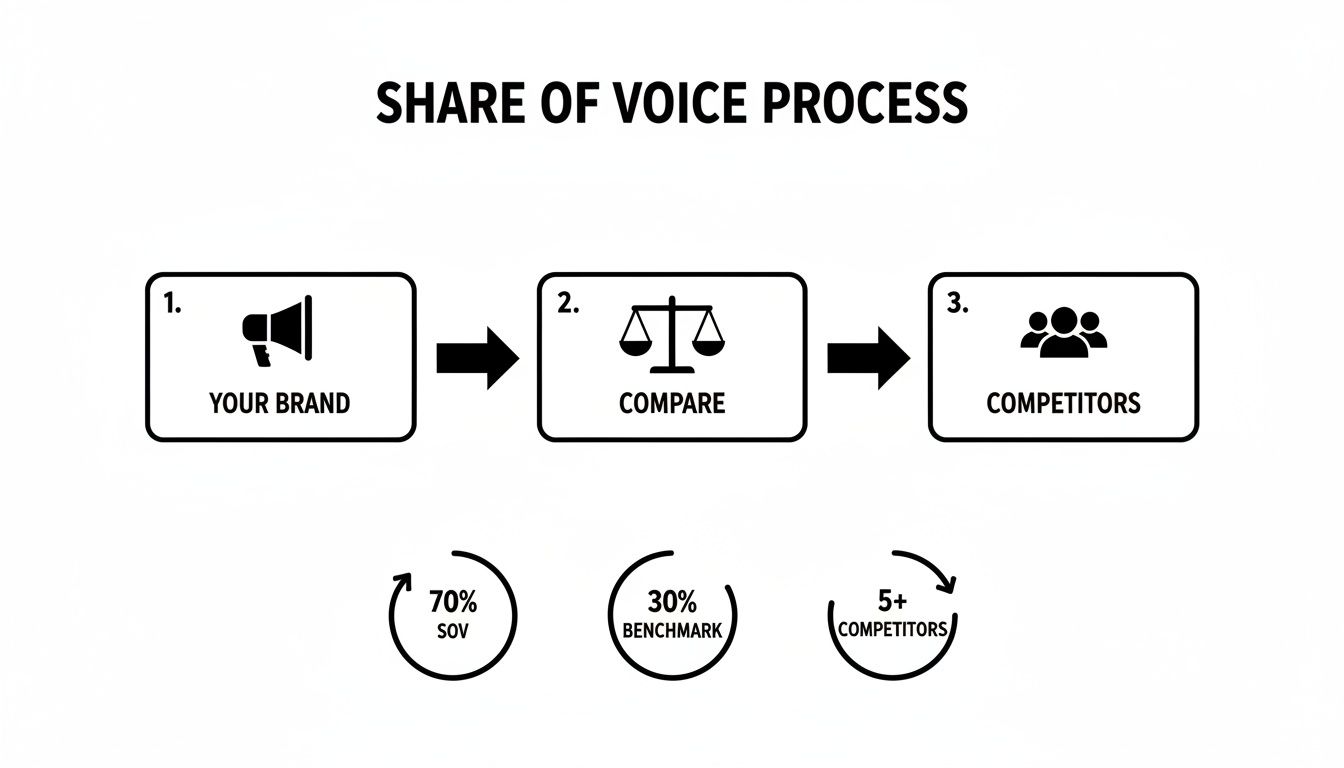
This visual really drives home the point: understanding your share of the conversation is the first, crucial step toward creating a strategy to grow it.
By creating a simple monthly or quarterly report that connects data points to actionable next steps, you build a powerful feedback loop. This transforms measurement from a passive reporting task into an active tool for growth.
Connecting these actions back to actual financial outcomes is the final, and most important, piece of the puzzle. For a deeper dive on that, check out our guide on how to calculate marketing ROI to prove campaign value.
Got Questions? Let's Get Them Answered
Diving into brand awareness metrics can bring up a few questions. Getting straight answers helps you stop wondering and start measuring what actually moves the needle for your business.
How Often Should I Actually Bother Measuring This Stuff?
For most small businesses, doing a proper deep-dive into your brand awareness every quarter is the sweet spot. This gives your marketing efforts enough time to actually make a dent in the data.
That said, you’ll want to keep a closer eye on real-time metrics like direct website traffic and social media mentions. A quick check weekly or monthly is perfect for spotting trends as they happen.
Pro tip: After a big campaign or a new launch, measure right before it starts and again about a month later. It’s the cleanest way to see a before-and-after snapshot of its impact.
What’s the Single Most Important Metric for a Small Business?
If I had to pick just one... well, I can't. But I can give you two that are pure gold when you're starting out: Branded Search Volume (which you can find in Google Search Console) and Direct Traffic (from Google Analytics).
Why these two? Because they’re solid proof that people are remembering your brand name and actively typing it into their browser or search bar. That’s a massive signal of growing brand recall, telling you your hard work is paying off and you're building a name for yourself.
Can I Really Measure Brand Awareness with Zero Budget?
Absolutely. You don't need to spend a fortune to get a decent read on your brand awareness. In fact, you can get started without spending a single penny.
Here's the low-budget game plan:
Get the freebies: Install Google Analytics and connect your website to Google Search Console. They're non-negotiable and cost nothing.
Do some manual snooping: Block out a little time each week to search for mentions of your brand on your main social media channels. It’s old school, but it works.
DIY surveys: Use a free tool like Google Forms to whip up a simple brand perception survey. Send it out to your email list or existing customers—they’re often happy to help.
Sure, paid tools can automate things and give you more data, but these free methods will give you a solid, actionable foundation to build on.
Ready to turn that growing brand awareness into a website that actually gets results? Baslon Digital builds custom Wix websites that don't just look pretty—they capture your brand's unique vibe and turn visitors into loyal customers. Let's build your standout digital presence today.
Comments