Creating a Price List That Turns Clicks Into Clients
- Baslon Digital

- Jan 6
- 15 min read
Updated: Jan 7
Before you can even think about putting numbers on a page, you need a solid game plan. Your pricing strategy isn't just about picking figures out of thin air; it’s about getting to the heart of your value, understanding your market, and nailing down how you deliver your services. A bit of upfront thinking transforms your price list from a simple menu into one of your most powerful sales tools.
Laying the Groundwork for Your Price List
So, where do you begin? The first major decision is choosing the structure for your pricing. This is the foundation everything else is built on. Each model works for different types of services and client relationships, so it’s crucial to pick the one that actually fits how you operate.
Exploring different common pricing models is a great starting point. It helps you see what’s standard in your industry and gives you a feel for what might work for your own unique offerings.
Choosing Your Pricing Model
Let's break down the big three. You've basically got three main ways to charge for what you do:
Hourly Rates: This is your best bet for work where the scope is a bit fuzzy or for projects where the client’s needs might evolve. It offers great flexibility, but the downside is that it can make it tricky for clients to budget.
Fixed-Price Projects: Perfect for services with a crystal-clear start and finish, like building a new website. Clients love this because it gives them cost certainty, which can be a huge selling point.
Monthly Retainers: If you offer ongoing services like SEO or social media management, this is your holy grail. It provides you with predictable, recurring revenue and gives clients continuous support. Win-win.
Stuck on which one to pick? This decision tree can help you visualise which path makes the most sense for the kind of services you provide.
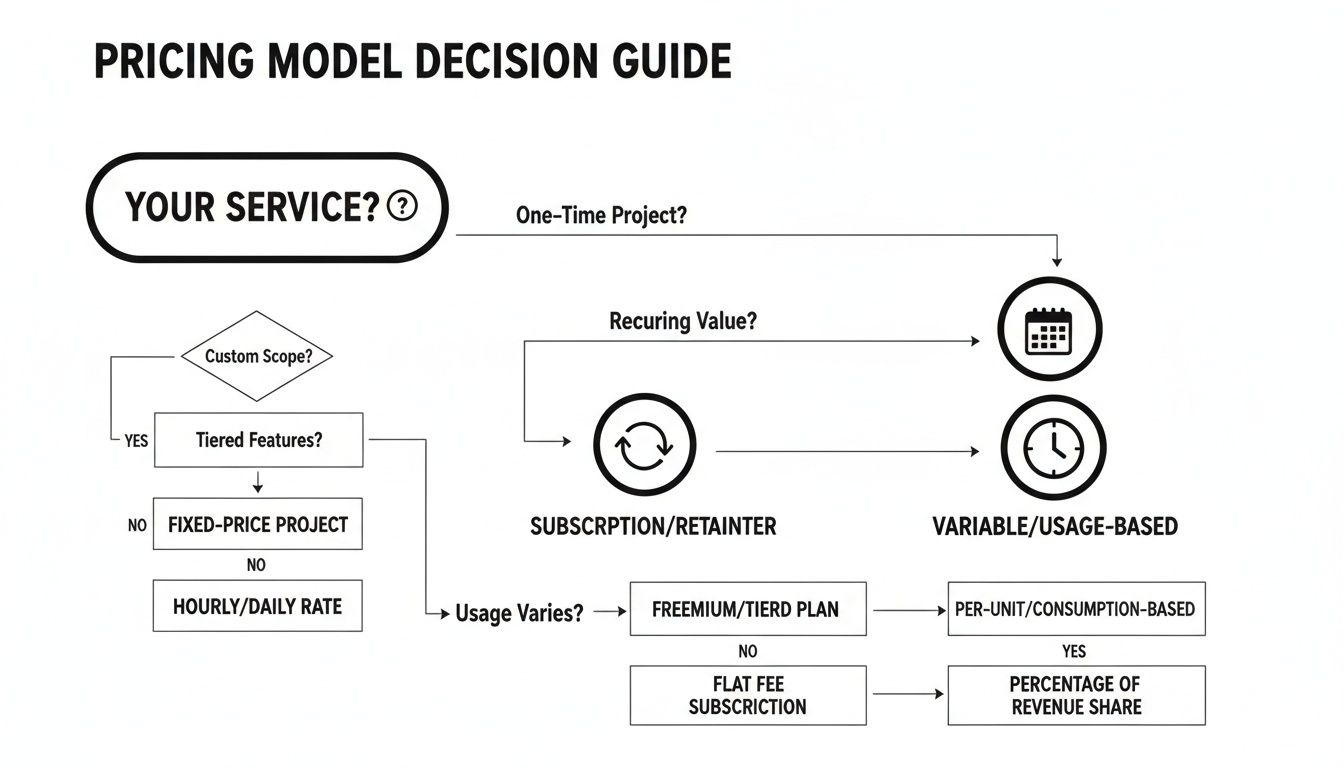
As you can see, the flowchart makes it simple by linking your service type—whether it's a one-off project, ongoing support, or variable work—directly to a logical pricing structure.
Defining Your Services and Packages
Once you’ve settled on a model, it’s time to get brutally clear about what you're actually selling. Vague service descriptions are a one-way ticket to confusion and dreaded scope creep. You need to break down your offerings into distinct, easy-to-understand items.
From there, think about bundling these individual services into packages. A tiered approach—think Basic, Standard, and Premium—is incredibly effective. It simplifies the choice for clients and often nudges them towards a higher-value option that better solves their problem. If you need a hand figuring out where you fit in the market, our practical guide on how to conduct competitor analysis for UK small businesses is a lifesaver.
A well-structured package doesn't just list features; it solves a specific client problem. Frame your tiers around the outcomes you deliver, not just the tasks you perform.
For instance, a "Website Starter" package might include a three-page design and basic SEO setup, solving the immediate problem of getting a new business online. An "E-commerce Growth" package could add product page optimisation and email marketing integration, addressing the need to actually increase sales.
Getting this foundational work right is absolutely critical. It ensures the prices you eventually set are firmly anchored to clear, defined value, which makes them far easier to justify and, ultimately, to sell.
How to Set Your Prices with Confidence
Figuring out what to charge can feel like throwing darts in the dark, but it doesn't have to be. Pricing is something you can absolutely control with a bit of simple maths and some smart research. It’s not just about getting paid for your time; it’s about tying your rates to the actual, tangible value you bring to your clients.
The whole point is to build a pricing structure that actually fuels your business's growth, not just one that keeps the lights on.
First things first, you need to get a handle on your numbers. Before you can even dream about profit, you have to know exactly what it costs you to be in business. And I mean everything.
Calculate Your Cost Baseline
Start by adding up every single one of your monthly business expenses. This means all the essentials like your software subscriptions, insurance, marketing spend, and any courses or training you're paying for. Crucially, don't forget to factor in your own salary—the amount you actually need to live on.
Once you’ve got a total monthly cost, you can work out your baseline hourly rate. A simple formula to get you started is:
Total Monthly Costs / Total Billable Hours per Month = Your Baseline Hourly Rate
This number is your break-even point. It’s the absolute rock-bottom minimum you have to charge just to cover everything without making a penny of profit. Knowing this figure is the first step to pricing with confidence because it grounds your decisions in reality, not just wishful thinking.
For a deeper look into this, check out our guide on how to build your customer acquisition cost calculator—it really helps you understand the true cost of winning new business.
Remember, your baseline rate is your floor, not your ceiling. Proper value-based pricing is all about building profit on top of this foundation, reflecting the results and expertise you actually deliver.
Research Your Market and Position Your Value
With your baseline sorted, it’s time to look outwards. Understanding where you fit in the market is critical for creating a price list that makes sense. You need to get a feel for what your ideal clients are used to paying and what your direct competitors are charging for similar work.
For instance, in the UK digital agency world, prices for a new website are all over the place. A simple one-page site might go for anything between £350-£2,000, while a complex e-commerce platform could hit £30,000. The average, though, often settles around £5,452.30.
Knowing these benchmarks helps you position your own custom projects—like those in the £3,000-£7,000 range—to attract clients who are looking for quality but aren't ready for that enterprise-level price tag. You can dig into more insights like this from these digital agency statistics on capsulecrm.com.
Setting Your Final Price
Alright, now it’s time to bring it all together. Combine your internal costs with your external market research to lock in your final price.
Start with your baseline rate. This is your non-negotiable minimum. It’s what keeps the business afloat.
Add a profit margin. This is where your business actually grows. For service-based businesses, a healthy margin is often somewhere between 20-50%, but this can shift depending on your industry and experience level.
Adjust for value and positioning. If your research shows you offer a more specialised service, have a killer portfolio, or deliver better results than the other guys, you have every right to price yourself at the higher end of the market. Don't be shy about it.
This three-step process—calculate costs, research the market, and add your value-based profit—gets you away from the guesswork. It’s a strategic approach that ensures you’re profitable and helps you attract the kind of high-quality clients you actually want to work with.
Ready to take these prices and build a page that converts? The next step is all about designing a price list that’s clear, persuasive, and makes it dead simple for clients to say "yes".
You've crunched the numbers and set your prices. Fantastic. But now comes the tricky part: how do you actually present them without scaring people away?
A price list is so much more than a menu. It’s a sales tool. Get it right, and it guides potential clients effortlessly towards hitting that "buy now" button. Get it wrong, and you've got a cluttered, confusing mess that makes people click away faster than you can say "lost sale."
The goal is to make your value blindingly obvious and the decision to hire you feel like a total no-brainer. This is where a bit of design and psychology comes into play.

Structure Your Packages So People Actually Understand Them
One of the best ways to lay out your services is with tiered pricing. You've seen this everywhere for a reason—it works. Think 'Good', 'Better', and 'Best'.
This structure simplifies the decision for your customer. Instead of being paralysed by a dozen different options, they're given a clear path. Funnily enough, most people instinctively skip the cheapest option and gravitate towards the middle one. It just feels like the safest bet and the best value for money.
To give them a gentle nudge in the right direction, you need to visually highlight your preferred package. This is your 'anchor' package, the one you want most people to choose.
You can make it pop by:
Using a bolder, brighter colour for its button.
Slapping a "Most Popular" or "Best Value" label on it.
Making its column a smidge wider or giving it a subtle border.
These are simple visual cues, but they draw the eye and silently recommend the best option. It takes the guesswork out of the equation and makes the customer feel more confident in their choice.
Use a Little Pricing Psychology (It’s Not as Sneaky as It Sounds)
The numbers themselves have a funny way of influencing how we feel about a purchase. A few small tweaks to how you display your prices can have a massive impact on how they're perceived.
The way you present a price can be just as important as the price itself. You're framing your value in a way that feels accessible and reasonable, which helps dial down that natural hesitation we all feel before buying something.
A classic trick is charm pricing—ending your prices in the number 9. There's a reason you see £499 instead of £500. Even though it’s only a quid difference, our brains process it as being significantly cheaper. It just feels like a better deal, and sometimes that's all it takes to tip someone over the edge.
Then there's price anchoring. By placing a super-high-priced 'Premium' or 'Enterprise' package next to your standard options, you make the others look like an absolute bargain in comparison. Very few people might actually buy the top-tier option, but its presence alone makes your mid-tier package look like an incredibly sensible, well-priced choice.
Combine a clean, tiered design with these psychological nudges, and your price list stops being a passive document and starts actively selling for you. It clarifies your value and makes saying "yes" to you the easiest decision they'll make all day.
Ready to build a pricing page that doesn't just look professional but actually brings in the business? Baslon Digital specialises in creating custom Wix websites with pricing pages designed to convert. Book a free consultation with us today and let's see how we can help.
The Essential Details Your Price List Needs

Let's be honest, when a potential client hits your pricing page, they're not just looking for numbers. They're looking for reassurance. A good price list answers their questions before they even ask them, turning that "hmm, maybe" into a confident "let's do this".
Just slapping a price next to a service name won’t cut it. Each package needs a quick, clear summary of what's actually included. This isn't just fluffy marketing—it’s your first line of defence against scope creep and helps set crystal-clear expectations right from the start.
Outline Your Process and Terms
People don't just want to know what you'll deliver; they want to know how you'll do it. A simple breakdown of your project process is incredibly calming for a new client. It shows you’re organised, you have a system, and this isn't your first rodeo.
This is also where you need to lay down the law with your terms and conditions. Don't think of it as boring legal stuff; think of it as the ground rules for a happy relationship. Make sure you cover the essentials:
Payment Schedules: How does it work? Is it 50% upfront and 50% on completion? Spell it out.
Revision Rounds: How many chances do they get to make changes? Defining this upfront prevents those never-ending tweak requests.
Project Scope: Clearly define where the project begins and, more importantly, where it ends. This protects both of you.
Think of your terms and conditions as the rulebook for a successful project. They protect you from being taken advantage of and give the client a clear understanding of what to expect, which builds immense trust.
Nailing your price list is especially crucial for small businesses. A London-based Wix specialist like Baslon Digital, for example, needs to cater to a huge range of budgets. While some UK businesses have hefty marketing funds, many are working with a lot less. In fact, while 19% of UK businesses budget between £50,000 and £119,999 for marketing, a significant 12% have less than £5,000 to spend. You can see more on these UK digital marketing statistics on localiq.co.uk. This is exactly why clear, tiered pricing is a game-changer.
Proactively Address Objections with an FAQ
Want to know a secret weapon for your pricing page? A targeted FAQ section. This is your chance to get in front of all those little doubts and questions that can stop a client from clicking "buy".
Think about the questions you get all the time. "What if I need something not included in a package?" or "What's the typical timeline for a project like this?". Answering these directly on the page builds massive confidence and shows you're on their wavelength. It's a simple move that smooths the path and makes it so much easier for them to say yes.
Ready to build a price list that does more than just list prices? The team at Baslon Digital can help you design a Wix website with a pricing page that reassures and converts. Book a no-obligation chat with us today.
Bringing Your Price List to Life on Wix
You’ve strategised, planned, and designed. Now for the fun part: turning that carefully crafted price list into a real, functioning page on your Wix website. This is where all your hard work moves from a document on your computer to a live sales tool that’s ready to convert visitors into clients.
Thankfully, Wix makes this bit straightforward. Whether you use the Wix Pricing Plans app or build your own layout with columns and repeaters, you’ve got the tools to create something that looks professional and matches your brand’s feel. The goal isn’t just to get the information online; it’s to present it clearly and persuasively.
Give Them Somewhere to Go: Integrating Strong Calls to Action
A price list with no clear next step is a digital dead end. It’s like telling someone all about your amazing services and then just walking away. Every single package or item on your list needs a powerful call-to-action (CTA) that tells the visitor exactly what to do next.
Forget weak, vague buttons like "Learn More." Be direct. Be action-oriented.
Try these on for size:
‘Book a Free Consultation’: Perfect for higher-ticket services where a conversation is the natural next step.
‘Get Started Today’: This creates a nice sense of urgency and momentum, pushing people to act now.
‘Choose This Plan’: Simple, decisive, and it makes the buying process feel easy for the user.
Stick these buttons right inside each pricing column where they can’t be missed. Use a contrasting colour that pops off the page. You want clicking that button to be the easiest, most obvious choice they can make. Speaking of costs, you can also explore our complete UK pricing guide for Wix to understand the platform’s own pricing structure.
Your CTA is the bridge between a potential client's interest and a tangible lead. Make it impossible to miss and simple to act upon.
Optimise for Mobile and Make Sure People See It
This is non-negotiable: your price list must look good on a phone. Jump into the Wix mobile editor and check it yourself. Do the columns stack neatly? Is the text big enough to read without pinching and zooming? Are the CTA buttons easy to tap with a thumb? If not, fix it.
Once your page is live, don't just leave it sitting there hoping people will find it. You need to drive traffic to it. Link to your shiny new pricing page from all the key spots on your website—your main navigation menu, the footer, and definitely within your service pages.
If you’re a Wix agency in the UK, it’s also crucial to know what the local market looks like. UK agencies often work on monthly retainers anywhere from £500 to £10,000. For most small to medium-sized businesses (SMEs), that sweet spot is usually £1,000-£5,000. And since around 10% of businesses have less than a £1,000 annual marketing budget, it’s a smart move to offer a well-defined, entry-level package alongside your premium tiers. You can learn more about how much digital marketing agencies cost in the UK on digital-marketing.us.com.
Ready to build a Wix website with a pricing page that actually works? The team at Baslon Digital can help you create an online presence that’s not just stunning but effective. Book a free consultation and let’s get started.
Got Questions About Your Price List? Let's Clear Them Up.
Even with a killer plan, a few nagging questions can pop up when you're putting your price list together. That’s totally normal. Nailing these common sticking points is the final piece of the puzzle, giving you the confidence to launch your pricing strategy.
Let's tackle these head-on. Getting this right ensures your price list is professional, robust, and ready to do its job.
How Often Should I Review My Prices?
Think of your prices as a living, breathing part of your business—not something you set once and forget about. Market conditions change, your skills get better, and your business costs will absolutely rise. An annual price review should be your absolute minimum.
But there are other clear signals that it’s time for an update:
You're constantly booked solid: If your calendar is full, that's a brilliant problem to have. It's also a massive sign that your services are undervalued.
Your skills have levelled up: Finished a new certification? Mastered a game-changing technique? Your prices need to reflect that shiny new expertise.
Your costs have gone up: When your software subscriptions, insurance, or other overheads increase, your prices have to adjust to protect your profit margins. Simple as that.
When you do raise your prices, just be transparent about it. For new clients, it’s easy—they only ever see the new rates. For your existing clients, a friendly heads-up goes a long way. Explain that the small adjustment allows you to keep delivering the high-quality service they've come to expect.
Should I Actually Post My Prices on My Website?
Ah, the great debate for every service business owner. The short answer? For most of us, especially agencies looking for serious, well-aligned clients, it’s a resounding yes.
Putting your prices out there is an incredibly powerful filter. It gently weeds out anyone who isn’t a good fit budget-wise, saving a massive amount of time for both you and them. It also builds instant trust. Transparency shows you're confident in the value you deliver.
The main argument against it is that your competitors can see your rates. Honestly, if your pricing is built on the unique value and results you deliver—not just on what everyone else is charging—this becomes a non-issue. Your ideal client isn’t just hunting for the cheapest option; they’re looking for the best solution.
Hiding your prices just creates a barrier. Public pricing smashes that barrier, qualifies your leads automatically, and kicks off the client relationship with honesty and clarity.
What’s the Best Way to Handle Discount Requests?
Sooner or later, it’s going to happen. Someone will ask for a discount. The trick is to respond without immediately devaluing your work. Instead of just slashing your price, reframe the conversation around the scope of the project.
If a client's budget is genuinely firm, show them how you can work within it. This demonstrates flexibility while protecting your value.
You could try suggesting:
Reducing the scope: "I can definitely work within that budget. To make it happen, we could focus on the three core website pages instead of the full five we discussed. How does that sound?"
Adjusting the deliverables: "To hit that price point, we could move forward without the monthly analytics report. You'll still get the fantastic core service."
Offering flexible payment terms: Sometimes, the issue isn't the total cost but the cash flow. Offering a three-month payment plan instead of a 50/50 split can make the investment feel much more manageable.
This approach turns a potentially awkward negotiation into a collaborative problem-solving session. You keep your pricing integrity intact, and the client feels heard and respected. Win-win.
How Do I Justify Charging More Than My Competitors?
If you charge more, you’ve got to prove you’re worth more. This is where your unique selling points (USPs) and a bit of social proof become your best friends. Your pricing page isn't just a list of numbers; it's your chance to build a compelling case for the investment.
Get crystal clear on what makes you different. Is it your specialised expertise in a tiny niche? Your proven, streamlined process that saves clients headaches? Or your killer track record of delivering amazing results? Weave these points right into your package descriptions.
Then, back it all up with proof. Sprinkle testimonials and short case studies throughout your pricing page. A glowing quote from a happy client placed right next to your "Best Value" package is far more persuasive than the price tag alone. It proves that investing more with you isn't a cost—it’s a guarantee of a better return.
Ready to build a Wix website with a pricing page that answers questions and actually drives sales? Book a free, no-obligation consultation with Baslon Digital today, and let’s create a pricing strategy that truly works for your business.
So, What's Next? Time to Get Confident with Your Prices
Look at that. You've just walked through everything you need to build a price list that doesn't just list prices—it actually sells for you. This is a massive step towards building a business that’s not just surviving, but properly thriving.
You now have the strategy, the design tips, and the practical know-how to put together a pricing page that turns curious visitors into paying clients. As you start pulling your own strategy together, it's always a good idea to explore current pricing models to see what others are doing. A bit of inspiration never hurts.
Honestly, the most important thing is just to start. Don’t overthink it into paralysis. Use what you’ve learned here, take a hard look at what you’re offering, and make a decision. A clear, well-crafted price list is your ticket to selling with confidence and finally attracting the kind of clients you actually want to work with.
Ready to build a price list that truly reflects your value and brings in your ideal clients? The team at Baslon Digital specialises in creating stunning, effective Wix websites with pricing pages designed to convert. Book a free consultation today and let’s get this sorted.
Comments