Build Your Customer Acquisition Cost Calculator

To build a customer acquisition cost calculator that actually works, you need to start with the basics. The formula is simple: take your total sales and marketing spend for a specific period, and divide it by the number of new customers you won in that same timeframe. It's a surprisingly straightforward calculation that tells you exactly how much you're paying to bring each new customer through the door.
Why Your Business Can't Ignore Customer Acquisition Cost
In today’s ridiculously competitive UK market, just getting customers isn't enough—you have to get them profitably. Customer Acquisition Cost (CAC) is the total amount you spend to convince a potential client to buy your product or service. Tracking this isn't just some boring bookkeeping task; it’s a fundamental health check for your entire business.
Think of it as the price tag on your growth. If you're spending £100 to land a customer who only ever spends £50, you've got an unsustainable business model on your hands. It’s that simple. Understanding your CAC helps you make smarter decisions across the board, from shaping your marketing budget to pricing your products. It shines a light on how efficient your sales and marketing engine truly is.
The Rising Cost of Gaining New Customers
Let's be honest, acquiring customers is getting more expensive. The digital advertising world is more crowded than a tube station at rush hour, which is driving up the cost of everything from keywords to ad placements. A lot of businesses are feeling this pinch directly on their bottom line.
For example, customer acquisition cost in the UK has shot up recently. A London-based consultancy crunched the numbers and found that the average CAC for a typical e-commerce brand hit £51.58 per customer in early 2025. That figure came from a monthly spend of £24,500 to acquire 475 new customers, and it really highlights how soaring ad costs and fierce competition are changing the game. You can find more insights on UK acquisition cost trends from Superhub Ltd to see how these shifts might be hitting your own campaigns.
This trend makes it critical to not just spend money, but to spend it wisely. If you don't have a firm grip on your CAC, you're essentially flying blind. You have no real way of knowing which channels are actually making you money and which are just a black hole for your budget.
"Your CAC is one of the most important metrics for your business. If you don’t know what it costs to acquire a customer, you can’t make informed decisions about where to invest your marketing budget for sustainable growth."
The Simple Formula for Calculating CAC
The formula itself is refreshingly simple. It cuts through all the marketing noise to give you one clear, actionable number that forms the foundation of any decent customer acquisition cost calculator.
CAC = (Total Sales Costs + Total Marketing Costs) / Number of New Customers Acquired
This table breaks it down for a quick glance.
The CAC Formula at a Glance
Here’s a summary of what goes into this calculation.
Component | Description | Example |
|---|---|---|
Total Marketing Costs | Every penny related to attracting leads, including ad spend, content creation, and software subscriptions. | £10,000 on Google Ads and social media campaigns. |
Total Sales Costs | All expenses tied to converting those leads, like sales team salaries, commissions, and CRM tools. | £15,000 in salaries and commissions for the sales team. |
New Customers Acquired | The total number of new, paying customers you gained within a specific period (e.g., a month or quarter). | 500 new customers signed up in Q1. |
By plugging your own numbers into this structure, you can get a snapshot of your cost per acquisition. This single number is powerful. It allows you to judge campaign performance, forecast your budgets with more accuracy, and ultimately build a more profitable business from the ground up.
Ready to gain full control over your marketing spend? Let Baslon Digital design a stunning, high-converting Wix website that turns visitors into loyal customers, helping you lower your CAC and maximise your return on investment.
Gathering the Right Data for an Accurate CAC
Your customer acquisition cost calculator is only as sharp as the data you feed it. The old saying "garbage in, garbage out" has never been more true; one small oversight can throw your final number way off and lead you to make some pretty questionable business decisions. Getting this right means digging a lot deeper than just your obvious ad spend.
First up, you need a complete picture of every single sales and marketing expense for a specific period. This could be a month, a quarter, or a whole year. The key here is consistency—pick a timeframe and stick with it so you can make meaningful comparisons down the road. Your mission is to track down every penny spent with the clear intention of bringing in new customers.
Uncovering All Your Acquisition Costs
So many businesses fall into the trap of only counting their advertising budget. Don't be one of them. The real cost of acquiring a customer is much, much broader. You'll need to meticulously hunt down every related expense to build a calculator you can actually trust.
Here are the main cost categories you absolutely must include:
Salaries and Commissions: This means the salaries of your marketing team and any commissions you pay out to your sales crew. If an employee splits their time between acquisition and, say, customer retention, you'll need to allocate a fair percentage of their salary to your acquisition costs.
Software and Tools: Think about all those monthly subscriptions that keep your marketing engine running. We're talking about your CRM, your email marketing platform, SEO tools like Ahrefs or Semrush, social media schedulers, and any analytics software you’re using.
Advertising Spend: This is the most obvious one, but it’s crucial. Tally up everything you've spent on platforms like Google Ads, Meta (that’s Facebook and Instagram), LinkedIn, TikTok, and any other paid channels you're experimenting with.
Content and Creative Production: Did you hire a freelance writer for your blog? A graphic designer for your ad creatives? A videographer for that slick new promotional video? All those costs need to be in the mix.
Agency and Contractor Fees: If you’re working with a marketing agency, an SEO consultant, or a paid ads specialist, their retainers or project fees are a massive part of your acquisition cost.
Honestly, tracking all these numbers might feel like a bit of a chore, but it’s completely non-negotiable if you want an accurate CAC. Using accounting software like Xero or QuickBooks can make this worlds easier, as you can tag expenses as you go. A well-organised spreadsheet works just fine too, especially for smaller businesses.
Correctly Identifying New Customers
The other side of the equation is just as vital and, frankly, often a bit trickier: counting your new customers correctly. This number must correspond to the exact same period you used for your costs. For example, if you've added up all your Q2 expenses, you can only count the new customers you won over in Q2.
A "new customer" is almost always defined as someone making their first-ever purchase. Returning customers don't count here, because you didn't spend this period's budget to acquire them in the first place.
A classic blunder is lumping all your customers together. It's a tempting shortcut, but it will artificially deflate your CAC and give you a dangerously false sense of security. You have to isolate only the first-time buyers for the period you're measuring.
To get this number, you'll have to get your hands dirty in your data. Your sales platform (think Shopify or WooCommerce) or your CRM should let you filter customers by their sign-up date or first purchase date. Cross-referencing this with insights from your website is also a smart move. For a better handle on tracking user behaviour on your site, check out our simple explanation of what website analytics is all about and start connecting the dots between your traffic and actual sales.
By diligently gathering both your total costs and your true number of new customers, you're building the foundation for a CAC calculator that gives you genuine insight. It’s what will help you steer your marketing ship with confidence.
Ready to put these numbers to work? Let the experts at Baslon Digital build you a high-performance Wix website designed to convert visitors into customers, helping you drive down your CAC and boost your bottom line.
Building Your Calculator in Google Sheets or Excel
Right, you’ve done the detective work and gathered all your costs and customer data. Now it's time to turn that raw info into something genuinely useful—a reusable tool that gives you instant clarity.
Building your own CAC calculator in Google Sheets or Excel is much easier than it sounds. You don’t need to be a spreadsheet guru or know any fancy formulas. The goal here is to create a simple, clean dashboard you can update monthly or quarterly without a fuss. This is how you turn a bunch of abstract numbers into a real asset for your business.
This visual breaks it down into the three essential bits of information you need: your total costs, the number of new customers you won, and the specific time period you're looking at.
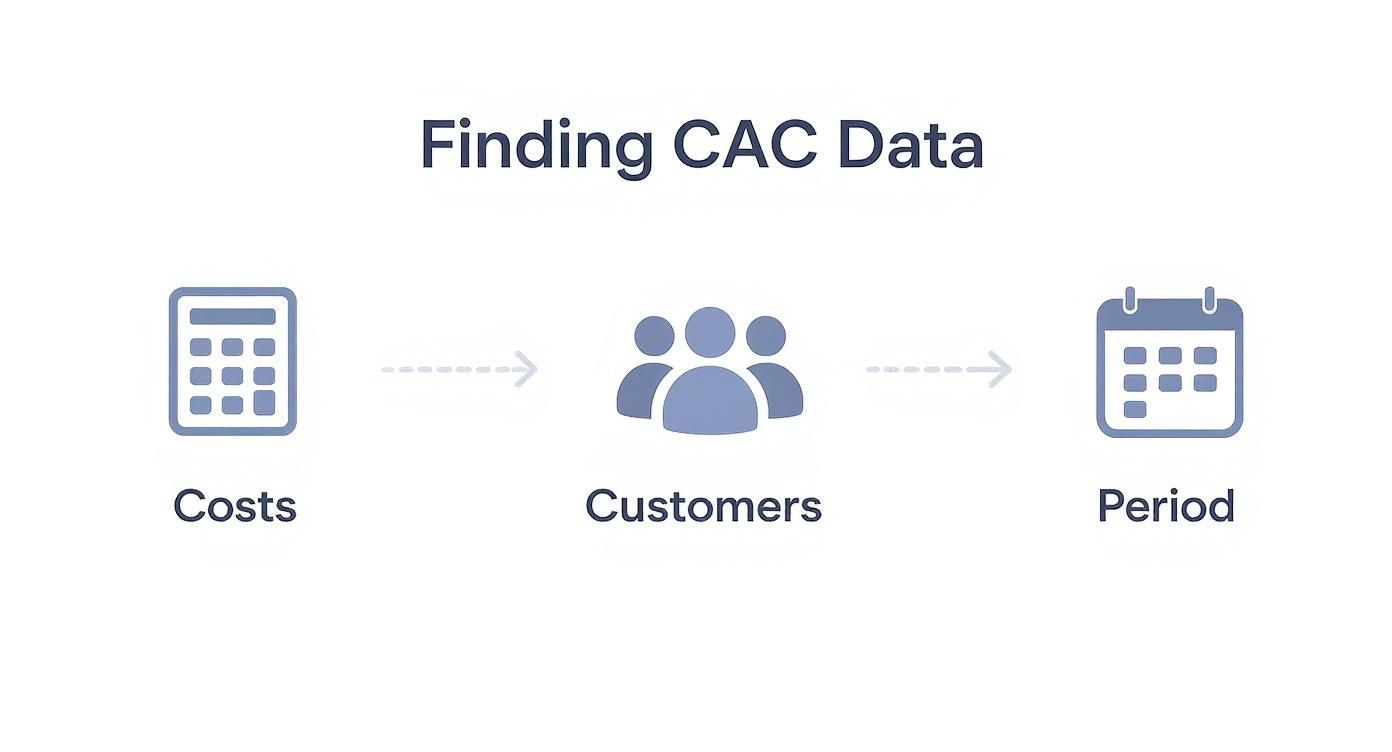
It’s a simple reminder, but an important one: get these three data points right, and you're well on your way to a meaningful CAC calculation.
Setting Up Your Spreadsheet Structure
First things first, open a blank sheet. The initial setup is all about creating a logical, organised layout. Think of it as building the skeleton of your calculator before you start plugging in the juicy numbers.
I always like to create two main sections: one for your Total Costs and another for the final CAC Calculation. Keeping them separate makes the whole thing much tidier and easier to read at a glance.
Start by labelling your columns and rows clearly. It might feel like a minor detail, but trust me, it’s what makes the sheet usable for anyone on your team, not just you.
Here’s a dead-simple structure you can copy:
Column A: Itemised Costs (e.g., "Google Ads Spend," "Marketing Team Salaries," "SEO Software Subscription").
Column B: Cost Amount (£) (This is where the actual numbers will go).
A separate area for the magic: Clearly label cells for "Total Costs," "Number of New Customers," and finally, the big one, "Customer Acquisition Cost (CAC)."
This clean setup is a best practice for any financial model, no matter how simple. It keeps your inputs and outputs distinct.
Inputting Your Cost and Customer Data
With the framework in place, it’s time to fill it in with the data you collected. Go down your list in Column A and pop every single sales and marketing expense into its own row.
Be specific here. Instead of a single, vague line item like "Marketing Spend," break it down. Something like this:
Meta Ads Spend: £1,200
Email Marketing Tool: £50
Freelance Content Writer: £450
Sales Team Commissions: £2,500
This level of detail isn't just for accuracy. Down the line, it lets you pinpoint exactly which costs are pushing your CAC up or down. That's where the real insights are hiding.
Once all your costs are listed, you need to add them up. In the cell you've set aside for "Total Costs," use the simple SUM function. If your costs are in cells B2 through B10, the formula is just . Easy. The best part is it will update automatically if you tweak any of the numbers later.
Just below your total costs, find your "Number of New Customers" cell and type in the final count for the period you're measuring.
Applying the CAC Formula
You’ve done the heavy lifting. The data is gathered, organised, and ready to go. Now for the satisfying part: bringing it all together with the CAC formula. This one simple step transforms your spreadsheet into a proper customer acquisition cost calculator.
In the cell you've labelled "Customer Acquisition Cost (CAC)," you'll enter a basic division formula. It's going to reference the cell with your total costs and the cell with your new customer count.
The real beauty of a spreadsheet calculator is that it’s reusable. Once it's built, you can just copy the sheet for the next month, plug in the new numbers, and get an instant CAC. No need to reinvent the wheel every time.
Let's say your total costs are in cell B12 and your number of new customers is in cell B13. The formula you'd type into your CAC cell (let's call it B15) is simply: .
That's it. The spreadsheet does the maths instantly. For a professional touch, format this cell as currency (£) to two decimal places.
And there you have it—a dynamic tool you can use month after month to keep a close eye on one of your most critical business metrics.
Feeling overwhelmed by the numbers? Let Baslon Digital handle the complexities. We design beautiful, high-converting Wix websites that attract the right customers, helping you lower your CAC and grow your business sustainably.
Making Sense of Your CAC Numbers
Okay, so you've built your customer acquisition cost calculator and plugged in the numbers. Now you're staring at a figure—let's say it's £62 per customer. So what? That number is pretty useless on its own.
The real magic happens when you understand what that figure is telling you about the health and future of your business. Is £62 a fantastic result or a massive red flag? The answer depends entirely on your industry and, more importantly, how much cash each customer brings in over time.
This is where we move from just doing sums to real strategic thinking.
Benchmarking Your CAC Against Industry Averages
One of the first things you should do is see how you stack up against everyone else. Costs can vary wildly between different sectors, so comparing your number to industry benchmarks gives you a much-needed dose of reality.
The UK’s customer acquisition cost landscape is all over the place, depending on the industry.
To give you an idea, we've pulled together some average CAC ranges for a few key UK industries. This should help you see if you're in the right ballpark.
UK Industry CAC Benchmarks
Industry | Average UK CAC Range (£) |
|---|---|
E-commerce | £43 - £74 |
Finance/Fintech | £95 - £160 |
Travel & Hospitality | £30 - £65 |
B2B SaaS | £150 - £400+ |
Retail (Brick & Mortar) | £15 - £50 |
Education | £60 - £120 |
Take these numbers with a pinch of salt, as they're just averages. A niche fashion e-commerce brand, for example, might have an average CAC of £54, while a high-end jewellery retailer could be looking at £74 per customer because of expensive influencer marketing and high return rates.
It's also worth noting that these figures tend to be 15-25% higher in the UK than in the US. You can discover more insights about UK e-commerce benchmarks to get a better feel for where you stand.
If your CAC is way higher than your industry average, it's a clear sign that something in your marketing or sales process is inefficient. On the flip side, if you're well below the average, give yourself a pat on the back—your strategy is likely working wonders.
The LTV to CAC Ratio: The Ultimate Health Metric
While benchmarks are handy, the single most important relationship to get your head around is the one between your Customer Acquisition Cost (CAC) and your Customer Lifetime Value (LTV).
LTV is the total revenue you can expect from a single customer throughout their entire relationship with you. The LTV to CAC ratio answers the most fundamental question in business: "Are my customers worth more than what I'm paying to get them?"
A widely accepted sweet spot is a 3:1 ratio. This means for every pound you spend reeling a customer in, they should generate at least three pounds in revenue.
A ratio of 1:1 or less: Houston, we have a problem. You're losing money with every new customer. This is a huge red flag and needs fixing, fast.
A ratio of 3:1: This is the gold standard. It points to a healthy, profitable, and scalable business where your marketing is delivering a solid return.
A ratio of 4:1 or higher: This is brilliant, but it could also mean you're underinvesting in marketing and missing out on faster growth. Time to open the purse strings?
The LTV:CAC ratio is more than just a metric; it's a strategic compass. It guides your spending, helps you identify your most valuable customer segments, and validates your entire growth strategy.
Calculating this forces you to stop thinking about one-off sales and start focusing on attracting high-value customers who will stick around for the long haul. This ties directly into other key metrics, and if you want to go deeper, you should check out our guide on how to calculate marketing ROI to prove campaign value. Understanding both gives you a much clearer picture of your performance.
Ready to attract customers who are actually worth more than they cost? Contact Baslon Digital today and let's build a Wix website designed to pull in high-value customers and send your LTV through the roof.
Proven Strategies to Lower Your Acquisition Costs
Knowing your CAC is the first step; lowering it is how you truly win. Moving from analysis to action is what separates the businesses that grow sustainably from those that just… spend. Forget the generic advice—let's get into the specific, proven tactics you can implement to make every pound in your marketing budget work harder.
This isn't about slashing your budget, either. It’s about investing smarter, fine-tuning your processes, and building assets that deliver long-term value, effectively taking the pressure off your paid advertising channels.
Sharpen Your Conversion Rate Optimisation
Honestly, the fastest way to drop your CAC is to convert more of the visitors you’re already getting. Think about it: every single visitor represents a cost, so turning more of them into customers directly improves your efficiency without spending an extra penny on ads. This is where Conversion Rate Optimisation (CRO) becomes your best friend.
Start by zeroing in on your landing pages. Are they clear, compelling, and laser-focused on a single call-to-action? Simple tweaks here can yield massive results.
A/B Test Your Headlines: Pit different headlines against each other. Find out which one grabs the most attention and makes people want to read on.
Simplify Your Forms: Be ruthless. Only ask for the information you absolutely need. Each extra field you add is another reason for someone to give up.
Improve Page Load Speed: A slow website is a conversion killer. Seriously, even a one-second delay can send your conversion rates plummeting.
Optimising your website is one of the most powerful levers you can pull; learn more about strategic web design for conversion.
Build Powerful Organic Funnels with SEO
Paid ads give you instant results, but it’s like renting a flat—the moment you stop paying, the traffic disappears. Search Engine Optimisation (SEO) is like buying the house; it's an asset you build over time that keeps generating "free" traffic long after the initial work is done.
A solid SEO strategy attracts highly qualified customers who are actively searching for solutions you provide. This intent-driven traffic often converts at a much higher rate than clicks from disruptive ads, bringing down your average CAC. The trick is to create genuinely valuable content that answers your target audience’s questions.
SEO is the ultimate long game for reducing CAC. By ranking for relevant keywords, you create a sustainable pipeline of high-intent leads that doesn't rely on a constant ad spend.
Launch a Customer Referral Programme
Your happiest customers are your best salespeople. A well-structured referral programme turns your existing customer base into a super low-cost acquisition channel. It’s a win-win: your loyal customer gets a reward, and you get a new customer who is already pre-qualified because they were recommended by someone just like them.
The key is to make it incredibly simple and rewarding. Offer a tangible benefit, like a discount on their next purchase or a cash incentive for every successful referral. This builds on word-of-mouth, which remains one of the most trusted forms of marketing out there.
Form Strategic Partnerships
Here in the UK, brands are paying more than ever to win new business, with CACs hitting all-time highs. For example, a hypothetical e-commerce store, Chic Boutique, recently spent £9,891 on marketing in one quarter just to acquire 63 new customers. That's a staggering CAC of around £157 per customer.
To combat this, brands are shifting towards strategic partnerships, which can dramatically reduce acquisition costs. Look for non-competing businesses that share your target audience. You could collaborate on co-branded content, run joint promotions, or offer bundled services. This gives you direct access to a warm, relevant audience for a fraction of what traditional advertising would cost.
Ready to attract more customers without breaking the bank? Let's talk. Contact Baslon Digital to design a high-converting Wix website that turns clicks into loyal customers and brings your CAC down for good.
Getting Your Calculator Live on Your Wix Website
Right, you’ve built your shiny new CAC calculator. Now what? Leaving it stuck in a spreadsheet is a bit like baking a brilliant cake and then never letting anyone see it. Let's get it onto your Wix website where it can actually be useful.
For anyone using Wix, this is a pretty simple job. You can pop the calculator onto an internal page for you and your team to use as a dashboard, or you could even get creative and use it as an interactive tool to pull in new clients. Think lead magnet!
The trick is to publish your Google Sheet to the web and then use Wix's own HTML embed feature to drop it right onto a page. This means your calculator will be live on your site, and here's the best part: it updates automatically whenever you tweak the numbers in your spreadsheet. No re-uploading, no faff.
How to Embed Your Google Sheet
First things first, you need to grab an embed code from your Google Sheet.
Open up your calculator spreadsheet and head to File > Share > Publish to web. You’ll see a couple of options pop up; make sure you click on the "Embed" tab. It's really important to only publish the specific sheet with your calculator on it, not the whole document, otherwise, you'll end up with all your messy data tabs showing too.
Once you do that, Google will spit out a little bit of HTML code. Copy it.
Now, jump over to your Wix Editor. Find the page where you want your calculator to live and add an HTML iframe element.
This screenshot shows you exactly where you'll be pasting your code inside the Wix editor. It's just a simple copy-and-paste job.
Paste the code you copied from Google Sheets into the box, and that's it—your calculator is now officially live on your website.
Making Your Embedded Calculator Look Good
Once it’s on the page, you'll probably need to do a few little tweaks to make sure it doesn't look like a dog's dinner.
In the Wix editor, play around with the size of the HTML box. You want to drag the corners until the whole calculator is visible without any of those ugly scroll bars appearing. You'll also need to check how it looks on a phone. Switch to the mobile view in the editor and adjust the dimensions there too, so it's still usable on a smaller screen.
Think of it this way: embedding your calculator isn't just about sticking a spreadsheet on a webpage. It's about bringing your core business metrics right into the heart of your digital home base. It makes keeping an eye on performance just another part of your daily workflow, not a separate chore.
By having your CAC front and centre on your Wix site, you're in a much better position to see how it sits alongside your other key business data. If you really want to create a killer performance dashboard, you should look into the best website analytics tools for your Wix site in 2025.
Ready to turn your Wix website into a proper, data-driven engine for growth? Contact Baslon Digital today, and let's have a chat about building a site that not only looks stunning but actually helps you track your metrics and drive down that CAC.
Ready to Actually Optimise Your Marketing Spend?
Okay, let's be real. You now have everything you need to finally get a grip on your customer acquisition costs. Armed with this knowledge and your shiny new calculator, you're making a massive shift. It's the difference between throwing money at marketing and hoping something sticks, and making smart, proactive decisions that actually deliver results.
The secret to sustainable growth isn't a one-time fix; it’s about consistent action. Start tracking your expenses like a hawk. Analyse the results without letting your ego get in the way. Tweak your approach based on what the cold, hard numbers are telling you. It's time to stop letting high acquisition costs call the shots.
So, take that first step. Build the calculator, dive into your data, and start making genuinely smarter marketing choices. The decisions you make this week will pay you back for years, directly shaping your profitability and making sure you don't just survive, but thrive. Your bottom line is waiting for it.
Ready to turn those insights into a high-converting website? Baslon Digital specialises in building stunning Wix websites designed to attract the right customers and drive down your acquisition costs. Visit us at https://www.baslondigital.com to get your project started.
Comments