Master Your Tone of Voice Guidelines: UK Business Guide 2026

Your homepage says one thing. Your Instagram captions sound like a different business. Your enquiry emails swing between polished and awkward. You know your service is good, but the words around it don't feel joined up.
That's where most small businesses start with tone of voice guidelines. Not with a grand brand workshop. With a nagging feeling that the business sounds inconsistent, and that inconsistency is costing trust.
For UK businesses on platforms like Wix, this matters more than people think. Clear voice helps visitors understand what you do, whether they feel they can trust you, and whether they take the next step. A guide doesn't need to be fancy. It needs to help you write your homepage, your service pages, your emails, and your social posts in a way that sounds recognisably like you every time.
Table of Contents
Why Your Brand Needs a Consistent Voice - Brand voice stays steady and tone shifts - Inconsistent copy creates extra work - What it changes for a small business
How to Define Your Core Voice Attributes - Start with voice and tone separately - Choose fewer traits and make them sharper - Test your choices before you lock them in
Creating Your Actionable Tone of Voice Document - Build a guide people will actually open - Add rules that remove doubt - Keep the document connected to real work
Tone of Voice Examples and a Reusable Template - Tone in action before and after - A copy and paste template
How to Apply Tone to Your Website and SEO - Where tone matters most on a small business website - How voice supports SEO without sounding forced
Testing Training and Maintaining Your Guidelines - Train for consistency, not uniformity - Review the guide before the business shifts
Why Your Brand Needs a Consistent Voice
A local service business often looks fine on the surface. The logo is decent. The Wix site is live. Posts go out every week. Then you read the copy across channels and the cracks show. The website sounds formal, the social captions sound chatty, and customer emails read like they were written in a hurry.
That mismatch creates friction. People don't always say, “your tone feels inconsistent”. They just hesitate. They click away. Or they enquire without confidence.

Brand voice stays steady and tone shifts
A lot of that confusion starts with language. UK small businesses frequently fail to distinguish between brand voice and tone of voice, which leads to rigid messaging across different platforms. Voice is your consistent personality. Tone is the situational mood you use depending on context, such as a polished LinkedIn post versus a more relaxed Instagram caption, as explained in Midland Marketing's guide to brand voice and tone of voice.
That distinction matters in practice. A florist can keep a warm, thoughtful voice everywhere while using a different tone for sympathy flowers, wedding packages, and Mother's Day promotions. A consultant can stay expert and clear while sounding more direct on a service page and more conversational in a follow-up email.
A business doesn't need to sound the same in every situation. It needs to sound like the same business.
Inconsistent copy creates extra work
When voice isn't defined, every new piece of writing becomes a fresh decision. You second-guess headlines. Freelancers send drafts that need heavy editing. AI-generated copy sounds polished but strangely generic.
That's why businesses are spending more time refining marketing AI text before publishing. The issue usually isn't the tool. It's the missing house style behind it.
A useful guide reduces that rewrite cycle. It tells you what kind of business you sound like, what language fits, and what crosses the line.
What it changes for a small business
The biggest win is trust. When your homepage, service descriptions, calls to action, and support emails all feel aligned, people get a stronger sense of who you are. That makes the business feel established, even if you're still small.
It also helps internally:
You write faster: Fewer choices means less staring at a blank screen.
Others can help: A VA, copywriter, or team member can follow the same rules.
Your Wix site feels sharper: Consistent wording improves the feel of the user journey from landing page to enquiry form.
Most businesses don't need a massive rebrand. They need a practical set of tone of voice guidelines that stop the drift.
How to Define Your Core Voice Attributes
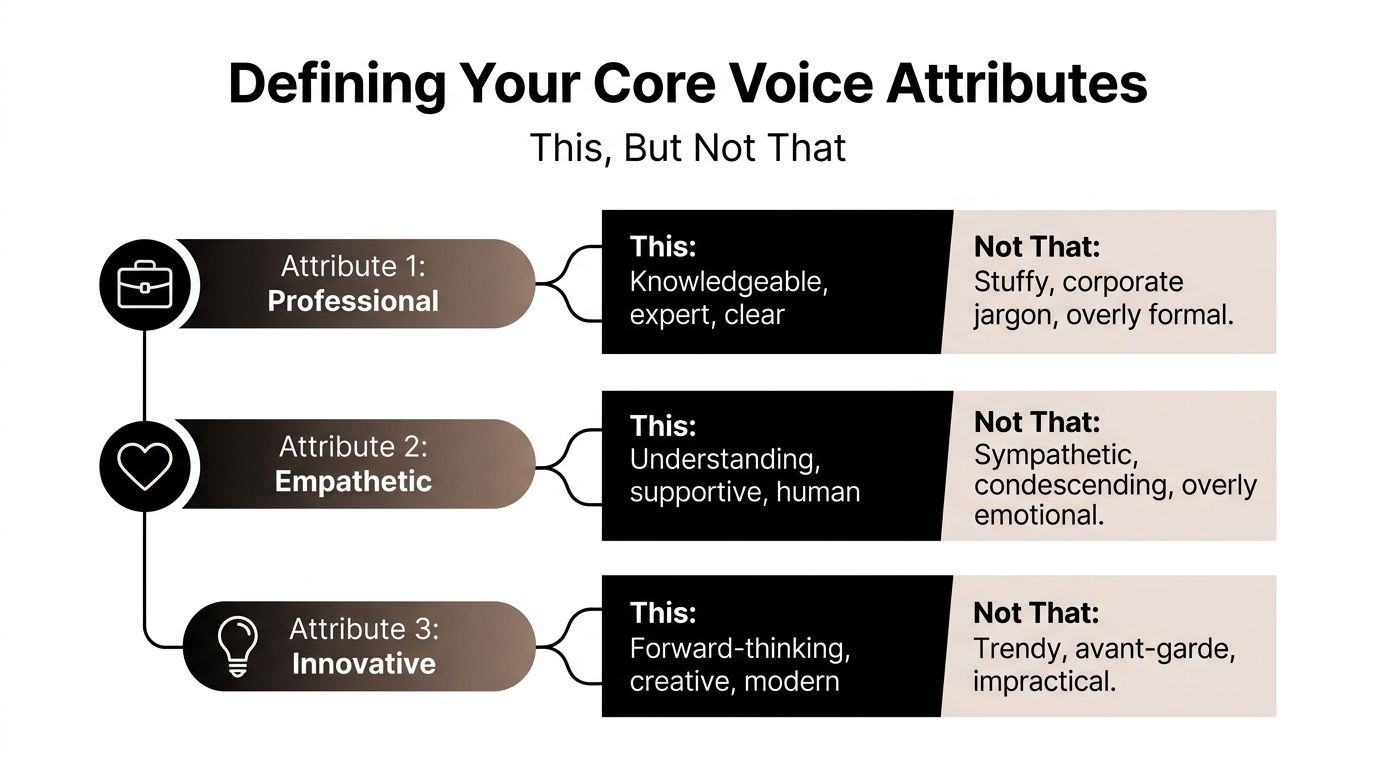
Most tone guides go wrong at the adjective stage. Businesses pick words like “professional”, “friendly”, and “creative”, then leave everyone else to interpret them. That's how one person writes clean, confident copy and another writes stiff corporate filler.
The fix is to make your attributes specific enough to guide choices.
Start with voice and tone separately
Begin with your core voice. This should describe the personality that stays consistent no matter where you're writing. Then consider tone by situation. Your payment reminder shouldn't sound like your welcome email.
A useful framework for this is the four NN/G dimensions: humour, formality, respectfulness, and enthusiasm. UK-based research summarised by Wynter found that testing tone against these dimensions with users on 5-point Likert scales increased message resonance by 32% compared with untested guidelines. The same source recommends choosing no more than 3 primary traits plus 1 to 2 anti-tone words so the guidance stays clear, as outlined in Wynter's tone of voice guide.
Choose fewer traits and make them sharper
A simple exercise works well.
Write down the words you instinctively use about your business.
Cross out anything that could describe almost any competitor.
Keep the three that match how you want customers to feel.
Add an anti-tone to each one.
That creates a clearer rule set. For example:
Professional, not stiff
Empathetic, not over-sentimental
Modern, not trendy
This is also the moment to think about audience definition. If you haven't pinned that down yet, it helps to clarify who you're writing for before finalising the language. This guide to defining your target audience is a useful grounding exercise because voice always lands differently depending on who's reading.
Practical rule: If a tone word doesn't change how you write a sentence, it's too vague to keep.
Another UK-specific consideration is readability. In the UK, tone of voice guidelines often target a maximum reading age of 9 to support accessibility and align with plain English standards, as noted in Girlguiding North West England's tone of voice guidelines. For a small business, that doesn't mean writing like a child's workbook. It means choosing simple, everyday wording over jargon.
Here's a quick example:
“We facilitate outcome-focused digital transformation.”
“We help small businesses improve their websites so more visitors become customers.”
Same intent. Very different clarity.
A short explainer can help if you want another take on finding the right voice balance:
Test your choices before you lock them in
Before you turn your three traits into official guidelines, test them against real copy. Take your homepage headline, your latest Instagram caption, and one customer email. Ask:
Does the writing reflect all three traits?
Does anything sound exaggerated?
Would a customer describe the business using those same words?
You can also give people a short comparison exercise. Show two or three versions of the same message and ask which one feels most like your business. This works especially well with past clients because they already know how you operate.
The strongest attributes feel obvious once you see them. The weak ones need explanation. Keep the obvious ones.
Creating Your Actionable Tone of Voice Document
A tone guide fails when it becomes a branding artefact instead of a working document. If it's full of vague language, buried in a slide deck, or padded out to impress, nobody uses it. The useful version is short, direct, and easy to scan while someone is writing.
Build a guide people will actually open
The best-performing tone of voice guidelines are concise. Aether Agency notes that leading UK brands reach 85%+ tone-of-voice consistency by using practical systems such as training, audits, and regular refinement. The same source says guides longer than 50 pages reduce adoption by 40%, while a 10 to 15 page core document is far easier for teams to use, according to Aether Agency's examples of tone of voice guides.
That should be reassuring for a small business owner. You do not need a giant manual. You need one clean reference document.
A strong structure looks like this:
Brand voice summary: Three core traits and their anti-tones.
Audience notes: Who you're speaking to, what they care about, and what language they already understand.
Channel guidance: How your tone shifts on your website, social media, email, and customer support.
Writing rules: Sentence length, punctuation preferences, grammar choices, formatting habits.
Dos and don'ts: Clear examples of approved and off-brand wording.
Sample rewrites: Before-and-after examples from your actual business copy.
Add rules that remove doubt
This is the part people skip, then regret later. Tone doesn't live in adjectives alone. It lives in sentence construction, punctuation, and vocabulary.
Healthwatch's updated UK guidance takes a firm line on readability. It prohibits the ampersand symbol in general text, using “and” instead except in recognised cases such as “A&E”, and it advises keeping sentences to about 20 words or fewer for clarity, as set out in Healthwatch's tone of voice guidelines.
For small business websites, that translates into practical rules:
Spell out “and”: It looks cleaner and reads more naturally in body copy.
Cut sentence sprawl: If a sentence has three ideas, split it.
Prefer everyday words: “Help” usually beats “assist”. “Use” usually beats “utilise”.
Use active voice: “Book a consultation” is clearer than “A consultation can be booked”.
If your guide doesn't settle common writing disputes, your team will keep having the same debate in every draft.
A simple style guide companion can help here. If you want a broader structure for brand rules beyond voice, this explanation of what a style guide is and why your brand needs one pairs well with tone guidance.
Keep the document connected to real work
A guide hidden in a forgotten folder won't change how you write. Store it where writing happens. That might be your Wix project notes, Google Drive, Notion workspace, or content brief template.
It also helps to connect your tone guide to your wider messaging process. If you're planning launches, campaigns, or public announcements, Press Release Zen's communication plan is a useful reference because it shows how messaging decisions fit into actual business communication, not just brand theory.
One more practical move: add a one-page quick sheet. Include your three voice traits, banned phrases, preferred wording, and a few sample lines. That's the page people will check before publishing.
Tone of Voice Examples and a Reusable Template
Abstract advice becomes useful when you can see the sentence change. A lot of businesses already know their copy feels off. What they need is a concrete example of what “more authoritative” or “more approachable” looks like.
Tone in action before and after
Here's a simple comparison using the same message.
Original Copy | Rewritten with 'Authoritative & Formal' Tone | Rewritten with 'Friendly & Encouraging' Tone |
|---|---|---|
We offer website services for businesses looking to improve their online presence and get better results. | We design and refine business websites that improve clarity, strengthen credibility, and support stronger online performance. | We help businesses build better websites so it's easier for customers to find you, trust you, and take action. |
Contact us today to learn more about how we can help. | Contact us to discuss your requirements and identify the most suitable next steps. | Get in touch and we'll talk through what's working, what isn't, and what to do next. |
Our team is experienced and committed to quality. | Our team brings proven expertise and a disciplined approach to every project. | You'll be working with people who care about getting the details right and making the process feel straightforward. |
The point isn't that one version is “best”. The point is that each version feels intentional.
Good tone of voice guidelines don't just tell you what to sound like. They show you how a sentence should change.
A copy and paste template
You don't need to build your guide from scratch. Start with a draft like this and customise it for your business.
Brand name Our core voiceWe sound:- [Trait 1] but not [anti-tone]- [Trait 2] but not [anti-tone]- [Trait 3] but not [anti-tone] Who we're speaking toOur audience includes:- [Primary customer group]- [Their main concern or goal]- [What they already know and what they don't] How our tone changes by situation- Homepage: [clear, confident, welcoming]- Service pages: [specific, reassuring, direct]- Social media: [lighter, more conversational]- Customer support: [calm, respectful, practical] Writing rules- Prefer short sentences- Use everyday words- Avoid jargon and filler- Use active voice where possible- Write calls to action in plain English Words we like[List preferred terms] Words we avoid[List overused, vague, or off-brand terms] Do- [Example of approved phrasing]- [Example of approved phrasing] Don't- [Example of off-brand phrasing]- [Example of off-brand phrasing] Example rewritesBefore: [insert weak sentence]After: [insert approved version]
A template like that works because it's practical. It leaves room for nuance, but it doesn't drift into branding theatre.
How to Apply Tone to Your Website and SEO
A visitor lands on your homepage, scans the first few lines, clicks to a service page, then hesitates at the enquiry form. That decision often has less to do with your logo or colours than the way the words feel. For a small business website, tone shapes whether people trust you enough to keep going.
Where tone matters most on a small business website
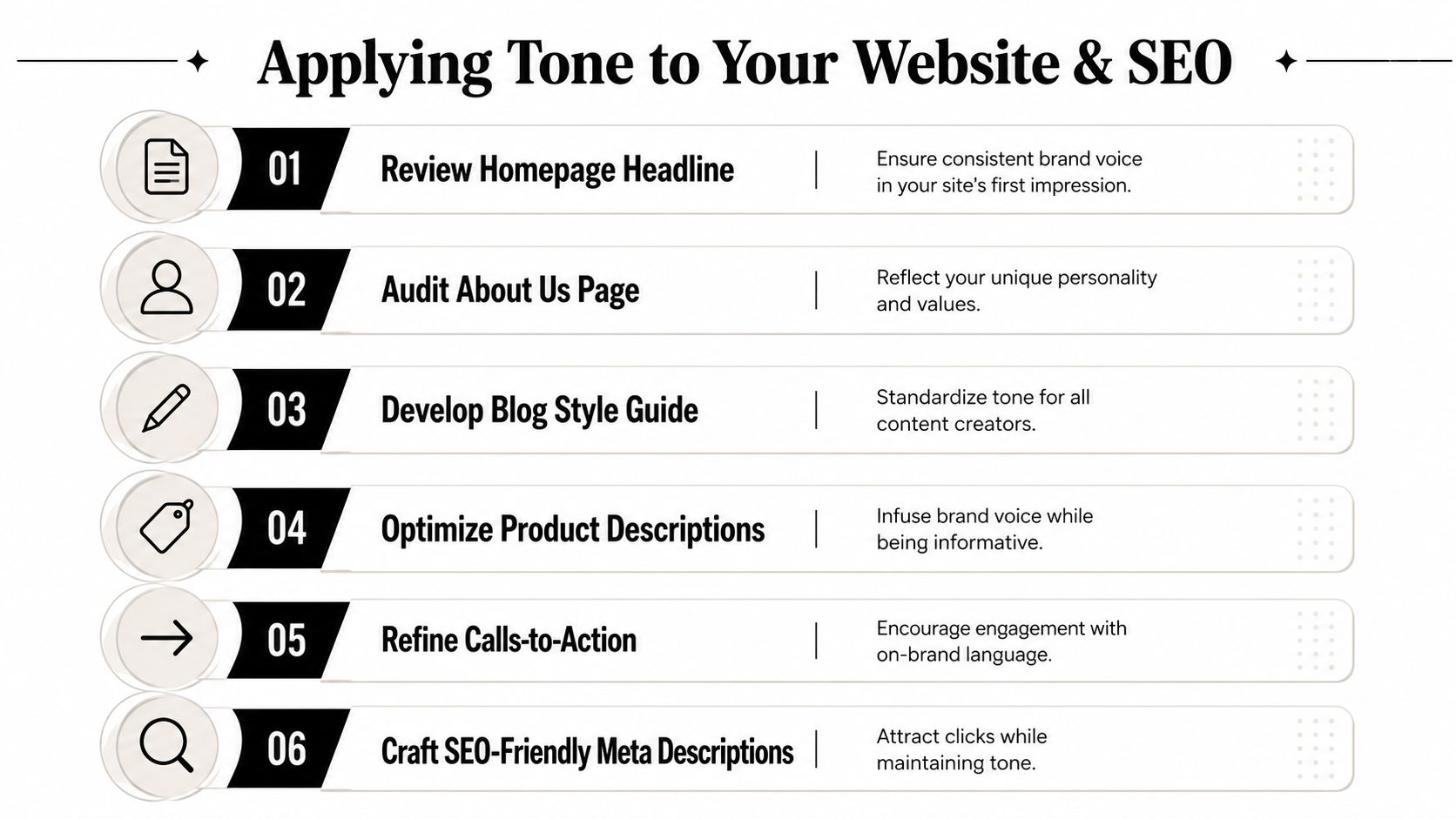
Apply your tone where buying decisions happen, not just in brand statements.
Homepage headline: Say what you do in plain English, with the level of confidence that fits your business.
About page: Sound like the owner or team customers will deal with. A warm, direct tone usually works better than a polished life story.
Service pages: Explain outcomes, process, and limits clearly. UK customers often respond well to copy that is straightforward and low on hype.
Calls to action: Match the commitment to the page. “Book a call” and “Request a quote” set clearer expectations than vague prompts.
Forms and confirmation messages: These moments are easy to ignore, but they affect trust. A short note about response times can reduce drop-off.
For many UK small businesses, plain English is the right baseline. If a sentence sounds strained when you read it aloud, rewrite it. If a customer would need to stop and decode what you mean, simplify it. That matters even more on Wix sites, where business owners often update copy themselves and small edits can quickly make one page sound unlike the rest.
One practical workshop exercise works well here. Open your homepage, one service page, your about page, and your main contact form. Then ask four simple questions page by page:
Does this sound like the same business throughout?
Would a first-time visitor understand it quickly?
Does the wording match the level of trust someone needs at this stage?
Is any sentence trying too hard to sound impressive?
Those checks catch problems fast.
How voice supports SEO without sounding forced
Good SEO copy should still sound like your business. If it reads like it was written for a search engine first, people notice.
Your tone guidelines should shape the parts of the page that affect both rankings and clicks:
Meta titles: Clear wording with the main search term included naturally.
Meta descriptions: Useful, specific copy that gives people a reason to click.
Headings: Descriptive language that reflects what the page covers.
Image alt text: Accurate descriptions, written like a person would describe the image.
Opening paragraphs: A direct answer early on, then supporting detail underneath.
For Wix users, this is a practical advantage. The platform lets you edit page titles, descriptions, headings, slugs, and image settings without much friction. The risk is speed. It becomes easy to publish generic SEO wording across multiple pages. If you want to review those settings properly, this guide to Wix for SEO is a useful companion.
The trade-off is simple. Copy built only around keywords can rank for the wrong reasons and fail to convert. Copy built only around personality can sound great but miss the phrases people search for. The better approach is to use the search term where it helps, then write the surrounding copy in your normal voice.
For example, “Wix Website Design for London Small Businesses” is a sensible page title because it is specific and searchable. The sentence below it should then sound human, such as explaining who the service is for, what the process includes, and what happens next.
If your pages get stuck in review because everyone wants to tweak the wording, set a lighter process so good copy can go live. A clear tone guide helps, and a better way to streamline content approval helps too.
SEO reminder: Search gets the click. Tone helps turn that visit into an enquiry.
Testing Training and Maintaining Your Guidelines
A small business usually notices tone problems at the same point. The website sounds like the founder, the latest blog post sounds like ChatGPT, and the last sales email reads like it came from a different company altogether. That gap is usually a training problem first, not a writing problem.
A tone guide only helps if people can use it under normal working conditions. That matters even more if you run a lean team, rely on freelancers, or update your Wix site yourself between client work. In practice, the best guidelines are the ones a real person can check in five minutes before publishing a page, post, or email.
Train for consistency, not uniformity
Consistency does not mean every sentence should sound identical. It means customers should recognise the same business whether they land on a service page, read a follow-up email, or see a Google Business Profile update.
For small UK businesses, I recommend a light system people will continue to use:
Give every new writer a short walkthrough: Show them the guide, your best-performing examples, and one weak example with notes on what to fix.
Train with live copy, not theory: Use your actual homepage, enquiry emails, service pages, and FAQs. This works far better than abstract brand language.
Set a monthly review: Check a small sample of published content and mark where the tone drifted. Look for patterns, not one-off mistakes.
Update the guide every quarter: Add fresh examples from new services, seasonal campaigns, or common customer questions.
Include AI rules: If you use AI to draft copy, state what it can help with and what still needs a human edit. This saves time and protects quality.
One practical tip. Add a short approval checklist beside your guide. On Wix projects, that might include page title, H1, intro paragraph, call to action, and image alt text. It keeps reviews grounded in the parts that affect both brand clarity and SEO, rather than endless debate over minor wording preferences.
If content keeps stalling because too many people want to edit the same paragraph, fix the workflow as well as the writing rules. A clearer process to streamline content approval can reduce delays without lowering standards.
Review the guide before the business shifts
Your voice should stay recognisable, but your guidelines should not stay frozen.
New services, new locations, and new sales channels often expose weak spots. A company serving local clients across Leeds, Bristol, or London may need examples that reflect regional wording differences without slipping into clichés. A business that starts publishing more landing pages on Wix may also need clearer rules for headings, search snippets, and calls to action so SEO copy still sounds like the brand.
Watch for a few common signs that your guide needs attention:
Website pages feel polished, but emails feel blunt
Social captions sound friendly, but service pages drift into jargon
Different team members interpret “professional” in different ways
New offers have no approved examples, so everyone improvises
When that happens, do not rewrite the whole document. Tighten definitions, swap in better examples, and remove any rule people keep misunderstanding.
A useful review question is simple. Does this still sound like the business you are now, and does it still help the reader take the next step? If not, revise it while the gap is still small. That is how tone guidelines stay useful, especially for small businesses that need a brand voice they can apply quickly across websites, SEO content, emails, and day-to-day updates.
Comments