How To Write SEO Content That Ranks and Converts

Updated: Jan 29
Before you even think about writing a single word, you need a plan. Creating content that actually ranks on Google isn’t about just picking a topic and hoping for the best. The real secret is getting the foundation right first—understanding what people are searching for and, crucially, why they’re searching for it.
Nail this part, and you're not just writing an article; you're building a magnet for the right kind of traffic.
Laying the Groundwork for High-Ranking Content
Great content doesn't happen by accident. To really increase website traffic organically, you need to move from a vague idea to a data-driven strategy. This all starts with keyword research.
Think of it as digital eavesdropping on your potential customers. It’s the process of finding the exact words and phrases your ideal clients are typing into Google. You’re not guessing what they want; you’re using tools to uncover their exact language.
This step is non-negotiable. You could write the most mind-blowing, perfectly crafted article in existence, but if nobody is searching for that topic, it’s just going to sit there collecting digital dust. No searches, no traffic. Simple as that.
Finding the Right Keywords for Your Business
If you’re a small business in the UK, your keyword strategy needs to be smart. Aiming for a monster term like "London web design" is a bit like trying to win a shouting match at a rock concert—it’s incredibly competitive and you probably won't be heard.
A much better approach is to focus on longer, more specific phrases known as long-tail keywords. These are the queries that show someone knows what they want.
Instead of battling for "London web design," you could target things like:
"Wix website designer for small business London"
"Affordable ecommerce website design UK"
"How much does a website cost for a freelancer"
See the difference? These people are much closer to making a decision. They have a specific problem and are looking for a very specific solution.
Your goal isn't just to find any keyword, but the right keyword. It needs to have a decent search volume, be super relevant to what you sell, and give you a realistic shot at ranking on page one.
Decoding the Why Behind the Search
Okay, so you’ve got a list of potential keywords. What next? Now you have to figure out the search intent—the "why" behind the search query. This is the user's ultimate goal, and trust me, Google is frighteningly good at understanding it.
Matching search intent is everything. If you get it wrong, your content will miss the mark completely, no matter how amazing it is.
There are generally four types of search intent you'll come across:
Informational: The user wants to learn. Think "how to write seo content" or "what is a meta description." These queries need educational content like how-to guides and in-depth articles.
Navigational: The user wants to find a specific site, like searching for "Baslon Digital blog." There's not much to do here unless it's your brand name.
Commercial Investigation: The user is weighing up their options. They're searching for things like "best Wix design agencies UK" or "Wix vs WordPress for small business." Comparison posts and "best of" lists work wonders here.
Transactional: The user is ready to pull out their wallet. They're typing in "hire Wix developer London" or "Wix maintenance plan pricing." This intent is best served by your service or product pages.
Not sure what the intent is for your keyword? Just Google it. Seriously. Look at the top results. Are they blog posts? Service pages? Videos? Google is literally showing you what it thinks users want to see. Your job is to create something that fits that mould, but is ten times better.
For a bit more on the basics, our guide on search engine optimisation for beginners made simple is a great place to start.
Now that we’ve got the theory down, let’s get practical and start building out your content plan.
Building Your Content Blueprint for Success
You’ve done your keyword research and figured out what your audience is really looking for. What’s next? Building the skeleton of your article.
Trying to write SEO content without an outline is like building a house without a blueprint. You might end up with something that looks like a house, but it'll probably be wobbly, confusing, and ready to fall down at the slightest gust of wind.
A solid outline is your road map. It makes sure you hit every important point, takes your reader on a logical journey, and gives Google a clear picture of what your content is all about. For a small business, this is the step that turns a massive topic into manageable chunks.
Structuring Your Ideas with Headings
The backbone of your outline is your headings—specifically, your H2s and H3s. These aren’t just for making the page look neat; they create a hierarchy that helps people and search engine bots understand your content in a flash.
Your article title is your H1. You only get one, so make it count.
The main sections of your article will be your H2s, and any sub-topics within those sections become your H3s.
Let's say your main keyword is "how to write seo content." Your H2 headings might look something like this:
Then, under an H2 like , you could slot in some H3s for the nitty-gritty details:
This structure makes your article easy to skim, which is a massive win since most people scan online content before they decide to read it properly.
Creating a detailed outline with H2s and H3s before you write a single paragraph is the single best way to prevent writer's block. It organises the entire piece, making the writing process feel more like filling in the blanks.
Weaving Keywords into Your Headings
One of the sneakiest—and most effective—ways to signal your topic to Google is to sprinkle your target keywords into your headings. It's a classic on-page SEO move that tells search engines exactly what each section covers.
But here’s the trick: you have to do it without sounding like a robot. Readability for actual humans always comes first.
Imagine you're a London-based caterer and you’re targeting the keyword "small wedding catering London."
Bad, keyword-stuffed H2:
Good, natural H2:
The second one just flows better, right? It uses all the key concepts ("catering," "small weddings," "London") without awkwardly shoehorning the exact keyword phrase in. You should also mix in synonyms and related terms into your subheadings to show Google you’re an expert on the topic.
As you build your outline, think of each heading as a mini-answer or a clear signpost guiding the reader. Of course, knowing who you're writing for is just as critical. For a deeper dive, check out our guide on how to create user personas that drive results, which will help you sharpen your content even more.
Writing Content That Engages Both People and Search Engines
You’ve got your keywords sorted and a solid blueprint in hand. Now for the fun part: turning all that planning into actual content. This is where the magic happens, where you write words that don't just tick Google's boxes but actually connect with a real human being.
It’s a bit of a balancing act, really. You need enough structure for search engines to get what you’re about, but it has to flow naturally for the person reading it. Let's get into how you pull that off.
Crafting Your Shop Window: The Title and Meta Description
Your title tag and meta description are the first things anyone sees in the search results. Think of them as your digital shop window—they need to be interesting enough to make someone want to step inside. Even the most amazing article can fall flat with a boring title.
In the UK market, getting these right can seriously boost how many people click on your link. One deep dive found that title tags between 40-60 characters hit the sweet spot, pulling in a massive 33.33% organic click-through rate. When you consider that organic search brings in 53% of all web traffic for UK businesses, you can see why this is a big deal. You can get more details on these crucial UK digital marketing stats for 2023 on creativemarketingltd.co.uk.
So, how do you write titles and metas that work?
Lead with your keyword: Shove your main keyword as close to the start of the title as you can. It tells Google and the reader exactly what the page is about, instantly.
Use numbers and action words: Things like "10 Proven Ways to..." or "How to Finally Master..." just feel more concrete and valuable.
Make them curious: Ask a question. Make a bold claim that your article backs up. Give them a reason to click.
Sum up the value: Your meta description is your 155-character elevator pitch. Tell them precisely why your link is the one they need to click on.
Building Clean URLs and Smart Internal Links
Once someone clicks, other little SEO details start to matter. Your URL, for instance. A clean, simple URL is just easier for everyone—people and search engines included—to understand.
A messy URL might look like . Yuck. A much better, SEO-friendly version is . It’s short, says what it is, and even has keywords. Simple.
Next up is internal linking—basically, linking to other relevant pages on your own website. This is an absolute powerhouse tactic for a few reasons.
It helps search engines find all your other great content and see how it all fits together.
It passes around "link equity" (think of it as authority or SEO juice) across your site.
Crucially, it keeps people on your website longer by pointing them towards more helpful stuff.
Honestly, internal linking is one of the most underrated parts of SEO writing. A strong link from a page that’s already doing well can give a brand-new article a serious leg up in the rankings.
Prioritising Readability and Keeping People Hooked
Look, all the technical SEO tricks in the world won’t save you if your content is a giant, unreadable wall of text. People don’t read online; they scan. Your job is to make your content as easy to scan as possible.
This means you need to be ruthless about breaking up your text. Embrace the whitespace.
Short paragraphs are your friend: Aim for one to three sentences, max. It gives the text room to breathe and feels way less intimidating.
Use bullet points and lists: They are perfect for breaking down complicated ideas or listing out steps, features, or benefits.
Use your headings: Like we talked about in the outlining stage, H2s and H3s are signposts that guide your reader through the article.
Be smart with bold text: Bolding key phrases or important numbers makes them pop for scanners, pulling their eyes to the most critical bits of info.
Your introduction is your hook. You have just a few seconds to grab the reader by addressing their problem and promising a solution. Ditch the long, waffly intros and get straight to it.
Finally, every piece of content needs a point. What should the reader do next? That’s where your call-to-action (CTA) comes in. It needs to be a clear, direct instruction, like "Book a free consultation" or "Download our guide." A good CTA turns someone from a passive reader into an active lead.
Publishing and Optimising Your Content on Wix

You've done the heavy lifting—the research, the planning, the writing. Now it’s time to get your masterpiece live on your Wix site. But hold on. Just hitting 'publish' and calling it a day is a massive missed opportunity.
You need to translate all that brilliant SEO strategy into the specific settings inside the Wix Editor. This isn’t just a final tick-box exercise; it’s how you tell Google precisely what your page is about and who it’s for. Think of it as carefully arranging your products in a shop window after spending weeks designing them.
Nailing Your SEO Basics in the Wix Editor
Thankfully, Wix makes this part pretty straightforward. Once you’re in the blog post editor, your command centre is the 'SEO' tab tucked away in the side panel. This is where the magic happens for your most important metadata.
Here, you can pop in the title tag and meta description you crafted earlier. It’s also where you can clean up your URL slug. Wix often generates a long URL from your headline, but you should always chop it down to just your primary keyword for a clean, focused address.
For example, if your blog title is "My Top 10 Tips for Writing Great SEO Content in 2024", your URL slug should be something like . It's a tiny tweak that makes a big difference for both users and search engines.
Quick tip: The settings in the Wix SEO panel override what's on the page itself for Google's search results. This means your SEO title can be different from your on-page H1, giving you a chance to write a headline specifically engineered to get clicks from the search results page.
Structuring Content with Headings and Images
Getting your structure right in the Wix Editor is just as important for readability as it is for SEO. Your article's main title automatically becomes the H1 heading, so you just need to worry about organising the rest of the text with H2s and H3s.
Use the text formatting toolbar to assign these heading tags to the section titles from your outline. This creates a clean hierarchy that helps search engines understand your content's structure and makes it a breeze for readers to scan.
Image optimisation is another area that’s easy to get right but so often overlooked. Every single image you upload to your Wix blog needs descriptive alt text. Alt text does two crucial things:
It helps visually impaired users understand your content by describing the image via screen readers.
It gives search engines context, helping your images show up in Google Image searches.
Don’t just write "image1". Be specific. For a picture of a coffee shop, you’d write something like "cosy London coffee shop with wooden tables and exposed brick walls". To explore more ways to get your site noticed, check out these effective strategies for Wix SEO success. It’s a small effort that adds up.
By paying attention to these details within Wix, you're making sure every piece of content you publish is perfectly positioned to perform.
Tracking Your Performance and Refining Your Strategy
Hitting ‘publish’ feels like the finish line, but really, it’s just the starting pistol. SEO isn't a "set it and forget it" kind of deal. The real magic happens when you start paying attention to what’s working, what’s flopping, and then use that intel to make your next piece of content even smarter.
This last step is all about measuring and tweaking. If you're not tracking performance, you’re basically just throwing content at the wall and hoping something sticks. With a little data, you can stop guessing and start building a predictable way to bring in the right kind of customers.
Essential Tools for Measuring SEO Content
You don't need some ridiculously complex analytics suite to get started. Honestly, for most freelancers and small businesses, two free tools from Google are more than enough to see what’s going on.
Google Search Console (GSC): Think of this as your direct line to Google. It tells you exactly which keywords your pages are showing up for, how many eyeballs are seeing them (impressions), and how many people are actually clicking through to your site (clicks). It's non-negotiable.
Google Analytics (GA4): This tool takes over once a visitor lands on your site. GA4 shows you what people do after they arrive—how long they stick around, where they go next, and whether they do important stuff, like filling out your contact form.
These two work together to tell the full story, from a person's initial Google search right through to them becoming a potential customer.
Key Metrics That Actually Matter
It’s way too easy to get lost in a sea of data. The trick is to focus on a handful of metrics that give you clues on how to write better content.
Don’t just stare at traffic numbers. Your job is to play detective and figure out why the numbers are changing. Seeing lots of impressions but hardly any clicks? That’s not a content problem; that’s a boring headline problem.
Let’s break down what to watch and what it’s telling you.
Metric | Where to Find It | What It's Telling You |
|---|---|---|
Organic Traffic | Google Analytics | This is the big one: how many visitors are coming from search engines. It's your top-level sign of whether your SEO efforts are paying off. |
Keyword Rankings | Google Search Console | This shows the specific search terms your content is ranking for and where it sits on the results page. Are you on page 1 or page 10? |
Click-Through Rate (CTR) | Google Search Console | The percentage of people who see your page in search results and bother to click. A low CTR is a huge red flag for a weak title or meta description. |
Bounce Rate/Engagement Rate | Google Analytics | This reveals if your content delivers on its promise. A high bounce rate means people are landing on your page and leaving immediately—a sign of a mismatch. |
Once your content is out in the wild, knowing how it’s doing is crucial. To really get into the weeds, you can learn how to truly measure content performance like a pro.
Turning Insights into Action
Data is totally useless if you don't do anything with it. The final piece of the puzzle is using what you've learned to create a feedback loop where you're always getting better. This is how you build a powerful content engine for your business over time.
Based on what you find, here’s what you can do next:
Update and Refresh: Got an old post with high impressions but a pathetic CTR for a keyword you care about? Go back and rewrite that title and meta description. Make it irresistible.
Expand and Improve: Is a particular post seeing a high bounce rate? It’s probably not giving people the depth they wanted. Check out the top-ranking articles for that keyword and see what you missed. Add new sections to make your content the most thorough resource out there.
Fuel Future Content: Have you noticed you’re starting to rank for a keyword you didn’t even mean to target? That’s gold. Your audience is literally telling you what they want from you. Create a brand new, dedicated article that dives deep into that topic.
By regularly checking in on your performance and refining your game plan, you stop being just another person writing articles. You start building a strategic asset that consistently brings your business results.
Burning Questions About SEO Content Writing
Diving into SEO writing can feel like you’ve been handed a puzzle with half the pieces missing. If you’re a freelancer or small business owner in the UK, you’ve probably got a million questions swirling around. Let's clear the fog.
These aren't just textbook answers. This is real talk, based on years of getting our hands dirty and helping businesses just like yours actually get found on Google. Think of this as your personal cheat sheet for those nagging SEO questions.
How Often Should I Be Pumping Out New SEO Content?
Forget the content treadmill. Consistency beats frequency every single time. It's far better to publish one brilliant, well-researched article every week or two than to churn out four mediocre posts a month just for the sake of it.
Google loves seeing a site that's alive and kicking with fresh, valuable information. A regular publishing rhythm tells search engines that you're a reliable source worth paying attention to.
The real goal is to find a schedule you can actually stick with long-term. A steady drumbeat of quality content is way more powerful for your SEO than a frantic burst of activity followed by radio silence.
SEO is all about momentum. A consistent publishing schedule is like a constant stream of new lottery tickets—each one is a new chance to rank and shows Google you’re a dependable resource.
Seriously, How Long Does It Take for SEO Content to Rank?
Patience is the least glamorous but most essential tool in SEO. This is a marathon, not a sprint. You're looking at anywhere from three to six months—and sometimes even longer—to see significant movement. I know, it feels like an eternity, but it's completely normal.
A few things can speed this up or slow it down:
Your Website's Clout: A brand-new site is starting from scratch, while an established one has a head start.
Keyword Competition: Trying to rank for super-competitive terms is like trying to get a table at The Ivy on a Saturday night. It takes time.
Content Quality: Genuinely amazing, helpful content gets noticed faster. No shortcuts here.
You might see little glimmers of hope early on, but real, lasting results come from playing the long game. Keep creating killer content for your audience and use tools like Google Search Console to keep an eye on your progress. Don't throw in the towel if you're not on page one in month one.
Can I Just Get AI to Write All My SEO Content?
Hold up. While AI tools are brilliant for brainstorming, knocking out an outline, or even drafting a section or two, letting them write your entire article is a massive mistake. Google is getting smarter, and its quality guidelines now scream about Experience, Expertise, Authoritativeness, and Trustworthiness (E-E-A-T).
AI-generated text is often flat. It lacks the personal stories, the unique perspective, and the genuine insight that makes a reader trust you. It can spit out facts, but it can't create that human connection that actually convinces someone to stick around.
Think of AI as your co-pilot, not the pilot. Let it handle the boring bits to speed things up, but a human absolutely needs to be in the driver's seat to add the personality, fact-check, and inject the soul that makes your content worth reading.
What’s a Bigger Deal: Internal or External Links?
Ah, the classic debate. The truth is, it’s not an either/or situation. They’re both critical, but they do completely different jobs. You need a healthy mix of both for a solid SEO strategy.
Here’s a simple way to think about it:
Internal Links (linking to other pages on your site): These are the hallways and doors inside your house. They connect everything, help spread ranking power ("link equity") through your site, and guide your visitors from one piece of content to the next. You have total control over these.
External Links (linking to other reputable sites): These are like citing your sources. They back up your claims with evidence, showing Google you’ve done your research and boosting your content's credibility.
First, focus on building a strong internal linking structure so your own content is neatly connected. Then, sprinkle in relevant, authoritative external links to support any stats, data, or big claims you make.
Time To Start Writing Content That Actually Grows Your Business
Alright, you've got the complete blueprint. Now you know how to write SEO content that doesn't just sit there but actively pulls in the right kind of audience and helps you hit your business goals.
The secret? Stop learning and start doing. Seriously. Pick one topic. Just one. Do the keyword research, map out your outline, and write like you're talking directly to your ideal customer.
This simple workflow is the best way to think about the creation stage:
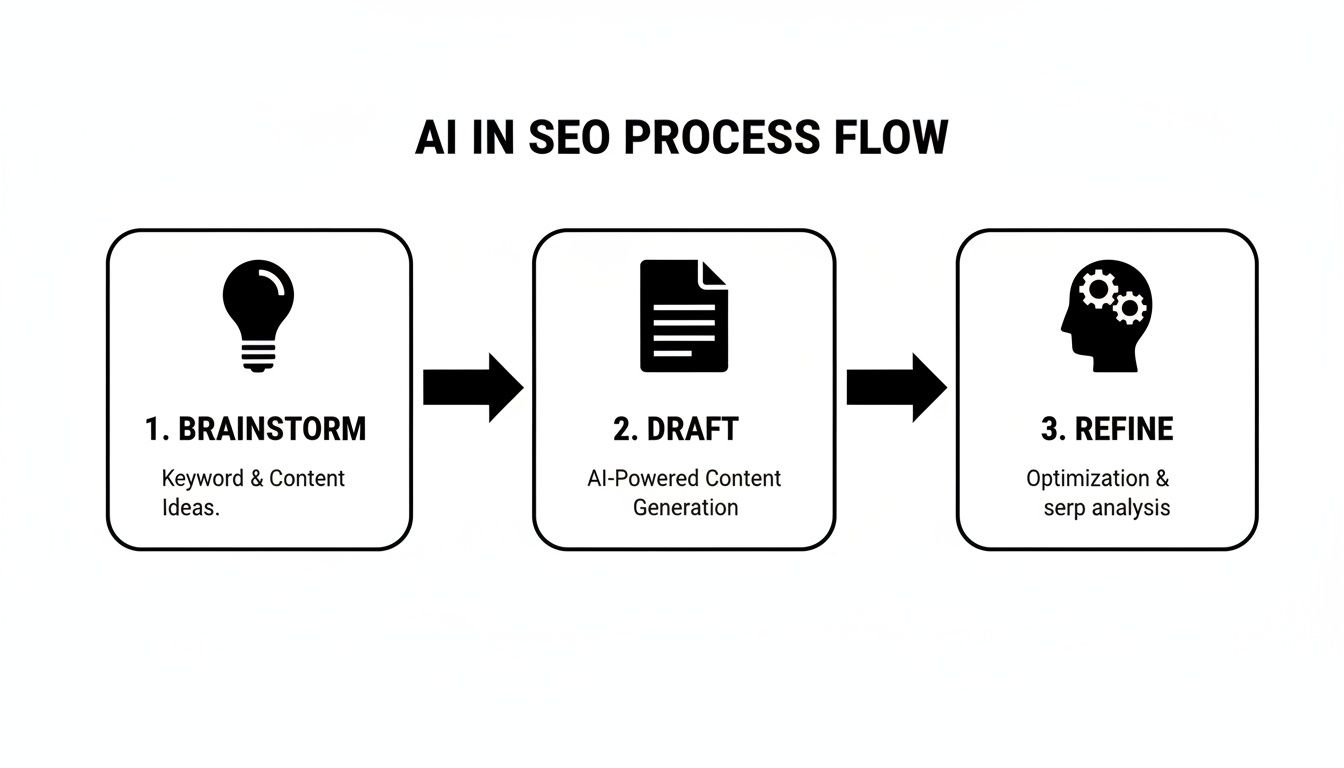
Notice the final step is always human refinement. That's non-negotiable. By putting these strategies into practice consistently, you'll be building one of the most powerful, long-term assets for your business.
Feeling inspired but need a hand bringing your content strategy to life? The expert team at Baslon Digital is here to help you turn these insights into rankings. Take a look at our Wix website design services and let's chat about growing your business.
Comments