Guide to cost of making a website: UK pricing and budgeting

Trying to figure out how much a website costs in the UK can feel a bit like asking, "How long is a piece of string?" The honest answer is that a simple DIY project could set you back less than £500, while a fully custom-built site from a professional agency can easily climb to £10,000 or more.
It all boils down to what you need, the features you can't live without, and who you get to build it.
Your Quick Guide to UK Website Costs
Let's be honest, the massive range in website pricing is enough to make anyone's head spin. One person tells you it costs a few hundred pounds, the next quotes you thousands. What gives?
Think of it like building a house. You could grab a flat-pack kit and assemble it yourself for a minimal cost – that's your DIY website builder. Or, you could hire a skilled contractor to manage the whole project for you (a freelancer). For a truly bespoke home, you'd bring in an architectural firm to design and construct it from the ground up (that’s a web design agency).
Each route gets you a house, but the investment, quality, and your own level of effort will be worlds apart. Your website is no different.
Finding Your Place on the Pricing Spectrum
To give you a clearer picture of where your project might land, this chart breaks down the typical investment for each approach.
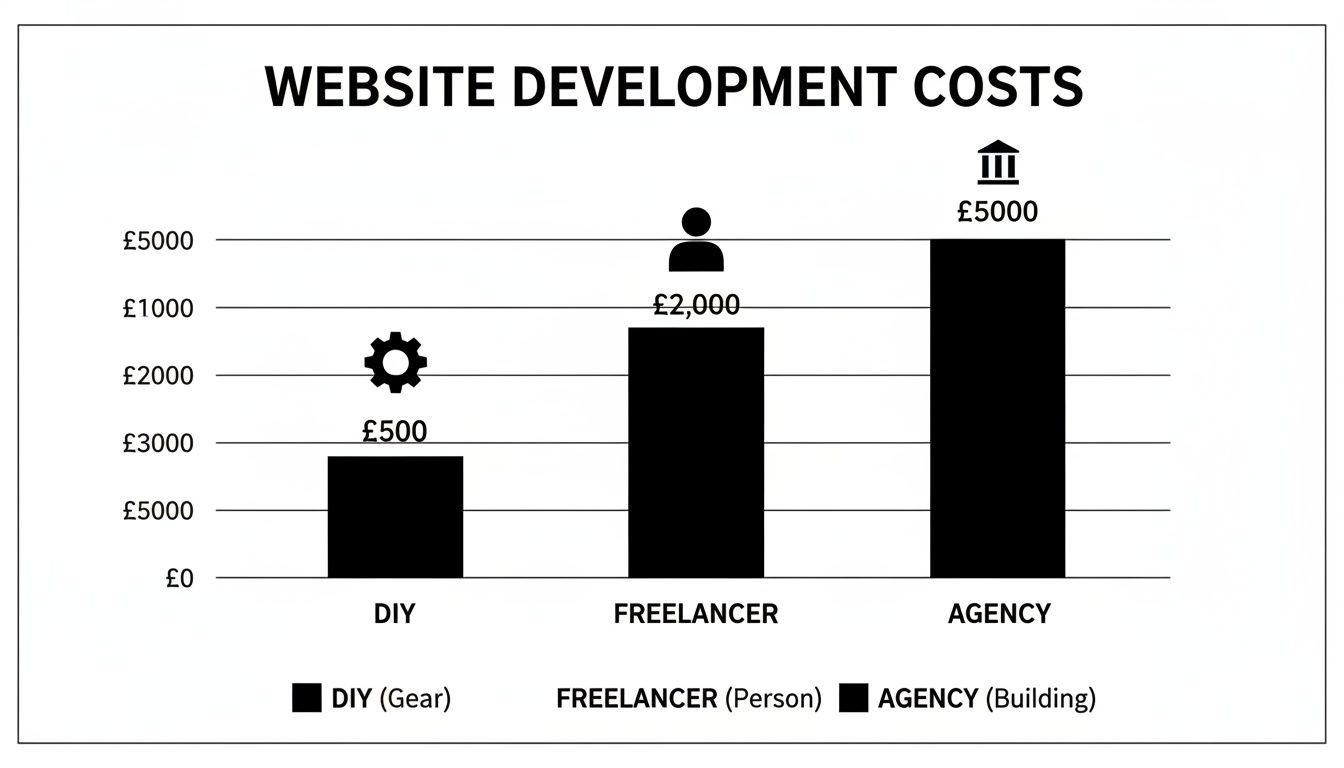
As you can see, deciding whether to go DIY, hire a freelancer, or partner with an agency is the single biggest factor that will shape your initial budget.
Estimated Website Build Costs in the UK at a Glance
To make things even simpler, here’s a table that breaks down those costs based on the most common types of websites we see. Think of it as a quick financial snapshot to help you benchmark your project right from the start.
Website Type | DIY (e.g., Wix, Squarespace) | Freelancer Build | Agency Build (e.g., Baslon Digital) |
|---|---|---|---|
Simple Brochure Site | £200 - £800 | £1,000 - £3,000 | £3,000 - £8,000 |
Small Business Site | £500 - £1,500 | £2,500 - £6,000 | £5,000 - £12,000 |
E-commerce Store | £800 - £2,500 | £4,000 - £10,000 | £8,000 - £25,000+ |
These figures should give you a realistic idea of what to expect as you start planning. Remember, you're not just buying a website; you're investing in your business's front door on the internet.
Ready to build a professional website that doesn't just look good but actually delivers results? Contact Baslon Digital today for a free consultation and let’s have a chat about your project.
Budgeting for a Small Business Website
For any small business in the UK, your website is your digital front door. Seriously. It’s often the first handshake a potential customer has with your brand, making it an absolutely critical tool for building trust, showing off what you do, and bringing in new business. This kind of site is often called a 'brochure' website—a professional online presence that works its socks off for you, 24/7.
Trying to figure out the cost is a bit like planning to open a physical shop. Your domain name is the address on the high street, the hosting is the plot of land it sits on, and the design is your carefully crafted storefront and interior layout. Each piece needs the right investment to create an experience that makes visitors want to stick around.
Deconstructing the Core Costs
So, let's pull back the curtain and see exactly where your money goes when building a professional small business website. While every project has its own quirks, the fundamental bits and bobs are pretty consistent.
This initial investment isn't just a list of charges on an invoice; these are the actual building blocks of your digital reputation. They cover all the essential services that take your vision from a scribble on a napkin to a fully functioning online asset.
Here’s a look at the main cost areas:
Domain Name: This is your website's unique address (e.g., yourbusiness.co.uk). It’ll usually set you back £10 - £20 per year, making it one of the smallest but most vital expenses.
Web Hosting: If the domain is the address, hosting is the actual space where your website's files live. A solid, reliable hosting plan for a small business will be in the ballpark of £100 - £300 per year.
Website Design and Development: This is the big one. It covers the visual layout, the user experience (UX), and the technical build of the site itself.
Content Creation: This means writing snappy, persuasive text and finding high-quality images that tell your brand's story and get your message across.
Essential Features: Think contact forms, service pages, and an 'About Us' section—the non-negotiables for engaging with customers.
Realistic Price Ranges for Small Businesses
Right, the million-dollar question: what’s a realistic budget for a small UK business? While you can certainly go the DIY route to keep costs down at the start, bringing in a professional ensures you get a high-quality, reliable site that actually works.
In the UK, a professionally built website for a small business typically costs between £2,000 and £10,000. This is a great entry point for freelancers and startups who need a proper online presence without emptying the bank account. This price range usually gets you a 5-10 page site, complete with contact forms, a polished design, and other essential features. It’s the perfect fit for a local café owner or an independent consultant in London who needs a site to showcase their services and capture leads. You can explore more about UK web development pricing to see how these numbers stack up.
Here's a common mistake: seeing a website as just another expense. A well-designed site is an investment in your company's growth. It generates leads and builds credibility around the clock. It's a marketing asset that pays for itself over time.
The Agency Advantage for Small Budgets
You might think hiring an agency is completely out of reach for a small business, but specialist agencies can offer incredible value. Working with a dedicated Wix agency like Baslon Digital, for instance, gives you the best of both worlds.
We tap into the power and flexibility of the Wix platform to deliver a premium, custom-feel website that drives real business growth—but without the eye-watering price tag that often comes with fully custom-coded sites. This approach gives small businesses access to top-tier design and functionality while keeping the cost manageable and predictable.
At the end of the day, budgeting for your website means understanding you're investing in a powerful tool for growth. It’s about setting aside funds not just for a launch, but for creating a lasting digital asset that will serve your business for years to come.
Ready to chat about creating a stunning and effective website that fits your budget? Book a free discovery call with Baslon Digital today and let's bring your vision to life.
The Investment for an E-commerce Store
If a small business website is a digital front door, then an e-commerce store is the full retail operation, complete with tills, a stockroom, and security. It’s not just a place to browse; it’s a complex machine built to handle transactions, manage stock, and give customers a shopping experience so smooth they barely notice it.
Moving into online sales means your website has to do a lot more than just look pretty. It needs to securely process payments, show off your products in their best light, and handle customer data with care. These extra layers of functionality are what turn a simple brochure site into a money-making online shop, and they’re the main reason the price tag is higher.
Breaking Down E-commerce Build Costs
When you start selling online, several new pieces of the puzzle come into play that a standard business site just doesn't need. Each one adds to the final cost, but they are absolutely essential for running a shop that’s both successful and secure.
Think of these features as the backbone of your online business:
Secure Payment Gateways: This is your digital till. You can't skip this. Integrating trusted payment processors like Stripe and PayPal is non-negotiable for taking card payments safely.
Product Catalogue Setup: This is much more than just uploading a few pictures. It’s about building out product pages with different options (like size and colour), setting prices, and writing descriptions that actually convince people to buy.
Inventory Management Systems: Welcome to your virtual stockroom. A good system automatically tracks what you have, marking items as "out of stock" to stop you from selling things you don't have. It’s a huge headache-saver.
Shopping Cart and Checkout: The checkout process needs to be dead simple. A clunky or confusing checkout is the number one reason people abandon their carts and you lose a sale.
Customer Account Features: Letting customers create accounts to see their order history, save addresses, and track parcels is a brilliant way to build loyalty and get them coming back for more.
What Is the Typical Cost for an E-commerce Website?
With all these moving parts, e-commerce websites in the UK naturally need a bigger investment, usually somewhere between £5,000 and £50,000, and sometimes more. The big price jump comes down to needing those advanced features—payment gateways, big product catalogues, and secure checkouts—that are vital for anyone selling online.
For more complex builds that need sophisticated stock management or detailed customer accounts, you’re often looking at the £10,000 to £30,000+ range. It's a serious investment, but a necessary one for entrepreneurs who are serious about growing.
An e-commerce site isn’t just a website; it's the engine of your business. Investing in a robust, secure, and user-friendly platform from the start prevents costly technical headaches and lost sales down the line.
To give you a clearer picture, let's break down where that money goes.
Typical E-commerce Website Cost Breakdown
This table outlines the essential features of an e-commerce site and their estimated cost ranges, from a basic setup to a more advanced online store.
Feature | Basic E-commerce (1-50 Products) | Advanced E-commerce (50+ Products & Integrations) |
|---|---|---|
Platform Setup & Design | £2,000 - £5,000 | £5,000 - £15,000+ |
Product Catalogue & Entry | £500 - £1,500 | £1,500 - £5,000+ |
Payment Gateway Integration | £300 - £800 | £800 - £2,500+ |
Shopping Cart & Checkout | Included in platform | £1,000 - £4,000 (for custom features) |
Inventory Management System | Included in platform | £1,000 - £5,000+ (for advanced integrations) |
Customer Account Features | Basic features included | £500 - £2,000+ (for custom loyalty features) |
Initial SEO Setup | £500 - £1,500 | £1,500 - £5,000+ |
TOTAL ESTIMATED COST | £3,800 - £10,300 | £11,300 - £38,500+ |
As you can see, the costs scale up quickly as your needs become more complex, especially if you require custom integrations with other business systems like accounting or shipping software.
Platform Choices: Wix Commerce vs Fully Custom
Your choice of platform will have the biggest impact on your budget. A fully custom-coded e-commerce solution offers endless flexibility but comes with a massive price tag and takes a whole lot longer to build.
On the other hand, a powerful platform like Wix Commerce offers a brilliant and cost-effective alternative. It comes with all the e-commerce tools you need already built-in—from secure payments to inventory management—letting you get your store up and running much faster without looking unprofessional. For a deeper look into this, you might find our guide to understanding e-commerce website costs in the UK helpful.
For most small to medium-sized businesses, using a platform like Wix hits that sweet spot between advanced features and a manageable cost. It gives you everything you need to launch a secure, user-friendly online store that turns visitors into loyal customers.
Ready to build an online store that drives sales and grows your brand? Get in touch with Baslon Digital for a personalised e-commerce quote.
Pricing Custom and Large-Scale Web Projects
At some point, your business might outgrow the standard website templates. When that happens, you step into the world of custom web development. This is where a website stops being just a digital brochure and becomes a powerful, bespoke tool built specifically for your business.
Think unique features like members-only portals, custom booking systems, or sprawling corporate websites. If that’s what you’re after, you’re in the right place.
It’s a bit like commissioning a tailor-made suit versus buying one off the rack. The off-the-rack suit does the job and looks fine, but the bespoke suit is crafted to your exact measurements from premium materials. It’s designed to do one thing perfectly. A custom website is the same—it’s built from the ground up to solve your unique business challenges.
What Drives Costs into Five Figures
Moving into custom projects means the cost of making a website can easily jump into the five or even six-figure range. That huge leap isn't random; it's a direct reflection of the skill, complexity, and sheer time it takes to build something truly one-of-a-kind.
A few key factors are responsible for this price jump:
Bespoke Design: We're not talking about tweaking a template here. This involves a deep dive into user experience (UX) and user interface (UI) to create a completely original look and feel that nails your brand and speaks directly to your audience.
Complex Backend Functionality: This is the engine under the bonnet. Custom features like a client dashboard, a real-time booking engine, or a multi-level membership system require serious custom coding and database work.
Third-Party API Integrations: Need your website to talk seamlessly to your CRM, accounting software, or other business tools? That requires expert developers to build and maintain those digital bridges.
For large-scale projects, bespoke sites can start from £10,000 and climb much, much higher. The design alone can sometimes cost that much. When you add annual hosting fees of over £1,120 and maintenance plans that can exceed £10,000 per year, the first-year total often sails past £11,185.
The Smart Alternative: Powerful Platforms with Custom Tools
Going for a fully bespoke, hand-coded website is a massive undertaking, both in terms of money and time. But thankfully, there’s a powerful middle ground that gives you much of the same custom functionality without the eye-watering price tag. This is where platforms like Wix, supercharged with custom development tools, really shine.
A common misconception is that website builders are only for simple sites. Modern platforms equipped with advanced development environments can handle incredibly complex tasks, offering a scalable and efficient alternative to starting from scratch.
By building on top of a robust platform, you get a proven, secure, and stable foundation right out of the box. Developers don't have to waste time reinventing the wheel on basic features. Instead, they can focus their skills on building the unique, advanced stuff you need using tools like Velo by Wix, which allows for custom code and sophisticated integrations.
This hybrid approach really is the best of both worlds. You get a highly customised, powerful website that meets your specific business needs, but with a much more predictable budget and a faster timeline. Often, this means partnering with a specialist agency that knows how to push the platform to its limits. If you need help finding the right partner, have a look at our guide on how to choose a web design agency.
This strategy makes high-level customisation accessible, helping you hit your big goals without breaking the bank.
Need a website with custom features but want to avoid the massive costs of a fully bespoke build? Schedule a free consultation with Baslon Digital to explore how we can create a powerful, tailored solution for your business.
Uncovering Ongoing and Hidden Website Costs
Launching your website is a massive win, but it's just the starting line, not the finish. So many business owners get a nasty shock when they realise the initial build cost is only part of the story. Keeping a site secure, fast, and actually doing its job requires an ongoing budget.
Think of it like buying a new car. You’ve paid the sticker price, which feels like the big expense. But you wouldn't dream of driving it off the forecourt without budgeting for fuel, insurance, and regular servicing to keep it running safely. Your website is exactly the same; it needs consistent care to perform well and protect that initial investment.
Core Recurring Website Expenses
Beyond the one-off design and development fees, some recurring costs are simply non-negotiable. These are the absolute essentials that keep your site online, secure, and available to your customers, year in, year out.
These charges are predictable and easy to factor into your annual business budget. They might seem small on their own, but they're vital for your website's very existence.
Here’s a breakdown of what you'll need to account for:
Domain Name Renewal: Your website's address (like ) isn't a one-time purchase. You're effectively renting it, and this usually costs £10 - £20 per year to renew.
Web Hosting or Platform Fees: This is the rent you pay for your website's little patch of internet real estate. For platforms like Wix, this is covered by your Premium Plan, which can range from £100 to £450+ a year, depending on the features you need.
SSL Certificate: This is what puts the little padlock in the browser bar, encrypting data between your users and your site. It’s a huge trust signal and essential for security. Many hosting plans, including those from Wix, bundle this in for free, but standalone certificates can cost £50 - £250 annually.
The Value of Professional Website Maintenance
This is the area where businesses often try to cut corners, and it almost always backfires. Spectacularly. Professional maintenance is the "servicing" for your digital car. It's the proactive work that stops things from breaking, shields your site from threats, and makes sure everything runs like a dream for your visitors.
Without it, your site becomes a sitting duck. Performance slows to a crawl, hackers exploit security holes, and broken features frustrate potential customers, costing you sales and wrecking your reputation.
A website is a living asset, not a static brochure. Neglecting maintenance is like ignoring a strange noise in your car's engine; it might save you a few quid today, but it often leads to a much more expensive breakdown tomorrow.
A solid maintenance plan typically covers several critical tasks:
Regular Backups: Creating secure copies of your site so it can be restored in a flash if the worst happens.
Security Monitoring: Actively scanning for malware, hacking attempts, and other nasties to keep your data and your customers safe. A sobering 43% of cyber attacks are aimed at small businesses, making this a crucial line of defence.
Software Updates: Keeping all plugins, apps, and platform features up to date. This patches security holes and stops things from breaking.
Performance Checks: Monitoring site speed and fixing whatever is slowing it down and sending visitors running for the hills.
Investing in a maintenance package is really about buying peace of mind and protecting your investment. To get a more detailed picture, you can learn more about typical UK website maintenance costs explained in our guide.
Other Potential Hidden Costs
Finally, there are other expenses that can pop up as your business grows. Not all of these will apply to every site, but it’s smart to have them on your radar to avoid any unpleasant financial shocks down the road.
These costs usually come from adding new features or premium services:
Premium Apps or Plugins: Need an advanced booking system or a specialised marketing tool? Many of these come with their own monthly or annual subscription fee.
Professional Email Hosting: An email like looks miles more professional than a generic Gmail account. This typically costs £5 - £15 per user, per month.
Content Updates and SEO: If you plan on regularly adding blog posts, updating service pages, or actively climbing the search rankings, you'll need an ongoing budget for a content creator or SEO specialist.
Transaction Fees: For e-commerce sites, payment gateways like Stripe and PayPal will take a small percentage of every sale. It’s a small slice, but it adds up.
By anticipating these ongoing and hidden expenses, you can create a realistic budget for the entire life of your website, not just its grand opening.
How to Budget for Your Website and Maximise ROI
Let's get one thing straight: a well-built website isn't just another expense. It's a hard-working investment in your business. Thinking of it this way is the first step to creating a digital presence that actually delivers a return. When you plan your budget smartly, every pound you put in works to get you closer to your goals.
The trick is to start with a clear objective. Are you trying to get more leads? Sell products online? Or maybe build a stunning portfolio to snag high-value clients? A specific goal makes it so much easier to figure out where to spend your money for the biggest impact.
Prioritise Your Must-Have Features
Once you know what you’re aiming for, you can start sorting your ‘must-haves’ from your ‘nice-to-haves’. Honestly, this one exercise is the most powerful way to control the cost of making a website and stop your budget from spiralling out of control.
For example, a new e-commerce shop must have secure payment options and a ridiculously smooth checkout process. A local plumber, on the other hand, needs a simple contact form, a phone number you can't miss, and a gallery showing off their finished jobs. See the difference?
Here’s a quick checklist to nail down your priorities:
Main Goal: What’s the single most important thing you want a visitor to do? (e.g., Book a call, buy something, sign up for your newsletter).
Essential Features: List the top three website functions that directly help achieve that main goal.
Future Features: What cool features could you add in six months or a year, after the site has started paying for itself?
This approach lets you launch with a lean, effective website and then add the bells and whistles as your business grows. It stops you from splashing cash on features you think you need before you have the data to prove it.
Measuring Your Return on Investment
So, how do you know if your investment is actually working? You have to connect what you spent with real business results. A beautiful website is lovely, but a website that bumps up enquiries by 20% is a genuine success.
Your website's success shouldn't be a mystery. By tracking the right metrics, you can draw a straight line from your initial investment to your bottom line, proving its value month after month.
Start tracking Key Performance Indicators (KPIs) that match your goals. This could be anything from the number of contact forms submitted, to online sales figures, or even a jump in phone calls where people mention they found you online. When you're budgeting, it's also vital to think about the potential return from different parts of your site, like evaluating the ROI of SEO efforts.
Bringing in a professional agency like Baslon Digital is a strategic move that pays for itself. A fantastic user experience, polished design, and expert SEO setup all lead to higher conversion rates. This ensures your website isn't just a cost, but a powerful engine for growth.
Ready to invest in a website that delivers a measurable return? Contact Baslon Digital for a free, no-obligation consultation and let's build a website that works as hard as you do.
A Few Common Questions About Website Costs
Trying to pin down the cost of a new website can feel like nailing jelly to a wall. Prices seem to be all over the place, and it's tough to know what's a fair deal. Let's tackle some of the most common questions that pop up when you're trying to figure out your budget.
So, why the huge price difference between providers? It’s simple: you’re not just buying a product. You’re investing in a blend of design talent, tech skills, and strategic thinking. A freelancer might offer a cheaper rate because they're a one-person show, but an agency has a whole team of specialists for design, development, and SEO. That usually means a more polished, high-performing website in the end. The biggest driver, though, is customisation. A site built on a template is always going to be faster and cheaper than a completely bespoke build with unique features created from scratch.
How Long Does It Take to Build a Website?
Honestly, a website’s timeline is tied directly to how complex it is and how quickly decisions are made. For a straightforward brochure website, assuming all the text and images are ready to go, a professional agency can get it designed and launched in as little as 2-4 weeks.
If you're looking at a more detailed small business site or a basic online shop, a timeframe of 4-8 weeks is much more realistic. This gives everyone enough breathing room for proper strategy, a few rounds of design changes, and making sure everything works perfectly. For the big, custom projects with all the bells and whistles, you could be looking at 3-6 months or even longer. They just need a ton more planning, development, and tricky integration work.
One-Off Fee vs. Monthly Subscription?
This is a classic dilemma, and the right choice really comes down to your budget and how you want to manage things long-term. A one-off fee usually covers the initial design and build. You own the site outright from day one, which is great, but it also means you're on the hook for sorting out your own hosting, maintenance, and security. It’s a predictable cost upfront but requires you to be more hands-on.
On the other hand, a monthly subscription, which many agencies offer, bundles everything together. The initial build cost is spread out and includes ongoing hosting, security, support, and maintenance. The upfront hit is much smaller, though the total cost over a few years might be higher. The trade-off is total peace of mind—your site stays secure and up-to-date without you having to lift a finger. To make sure you're getting the most bang for your buck either way, brushing up on effective budgeting strategies is a smart move to keep those ongoing costs under control.
Ready to get a professional website that actually brings in business? At Baslon Digital, we build stunning, high-performance Wix websites that are tailored to your goals.


Comments