Costs of Website Ownership for UK Small Businesses

A typical UK small-business website costs around £1,000–£6,000 to build, but first-year total cost of ownership usually lands between £1,800 and £8,000 once hosting, maintenance, SEO and renewals are included. That's the number to use when you're comparing quotes, not the attractive build fee at the top of a proposal.
You're probably looking at three website quotes right now. One freelancer has offered to do it cheaply, a local agency has sent a longer proposal, and a premium studio has priced the project at a level that makes you wonder whether you're launching a website or opening a second business. The cheapest quote feels sensible until you add the costs nobody mentioned, plus your own time fixing content, chasing revisions and working out why enquiries aren't arriving.
A website is a 12-month operating cost, not a single invoice. The right budget includes the build, domain, platform, hosting, maintenance, security, content and SEO groundwork required to make the site useful. Wix can reduce technical overhead for many service businesses, but it doesn't remove the need for good structure, persuasive copy or ongoing attention.
Table of Contents
What a UK Small Business Website Really Costs - Budget for the first year, not launch day
The Main Cost Line Items in a Website Build - What pushes each line higher
How Provider Type Changes the Price - Where the apparent saving disappears
Ecommerce Sites and the Hidden Cost Layers - The layers owners forget
A Real First-Year Cost Breakdown for a London Service Business
Getting a Transparent Quote From a Wix Agency - Package pricing versus an incomplete headline
What a UK Small Business Website Really Costs
A £1,500 quote can become an expensive website if it leaves you paying for copy, fixes, hosting and missed enquiries. Compare the first-year cost, not just the launch invoice. UK guidance places regional agency-built small-business sites around £3,000–£6,000, freelancer brochure sites around £1,500–£3,000, and agency brochure sites around £3,000–£5,000, as outlined in UK website cost guidance from Media Village. A separate 2026 census of 769 providers found median prices of £513 from freelancers, £949 from local agencies and £2,950 from premium studios for a 5-page business site, according to Cellsior's UK web design pricing study.
Those figures describe different scopes, so do not compare them without checking what each supplier will deliver. Page count, copywriting, project management, bespoke functionality and post-launch support can change the total sharply. A simple brochure site may start around £200, while a more custom build can reach £30,000 or more, because bespoke design and engineering require substantially more work, as explained in GoDaddy's UK small-business website cost guide.
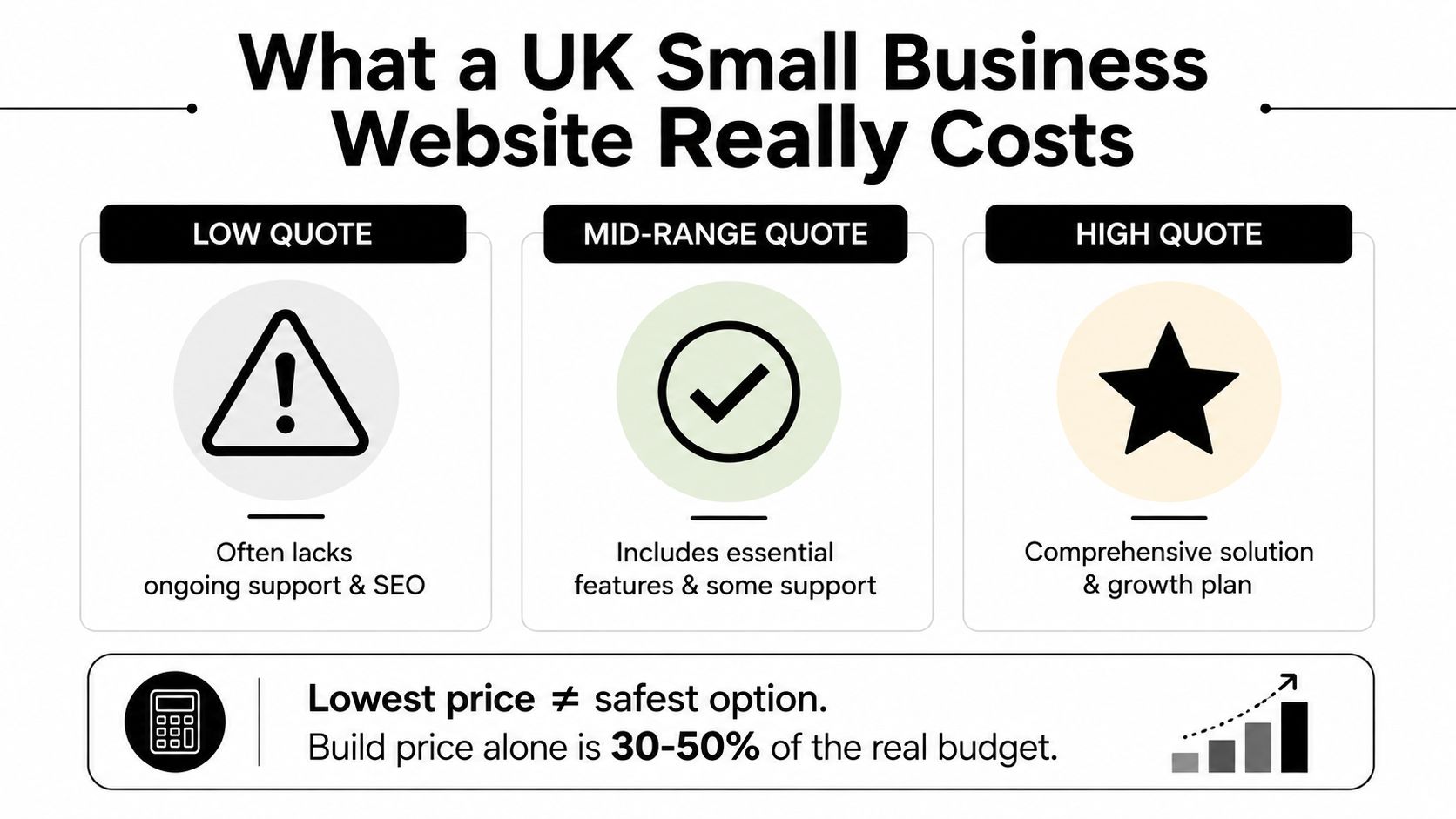
Budget for the first year, not launch day
Build cost is only the starting point. Your first-year budget also needs to cover:
Platform and hosting: These may sit inside a monthly package or appear as separate charges.
Domain renewal: Registration is inexpensive, but renewal returns every year.
Maintenance: Updates, backups, security checks, form testing and minor changes still need an owner.
SEO groundwork: Page titles, headings, local landing pages, internal links and Google Business Profile work must be planned before search visibility improves.
Renewals and subscriptions: SSL, premium apps, plugin licences and themes may fall outside the original quote.
Hosting commonly costs £8–£100 per month, and basic maintenance often costs £30–£100 per month. Hidden annual costs can add £500–£2,000 or more above the build price, according to the UK website cost breakdown from Media Village. For a small operator, planning around £1,800–£8,000 in the first year is more realistic than treating £1,000–£6,000 as the complete bill.
Wix-based delivery can keep technical overhead and support work under control for many service businesses. It still needs clear structure, persuasive copy and a quote that states exactly what happens after launch.
Practical rule: Ask every supplier for a 12-month total, including renewals, support and the work required to generate enquiries.
The Main Cost Line Items in a Website Build
A reliable quote separates costs by responsibility and timing. If the proposal contains one number called “website”, ask what has been bundled inside it and what you'll pay later.
Cost Item | Typical Range | Frequency |
|---|---|---|
Domain registration | £8–£25 per year | Annual |
Hosting or Wix Business plan | £0–£30 per month | Monthly |
Design and build | £1,000–£6,000 | One-off |
Premium themes or templates | £0–£250 | One-off or annual |
Copywriting | £300–£1,500 | One-off |
Professional photography | £150–£800 | One-off |
SSL and security | £0–£120 per year | Annual |
Email hosting | £3–£10 per user per month | Monthly |
Maintenance retainer | £40–£250 per month | Monthly |
Ongoing SEO agency work | £300–£1,500 per month | Monthly |
SEO tools | £50–£200 per month | Monthly |
The UK domain cost guide for small businesses is useful when you're checking whether registration, renewal and ownership have been included properly. A domain is inexpensive compared with design, but losing control of it creates a serious business problem.
What pushes each line higher
Design and build rises with page count, custom layouts, animation, booking systems, calculators, memberships and integrations. A reusable Wix structure keeps delivery leaner than a fully bespoke build, particularly for a service business with a clear set of pages.
Copywriting costs more when the writer must interview you, understand technical services, create a messaging strategy and write several service pages from scratch. Supplying rough notes can reduce the work, but poor copy often shifts the cost into missed enquiries later.
Photography depends on whether you use supplied images, licensed stock or a photographer. A trades business usually benefits more from genuine project photography than from generic images of smiling professionals.
Maintenance and SEO are separate decisions. Maintenance keeps the site working. SEO improves its ability to be found and chosen. Tools can support an in-house approach, while agency work includes strategy, content and implementation.
Platform choice changes the shape of these costs. Wix puts hosting, security and much of the technical infrastructure into a managed environment. WordPress can offer more control, but plugin licences, hosting, updates and troubleshooting usually create more moving parts. Before choosing a platform, price the recurring stack, not just the first build.
For search campaigns that need structured backlink support, you can check SemDash packages alongside your wider SEO budget. The important question is what work you're buying, how it fits your market and whether it's appropriate for your website's current foundations.
How Provider Type Changes the Price
The provider you choose determines more than the invoice. It changes how much responsibility sits with you, how quickly decisions get made and what happens when the site needs changing six months after launch.
Provider Type | Build Price Range | Best For |
|---|---|---|
DIY on Wix or Squarespace | £0–£500 | Owners with time, confidence and simple needs |
Freelance designer-developer | £800–£3,500 | Smaller projects needing personal support |
Regional or boutique agency | £2,500–£7,500 | Businesses needing strategy and accountability |
Premium London studio | £8,000–£25,000+ | Complex brands, campaigns and high-risk launches |
A DIY build looks cheap because you pay with time instead of labour. A simple site may still consume roughly 20–60 hours of owner time, based on the delivery assumptions in this comparison. That includes choosing a template, writing pages, resizing images, configuring forms, testing mobile layouts and correcting the inevitable details that don't look right.
Freelancers often provide strong value when the brief is organised and the decision-maker is available. UK pricing benchmarks place the freelancer median for a 5-page business site at £513, compared with £949 for a local agency and £2,950 for a premium studio, in Cellsior's provider census. Those medians help you sense-check a quote, but they don't replace a scope comparison.
Where the apparent saving disappears
A freelancer's lower fee may become expensive when you add repeated revisions, delayed responses, incomplete content, project management and post-launch fixes. The same applies to DIY when the owner spends evenings on tasks that could have been handled faster by a specialist.
A regional Wix specialist usually costs more than a basic freelancer because the service includes clearer process, design direction, structured content and someone accountable for the result. A premium London studio makes sense when brand risk, stakeholder management or custom engineering justifies the fee. It's unnecessary for a straightforward local service site.
Choose based on risk, internal capacity and the value of your time. An agency quote becomes cheaper than a freelancer quote when the freelancer's missing project management, revisions and support create work you have to absorb yourself.
Choosing Between Wix, WordPress and Shopify
Your platform decides where the costs sit. Wix compresses technical work into a managed system, WordPress spreads costs across hosting and extensions, and Shopify puts ecommerce operations at the centre.
Platform | Monthly Fee (Typical) | UK Build Cost | Annual Maintenance | Best Fit |
|---|---|---|---|---|
Wix | £0–£159 | Usually lower for standard sites | Usually lower with managed features | Service businesses and lead generation |
WordPress.org | Platform is free | Varies with theme, plugins and development | Higher where updates and support are active | Flexible content and custom requirements |
Shopify | £1 per month on Basic for the first three months, then £39 | Usually ecommerce-focused | Platform, apps and store support | Retailers with meaningful product volume |
Wix Business and Ecommerce plans typically fall between £0 and £159 per month, while the editor reduces the need for extensive theme and plugin customisation. For a consultant, trades firm, therapist or local professional, that lower friction often makes Wix the most sensible total-cost option. You still need a strong build, but you're less likely to accumulate a long list of technical subscriptions.
WordPress.org itself is free, yet a realistic setup can add £15–£120 per month for managed hosting, £0–£300 per year for premium themes, £50–£600 per year for paid plugins and a £60–£200 domain, based on the cost assumptions in the requested comparison. WordPress makes sense when you need its flexibility and have someone responsible for updates, compatibility and security. It isn't automatically cheaper because the core software has no licence fee.
Shopify starts at £1 per month on Basic for the first three months, then £39, with transaction fees of 2% plus payment gateway costs unless you use Shopify Payments, according to the platform pricing figures supplied for this comparison. It's the sensible choice when product management, checkout and retail operations drive the project. For a brochure site, it adds machinery you probably don't need.
For a fuller breakdown of Wix plans and inclusions, use this UK Wix pricing guide. Compare the first-year platform bill with maintenance and app requirements before you decide that a lower entry price is a lower total cost.
Ecommerce Sites and the Hidden Cost Layers
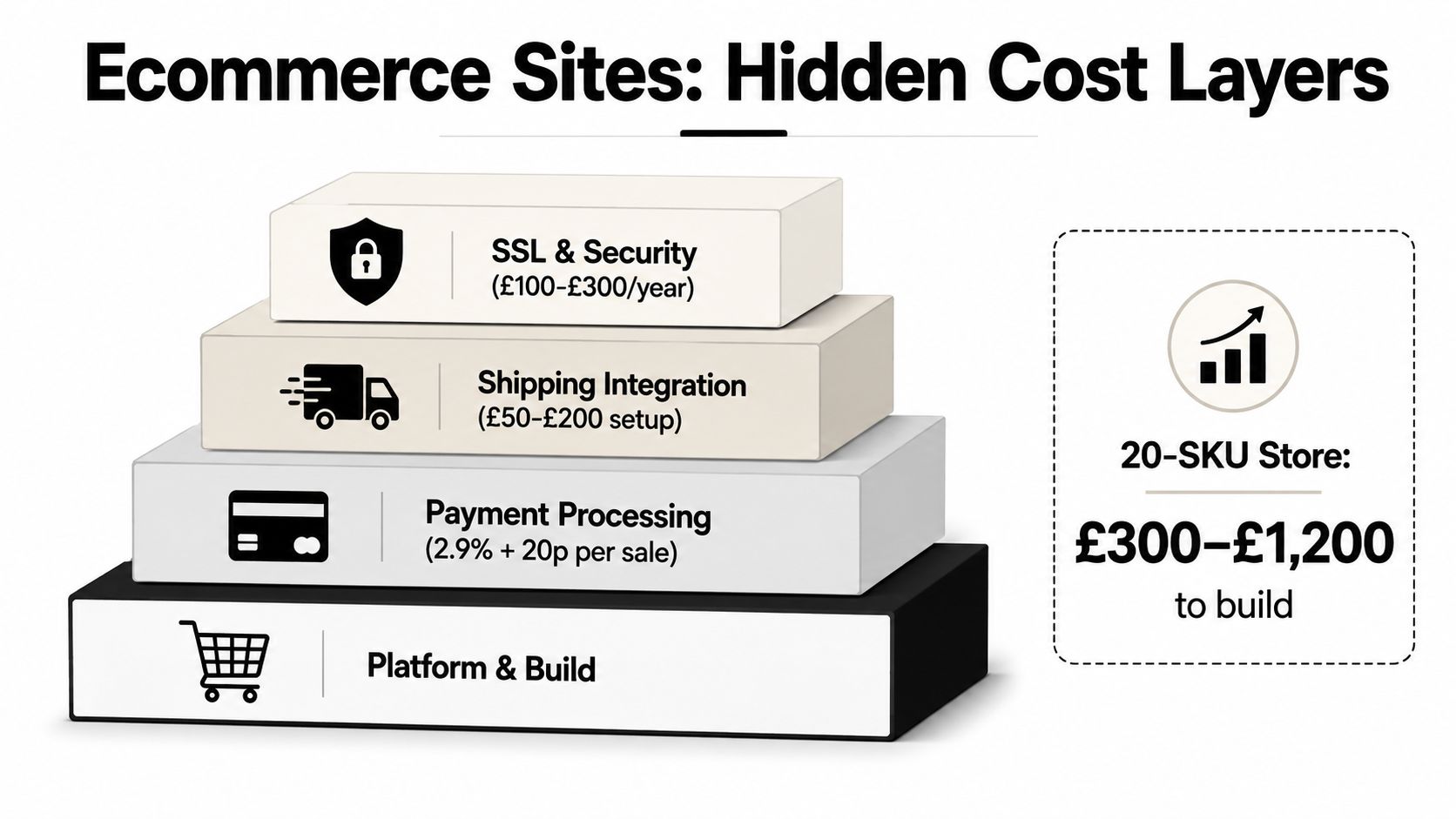
An online shop is an operating system for products, payments, stock, shipping and customer service. Price the first year, not just the build. A professionally built UK ecommerce site commonly costs £2,000–£10,000 upfront, with platform and operating fees starting at roughly £25 per month, according to UK ecommerce website cost guidance from JW Digital.
Product volume drives labour. A 20-SKU store can cost around £300–£1,200 to build. At 200 SKUs, the range can rise to £1,500–£4,500 because someone must prepare product data, upload images, configure filters and connect stock systems. Your platform will not prepare that information for you. Data preparation is paid work, so a Wix agency quote should show it separately.
The layers owners forget
The storefront is only the visible layer. Budget for the systems underneath it:
Payments: Stripe, Square and Shopify Payments can charge transaction fees in the region of 1.4%–2.9% per UK transaction, depending on the provider and setup.
Shipping: Calculators, carrier rules and label workflows add configuration and testing work.
Tax settings: VAT configuration, including MOSS or IOSS where relevant, requires careful setup.
Returns and accounts: Returns portals and Xero integrations can add £100–£500 to a build.
Store apps: Abandoned-cart tools can cost £10–£60 per month, while review platforms can cost £15–£50 per month.
Managed platforms may include PCI compliance, but configuration and testing still take developer time. SSL certificates can also become a recurring cost where security is not managed within the platform.
Treat a low ecommerce quote as a prompt to inspect the scope. A £500 build can become a first-year total of £2,500–£5,500 after platform fees, integrations, product entry, support and app subscriptions. UK small-store guidance also places Shopify-based builds around £2,000–£5,000, with monthly fees of £25–£100 or more, as outlined in the same JW Digital ecommerce pricing guide.
Ask for separate lines covering platform fees, build labour, payment processing, product loading and integrations. Transparent Wix agency packages make the first-year total easier to compare. If those costs sit inside one figure, you cannot manage the budget properly.
A Real First-Year Cost Breakdown for a London Service Business
Consider a representative three-person plumbing firm in South London. The owners need a 7-page Wix site with service pages, a quote form and basic local SEO. They don't need a complex portal or online shop, but they do need the website to make a visitor feel confident enough to request a quote.
The sensible budget is the one that connects each item to the launch and the next 12 months. The on-page SEO and Google Business Profile tuning are included in the build, but showing their value separately makes the scope easier to judge.
Line Item | Provider | Cost (£) |
|---|---|---|
Build and design on Wix | Wix specialist | 1,800 |
Domain, .co.uk, 2 years | Domain provider | 24 |
Wix Business plan | Wix | 276 |
Logo refresh | Designer | 250 |
Photography of completed jobs, half-day shoot | Photographer | 350 |
On-page SEO and Google Business Profile tuning | Included in build | 400 value |
Quarterly content updates and minor edits | Retainer | 480 |
Maintenance, security and uptime monitoring | Support provider | 240 |
Year-one total | Approximately 3,820 |
The £23 per month Wix Business plan accounts for the stated £276 annual platform cost, while the £40 per month retain plan accounts for £480 of quarterly updates and minor edits. The photography gives the firm genuine evidence of its work, and the local SEO setup ensures the pages and business profile support the same service area.
That budget should be judged against a yearly new-lead revenue target, not against another plumber's build quote. If the firm expects the site to contribute to booked work, the owners can ask how many profitable jobs it needs to support before the investment makes commercial sense.
A £1,200 DIY alternative can reach £2,200 once the owner counts their own hours, plugin mistakes and slower lead conversion in the comparison. Those assumptions come from this representative scenario, not a measured case study. The point is practical: calculate the cost of acquiring a customer, then decide whether the cheaper build helps you acquire one.
Matching Maintenance and SEO Spend to Your Business Model
Maintenance should match the site's commercial importance. A brochure site that mainly confirms referrals needs less active support than a website responsible for most bookings, and an ecommerce store needs more operational care than either.
UK maintenance guides place basic support around £30–£75 per month, standard SME support around £75–£200 per month and ecommerce or premium care around £200–£550 per month, according to Digital Otter's UK maintenance pricing guide. Another breakdown places brochure sites at £30–£100 per month, lead-generation sites at £100–£250, ecommerce at £250–£750 and web applications at £500–£2,000 or more, as set out by Logic Leap's maintenance cost bands.
Business Profile | Monthly Traffic | Recommended Monthly Spend | What It Covers |
|---|---|---|---|
Referral-led trades firm | 400 visits | £40–£80 | Backups, updates, uptime monitoring and quarterly content tweaks |
Local services brand | Not specified | £150–£300 | Security patches, speed audits, conversion testing and active link building |
Revenue-dependent online business | Varies | Match operational risk | Faster support, testing, technical SEO and ongoing improvements |
The traffic and spend examples above are planning profiles, not universal benchmarks. Use them to think about dependence, not to force your business into a tier.
A useful decision rule is to multiply monthly traffic by revenue per visitor, then allocate 5–10% of that figure to maintenance, as specified in the planning model for this article. Benchmark SEO spend against the cost of one lost customer. If one missed booking costs more than the monthly support fee, underfunding the site is a false saving.
Read this practical guide to SEO for small-business websites before signing an SEO retainer. Upgrade from a basic retainer to project-based work when you need a new service section, a technical restructure, a conversion experiment or a concentrated local campaign. Retainers are for continuity. Projects are for meaningful change.
Getting a Transparent Quote From a Wix Agency
A transparent Wix partner makes the cost easy to inspect. You should see package names or price bands, an itemised scope, clear post-launch support and live Wix work you can review. A vague proposal that says “custom website” and gives one total leaves too much room for costs to appear later.
Start with a brief that states the decisions the supplier needs to price:
Page count: List core pages and service pages separately.
Brand assets: Confirm whether you're supplying the logo, colours, photography and fonts.
Integrations: Name booking tools, quote forms, email marketing, CRM, maps and payment systems.
Content ownership: State who writes, edits and uploads the copy.
Handover date: Set a defined launch and training point.
Support period: Specify what happens during the first 90 days.
Package pricing versus an incomplete headline
A sensible Wix package may bundle design, build, hosting guidance, first-month maintenance and basic SEO setup. An itemised quote can work just as well, but only when it lists every expected extra, including Wix apps, copy, imagery, domain costs and future support.
Baslon Digital offers Wix website design, maintenance and SEO support for small businesses, so it's one option to include when you're comparing managed delivery with a DIY build. The important part is not the agency name. It's whether the scope matches the price and whether you'll still understand the bill after launch.
Ask these five questions before signing:
What's fixed and what's variable? Get revision limits and extra-work rates in writing.
Who owns the domain and templates? Your business should retain practical control of its core assets.
What does the first 90 days include? Confirm bug fixes, training, edits and response times.
How are change requests priced? Ask for an hourly rate or defined project method.
How will success be measured? Agree whether the focus is enquiries, bookings, sales, visibility or a clearer customer journey.
A 30-minute scoping call is the fastest route to a credible number because a specialist can price the actual page structure, integrations and support level rather than guessing from a vague enquiry.
Book a 30-minute scoping call with Baslon Digital to map your Wix build, first-year running costs, maintenance and SEO into one clear budget. You'll leave with a practical scope and a more honest view of what your website needs to cost before you commit.
Comments