Best Ecommerce Platforms for Small Business in the UK

Updated: Nov 10, 2025
Picking the right ecommerce platform is a massive decision for any small business in the UK. It's the digital foundation you'll build everything on. If you're just starting, the big names you'll hear thrown around are Shopify for serious sellers, Wix for creative freedom, and Squarespace for brands that live and die by their design.
Each one strikes a different balance between ease of use, raw power, and scalability. Getting this choice right from the start saves you a world of headaches later.
Choosing Your Business's Digital Foundation

Let's be clear: choosing an ecommerce platform isn't just a tech task. It's the bedrock of your online shop, dictating everything from your customer's first impression to how you'll grow in the future. This guide cuts through the usual feature lists to give you a practical analysis that actually makes sense for the UK market.
We'll dig into the things that really matter for small businesses trying to make a mark, like payment gateway options and whether the platform can grow with you. The UK ecommerce market is the biggest in Europe, with online sales expected to make up a whopping 30.7% of all UK retail spending this year. Think about that—nearly a third of every pound spent is happening online, which makes your platform choice absolutely critical.
Key Platforms at a Glance
This guide will put the top contenders head-to-head, looking at how they handle the real-world challenges you’ll face—from wrestling with inventory to launching your first marketing campaign. If you're at square one, our complete guide on how to start an online store in the UK is the perfect place to begin.
Platform | Best For | Core Strength | Ideal UK Business |
|---|---|---|---|
Shopify | Growth & Scalability | Robust, all-in-one commerce tools | Businesses with physical products and serious sales goals. |
Wix | Creative Control | Intuitive drag-and-drop website builder | Service providers and brands needing a unique visual identity. |
Squarespace | Design & Aesthetics | Stunning, professional templates | Creatives, photographers, and high-end artisanal sellers. |
This intro should give you a clear roadmap to making a confident decision that actually fits your business goals. For those looking to nail down their brand, a practical guide on how to start a jewelry business online successfully offers some great insights.
Ready to find the perfect home for your business? Let’s dive in.
A Quick Look at the Top UK Ecommerce Platforms
For business owners who just want the highlights, let's cut through the noise. Here's a straight-talking summary of the main players: Shopify, Wix, and Squarespace. We're comparing them on the things that actually matter to small UK businesses, giving you a starting point to figure out where you fit.
Each platform has carved out its own territory. Shopify is the undisputed powerhouse for serious, product-based selling. Wix gives you ultimate creative freedom, and Squarespace is the king of clean, beautiful design. Getting your head around these core differences is the first step to picking the right one for you.
Core Strengths and Ideal Users
Shopify is the go-to for anyone serious about selling products and scaling up. Its inventory management is rock-solid, and its ability to sell across multiple channels (online, in-person, social media) makes it perfect for ambitious brands. If your main game is shifting physical goods and you've got big plans for growth, Shopify has the specialised tools to back you up.
On the flip side, Wix is for entrepreneurs who want complete control over their website's look and feel. Its drag-and-drop editor is incredibly intuitive, letting you build a totally unique site without touching a line of code. This makes it a brilliant choice for service-based businesses or stores where a bespoke visual experience is non-negotiable.
Squarespace sits neatly in the middle, championing stunning design and simplicity. It’s the top pick for creatives, photographers, and artisan sellers whose products need to be shown off with beautiful, minimalist style. Their award-winning templates let you build a professional-looking storefront with surprisingly little effort.
Key Takeaway: The "best" platform isn't the one with the most bells and whistles. It's the one with the right features for what you're trying to do. Match your choice to your main goal—whether that's scalable sales, creative control, or killer design.
At a Glance: UK Platform Comparison
To make things even simpler, the table below gives you a side-by-side snapshot of these three platforms. It focuses on the essentials for a UK-based business, like local pricing and transaction fees, so you can see how they stack up.
Ecommerce Platform Snapshot for UK Businesses
Here's a quick look at how the top three platforms compare for UK businesses, focusing on their key differentiators and who they're built for.
Platform | Starting Price (UK) | Transaction Fees | Best For | Key Feature |
|---|---|---|---|---|
Shopify | From £25/month | 0% with Shopify Payments | Serious, product-heavy businesses aiming to scale sales. | All-in-one commerce engine with powerful inventory and POS. |
Wix | From £29/month (Ecommerce) | 0% with Wix Payments | Businesses needing total creative freedom and a unique site design. | Intuitive drag-and-drop editor for ultimate customisation. |
Squarespace | From £23/month (Business) | 0% (on higher plans) | Creatives and brands where premium aesthetics drive sales. | Award-winning, mobile-responsive design templates. |
This high-level view should give you a gut feeling for which platform lines up best with your business needs and future plans.
Now that you have the basics down, ready to figure out which one is the perfect match? Book a consultation with our team to get personalised advice on building your ideal online store.
Shopify: The Dedicated Commerce Engine for Growth
When a small business gets serious about growth, the conversation almost always lands on Shopify. It’s earned its stripes as a pure-bred commerce engine, built from the ground up to do one thing exceptionally well: sell products. This isn't just a website builder with a shopping cart clumsily tacked on; it's a whole ecosystem built around the art of the sale.
For UK businesses with bigger ambitions than a simple online shopfront, Shopify offers a seriously robust framework. It handles everything from inventory and payments to integrating with pretty much any tool you can think of. The entire point is to make selling as painless as possible, so you can focus on your products and customers instead of wrestling with tech.
Unifying Online and Offline Sales with Shopify POS
One of Shopify’s killer features, especially for UK retailers, is its integrated Point of Sale (POS) system. This is where the platform really flexes its muscles, blurring the lines between your online shop and your physical store until they’re one seamless operation. You can manage your entire stock from a single dashboard, whether a sale happens on your website, at a weekend market, or in your brick-and-mortar shop.
Let’s imagine a real-world scenario: a UK-based craft gin distillery. They sell bottles online but also have a physical tasting room and do the rounds at local food festivals.
Centralised Inventory: With Shopify POS, a bottle sold in the tasting room is instantly marked as 'sold' online. No more accidentally selling the same bottle twice or dealing with disappointed customers.
Unified Customer Data: Someone buys a bottle at a festival? You can add them to the same customer database as your online shoppers. This means you can send them a targeted "thank you" email with a discount for their next online purchase. Simple, but so effective.
A Single Source of Truth: All your sales data, from every single channel, flows into one analytics dashboard. This gives the distillery owner a crystal-clear picture of what's selling, where it's selling, and when. That’s how you make smarter business decisions.
By unifying online and offline commerce, Shopify POS stops you from running two separate businesses and merges them into a single, cohesive retail machine. That level of integration is a massive advantage for any brand trying to build a presence both on and off the screen.
The Power of Multi-Channel Selling and the App Ecosystem
Shopify gets that your customers aren't just on your website; they're everywhere. Its native integrations with platforms like Instagram and TikTok aren't just afterthoughts—they’re baked right into the core of the platform. You can create shoppable posts and ads that turn social media scrolling directly into sales. It’s all streamlined, making social commerce genuinely accessible, even if you're a one-person team.
Beyond social selling, the Shopify App Store is arguably its greatest weapon. With over 8,000 apps, you can bolt on almost any functionality you can dream of. Need advanced email marketing, subscription box management, or complex shipping calculators for international orders? There’s an app for that. This modular approach is brilliant because you only add—and pay for—the specific tools you need as your business grows.
Understanding the True Cost in the UK
Shopify is a top contender for UK small businesses, with plans typically ranging from £25 to £344 per month. Its popularity comes from a dead-simple user interface, powerful SEO tools, and its knack for multi-channel selling across Instagram, TikTok, and even Amazon. This article on the best ecommerce platforms from rapidformations.co.uk offers more insight into why it’s such a strong choice.
But it’s crucial to understand the full cost. While the pricier plans get rid of Shopify’s own transaction fees (as long as you use Shopify Payments), you still have standard credit card processing fees to think about. These are typically around 1.5% + 25p for UK cards on the advanced plan but can be a bit higher on the basic tiers. You absolutely have to factor these into your financial forecasts as your sales grow.
Automating with Shopify Magic
A real game-changer for Shopify is its suite of AI tools, which they’ve branded as Shopify Magic. If you're a small business owner wearing ten different hats, this stuff is gold. The AI can whip up compelling product descriptions, suggest email subject lines, and even handle customer chats for you. It automates those soul-destroying, time-consuming tasks, freeing you up to think about the bigger picture. Because these tools are built right in, they give you a serious leg-up if you don't have a big marketing or support team.
Of course, getting traffic is only half the battle; you have to convert it. Our guide on ecommerce conversion rate optimisation that works is packed with actionable strategies that pair perfectly with Shopify's powerful features.
Bottom line? For any business that's truly serious about scaling product sales and needs a reliable, all-in-one system to manage that growth across multiple channels, Shopify is a beast.
Ready to see how a dedicated commerce platform can transform your business? Explore Shopify's features and start a free trial today.
Wix: The Ultimate Creative and Flexible Builder
While some platforms are built from the ground up purely for commerce, Wix has always championed creative freedom first. It started life as a website builder and has since grown into a powerful ecommerce solution, but that design-centric DNA is still its greatest strength.
For small business owners who see their website as a direct extension of their brand identity, Wix offers an almost unmatched level of control. This makes it a top contender for anyone selling not just a product, but an entire brand experience. Its famous drag-and-drop editor is the star of the show, letting you build a truly bespoke online shop without needing to know a single line of code.
Intuitive Design Meets Smart Commerce Tools
The real magic of Wix lies in its visual editor. You can literally pick up any element—a text box, an image, a product gallery—and place it exactly where you want it. This pixel-perfect control is a massive advantage for businesses where aesthetics are everything.
But a pretty storefront is only half the story. Wix backs up its design flexibility with a solid suite of ecommerce tools built specifically for small businesses. These aren't just tacked-on features; they're woven right into the dashboard, creating a single, unified place to manage everything.
Abandoned Cart Recovery: Wix automatically sends reminder emails to customers who leave items in their cart, a feature proven to recapture otherwise lost sales.
Comprehensive Business Suite: You can manage bookings, appointments, subscriptions, and customer communications all from one central hub.
Integrated Marketing: The platform comes with built-in tools for email marketing, social media post creation, and even promotional videos.
This mix of creative control and essential business tools makes it a formidable choice for entrepreneurs who want to run their entire online presence from one spot.
A Practical Scenario: A UK Illustrator's Store
To see where Wix truly shines, let's picture a UK-based illustrator selling custom prints and digital downloads. For this kind of business, brand identity and visual presentation are completely non-negotiable.
The illustrator can use Wix’s editor to create a gallery that perfectly showcases their unique art style, something that might feel constrained on more rigid, theme-based platforms. They can easily set up product pages for physical prints with different size and framing options. Crucially, they can also sell digital downloads (like phone wallpapers or printable art) right alongside their physical goods—a feature Wix handles seamlessly.
Wix excels in scenarios where the business is a blend of products, services, and creative expression. It empowers entrepreneurs to build a digital storefront that is as unique and professional as their brand itself, without the need for technical expertise.
The integrated marketing tools are another huge win here. The illustrator can create a promotional video for a new print series using Wix Video Maker, send a newsletter announcing the launch, and create matching social media posts, all without ever leaving the Wix dashboard. This creates a cohesive and professional journey for their customers, from first glance to final purchase.
SEO Performance: A Balanced View
A common worry with highly visual, drag-and-drop builders is their SEO performance. In the past, this was a fair criticism of Wix. However, the platform has invested heavily in this area, and today’s Wix SEO tools are robust and effective for most small businesses.
You get full control over page titles, meta descriptions, URL slugs, and alt text. The platform even provides a personalised SEO plan to guide you through the optimisation process. While a dedicated commerce engine like Shopify might have a slight edge in technical SEO for massive, product-heavy stores, Wix more than holds its own. It provides plenty of power for the average small business to rank well. If you're building a store on this platform, you'll find plenty of helpful advice in your guide to ecommerce on Wix for UK stores.
Wix has successfully bridged the gap between a simple website builder and a capable ecommerce platform. For the creative entrepreneur, the service provider, or any small business that refuses to be boxed in by a template, it offers a compelling blend of design freedom and essential sales tools.
Ready to build a store that truly reflects your brand? Discover Wix’s ecommerce plans and start designing your unique shop today.
Squarespace: Where Design and Simplicity Drive Sales
For some small businesses, the product and the presentation are one and the same. This is where Squarespace really shines. It's the undisputed champ for brands where beautiful aesthetics aren't just a bonus; they're the entire business model. Think photographers, designers, and sellers of high-end, artisanal products.
Squarespace built its reputation on award-winning, mobile-responsive templates and an interface that feels clean and minimalist. This design-first approach means you can launch a sophisticated, visually stunning online shop with barely any technical faff. It’s less about endless tweaking and more about refined simplicity that just works, straight out of the box.
More Than Just a Pretty Face
While its looks are the main draw, don’t mistake Squarespace for just a portfolio site with a checkout button tacked on. The platform has seriously upped its ecommerce game, making it a solid choice for the right kind of business. It offers a well-rounded suite of tools built to support service providers and curated product sellers equally well.
These integrated features mean you can manage multiple revenue streams from a single, elegant dashboard. That’s a massive plus for creative entrepreneurs who often sell a mix of physical goods, digital products, and their own time.
Built-In Tools for Modern Commerce
Squarespace clearly gets its creative and service-based audience. The platform comes loaded with powerful, native tools that you'd need third-party apps for on other platforms. This makes for a much more cohesive and manageable experience for you, the business owner.
Here are a few key built-in features:
Appointment Scheduling: A fully integrated booking system that lets clients schedule and pay for services directly on your site. This is a game-changer for consultants, stylists, and wellness professionals.
Subscription Sales: Easily set up recurring orders for products or access to members-only content. Perfect for businesses offering curated boxes, regular product deliveries, or exclusive digital communities.
Digital Gift Cards: Let your customers purchase and send branded gift cards. It’s a simple but seriously effective way to bring in new business and boost loyalty.
For a creative professional, selling isn't just about moving stock; it's about building a brand ecosystem. Squarespace's strength lies in its ability to seamlessly blend content, commerce, and services into one beautiful package.
A Real-World Example: A Bespoke UK Jewellery Maker
Let’s put this into practice. Imagine a bespoke jewellery maker based in the UK who creates unique, handcrafted pieces. Her entire brand is built on craftsmanship, quality materials, and a distinct artistic vision. A generic, cluttered storefront would actively harm her business by cheapening the perceived value of her work.
This is where Squarespace nails it. The jeweller can use a minimalist template with huge, high-resolution images to show off the intricate details of each piece. The platform’s powerful visual storytelling features, like elegant image galleries and integrated lookbooks, let her tell the story behind her craft.
This curated, magazine-like experience does something crucial: it builds perceived value. When a product is presented beautifully, customers are more willing to pay a premium. The elegant design instils trust and communicates quality before someone even adds an item to their cart, which directly fuels higher conversion rates for high-end products.
With Squarespace, she could also use the integrated scheduling tool to offer paid design consultations, creating another revenue stream. This unified approach strengthens her brand and simplifies her operations, letting her focus on what she does best: creating beautiful jewellery. It proves that for certain businesses, a platform that prioritises design isn't a luxury; it's a strategic sales tool.
Ready to build a store that looks as good as your products? Explore Squarespace’s award-winning templates and start your free trial.
How to Choose the Right Platform for Your Business
Let's be honest, picking from the best ecommerce platforms for your small business isn't about finding some mythical "best" one. It's about finding the one that fits your specific goals, products, and the way you work. Each platform we’ve looked at offers a completely different road to selling online, and one of them is paved just for you.
The right choice comes down to asking the right questions about your own business. When you line up your needs with a platform's real strengths, you build a digital foundation that helps you grow instead of holding you back. This is about real-world results, not just ticking off features on a list.
Matching Your Business Model to the Right Platform
What's the main goal here? Are you planning to scale a product-heavy business with a warehouse full of inventory? In that case, Shopify’s robust inventory management and multi-channel selling tools make it the obvious choice. The whole system is built from the ground up for serious, scalable selling.
Or maybe your top priority is creating a totally unique brand experience. If you need pixel-perfect control over every single detail, Wix's flexible drag-and-drop editor is your ultimate canvas. It’s perfect for businesses where a bespoke look and feel is absolutely non-negotiable.
What if you're a creative selling a curated collection of products, services, or appointments? For anyone where premium aesthetics are everything, Squarespace’s elegant templates and built-in tools for bookings and subscriptions offer a sophisticated, all-in-one package.
This little decision tree helps to visualise things if a premium design is your number one priority.
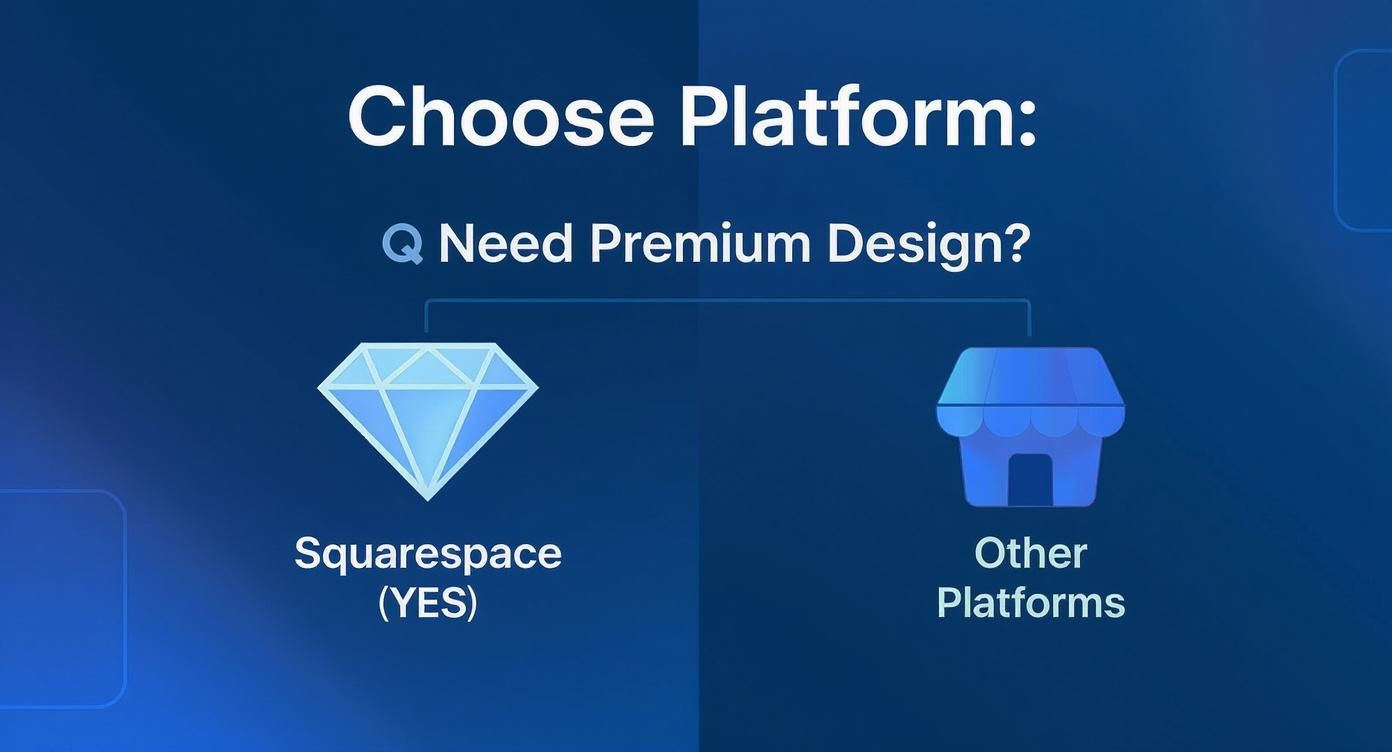
As you can see, if a top-tier design is where you start, Squarespace is the specialist. But if your needs are different, your path will lead elsewhere.
Key Insight: Don't get lost trying to find the platform with the most features. Focus on the one with the right features for what you actually do, whether that's powerful inventory, total design freedom, or minimalist elegance.
Making a Confident Decision
The UK is home to around 5.5 million private-sector businesses, and an incredible 99% of them are small enterprises. That’s a lot of competition, which makes it vital to have an accessible platform that works for smaller merchants. Many also use giants like Amazon UK, which pulls in about 220.7 million visitors a month, to get more eyes on their products. You can read more about the UK ecommerce market over on ShipBob.com.
Your platform is the first step in grabbing your slice of that market. The best way to lock in your decision? Get your hands dirty. Every platform offers a free trial, so you can actually test the dashboard, build a fake product page, and see which one just feels right to you.
Ready to stop thinking and start building the online store your business deserves? Start a free trial with your top choice today and make a decision you can feel good about.
Got Questions? We've Got Answers
Diving into the world of ecommerce platforms can feel like you've opened a can of worms. It’s not just about pretty themes; it’s about the real-world costs, the "what if I change my mind?" panic, and whether you need to be a coding genius to survive. Let's tackle the questions that really keep UK small business owners up at night.
How Much Does an Online Store Actually Cost to Start in the UK?
Right, let's get one thing straight: the monthly subscription fee is just the tip of the iceberg. If you want to budget properly and avoid any nasty surprises, you need to look at the whole picture.
Here’s a more realistic breakdown of what you'll likely spend to get off the ground:
Your Domain Name: This is your online address. Expect to pay around £10-£20 a year for a or domain. It’s a small but essential cost.
A Decent Theme: Sure, free themes exist, but a premium one can make your brand look legit overnight. This is a one-off payment, usually between £150-£300, and it's often money well spent.
The "Must-Have" Apps: Want to send slick marketing emails, show off customer reviews, or offer subscriptions? You'll probably need paid apps. Budget for an extra £20-£50+ per month for these.
Payment Processing Fees: There’s no escaping these. Every time you make a sale, a small slice goes to the payment processor. Most platforms charge somewhere in the region of 1.5% - 2.9% + 20-30p per transaction. It might not sound like much, but it adds up!
Is It a Nightmare to Switch Ecommerce Platforms Later?
In a word: yes. Switching platforms isn't like changing your shirt; it's a massive undertaking that can seriously disrupt your business if you're not careful. Think of it as moving house, but for your entire online operation.
You're looking at potential data migration headaches, where customer histories or product details can get lost in translation. Even worse, changing your site's structure can send your Google rankings into a temporary nosedive, which means less organic traffic.
Honestly, choosing the right platform from the get-go is one of the most important decisions you'll make. Getting it right saves you a world of pain, money, and time down the line.
Do I Need to Be a Tech Whizz to Build My Own Website?
Absolutely not. Forget everything you think you know about needing to be a coding expert. Modern ecommerce platforms are built for normal people, not web developers.
Builders like Wix and Squarespace have brilliant drag-and-drop editors that are genuinely intuitive. Shopify guides you through the setup process step-by-step. You don't need to write a single line of code to create a beautiful, professional, and fully working online shop.
Plus, all the big players have mountains of support—online guides, community forums, and 24/7 customer service—to help if you get stuck. The whole point is to empower you to run your business, not to force you into becoming a tech expert.
Ready to Take the Next Step?
Choosing the best ecommerce platform is a critical first move, but it's just the beginning. The real success comes from building a powerful, professional online presence that turns visitors into loyal customers. Whether you need a stunning design that captures your brand's essence or a robust store built for growth, having an expert partner can make all the difference.
At Baslon Digital, we specialise in creating high-performing websites for small businesses across the UK. We turn your vision into a powerful online store that not only looks incredible but also delivers real results.
Ready to build your dream store?
Get Your Free Website Consultation Today and let's discuss how we can help your business thrive online.
Comments