Affordable SEO for Small Business: A Practical 2026 Guide

You've got a limited marketing budget, a website that's doing little more than sitting online, and an SEO provider promising results you can't quite measure. You're right to be sceptical. Affordable SEO for small business isn't about buying the cheapest monthly package. It's about choosing the one or two actions most likely to create the next enquiry, then leaving lower-priority work alone until the budget supports it.
That matters particularly in the UK, where 32% of businesses don't have a website, rising to 35% among sole traders, according to the UK Business Data Survey 2024 summary. A basic, well-organised website paired with strong local visibility can give a small firm a practical starting point, without trying to outrank national brands for every possible search.
Table of Contents
Where Affordable SEO Actually Starts
Start with the assets that already influence whether a nearby customer can find and contact you. For most local firms, that means your Google Business Profile, business details, and existing service pages, not a large blog or a pile of backlinks.
Google Business Profile should be complete, accurate, and written for a real customer. Check your categories, opening hours, services, phone number, website, service areas, and photographs. Then check that your business name, address, and phone number, known as NAP data, match across your website and important directories.
Your existing service pages usually deserve attention before new content. A page that clearly explains what you do, where you operate, who you help, and how someone can contact you has a better chance of converting existing search demand than a generic blog post written around a loosely related phrase.
That sequencing is the central principle of affordable SEO. Fix the foundations, improve the pages closest to revenue, measure the response, and only then add content or outreach.
Keyword research still matters, but don't begin with a giant spreadsheet. Find the specific phrases customers use for your services and locations, then map them to pages you already have. This guide to finding long-tail keywords is useful when your budget doesn't allow specialist research software.
The question to ask each month is simple: what is the next action that can improve visibility for a high-intent customer? If your profile is incomplete, that answer is obvious. If your service pages are vague, improve them. If both are sound, move towards useful local content and carefully chosen authority building.
Local SEO Tactics That Deliver Quick Wins
Local SEO has two connected parts. The Local Pack and Google Maps results depend heavily on the strength and relevance of your local presence, while traditional organic results depend more directly on the quality and relevance of your website pages. A business can perform well in one area and poorly in the other, so don't treat a standard ranking report as the whole picture.
Google's local results are shaped by factors such as proximity, relevance, and prominence. You can't control where every searcher is located, but you can make your business easier to understand and easier to trust. Accurate categories, complete services, useful photographs, consistent directory information, and genuine reviews all support that process.
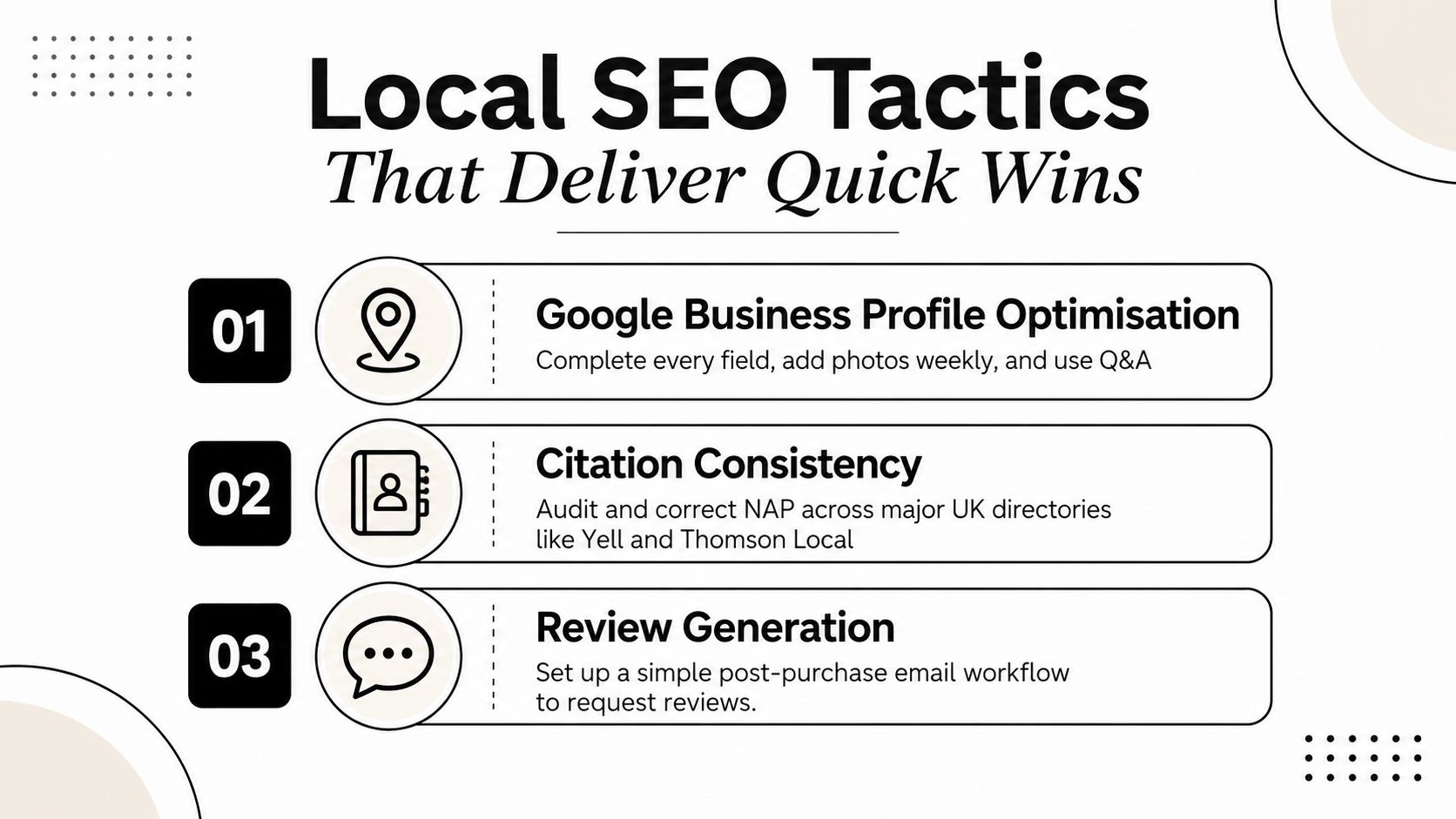
UK-focused reporting states that businesses appearing in Google's Local Pack can receive 126% more traffic than businesses outside the top three local positions, while complete Google Business Profiles can attract about 5x more views than incomplete profiles, as reported by UK local SEO statistics from Rank My Local. Treat those figures as a reason to prioritise profile quality, not as a promise of a particular result.
The practical local routine
Use one afternoon each quarter to run this sequence:
Review your profile: Confirm the primary category is precise, add relevant secondary categories, update services and opening hours, and rewrite the description using phrases customers use.
Check your citations: Search your business name and inspect major UK directories such as Yell and Thomson Local. Correct old phone numbers, addresses, trading names, and website links.
Create a review workflow: Ask satisfied customers shortly after delivery, use a direct review link, and make the request part of your normal follow-up process.
Refresh visual evidence: Add new, genuine images regularly. Show completed work, your premises, staff, products, or vehicles. Don't use stock photography as a substitute for proof.
Respond consistently: Reply to every review professionally and promptly, especially when a customer raises a concern.
A complete profile and a steady flow of authentic reviews generally give a local service business a stronger foundation than spending the same budget on indiscriminate links. You can use this list of 10 actionable SEO quick wins to identify additional practical tasks, and this explanation of local SEO provides useful context if the distinction between Maps and organic search is still unclear.
On-Page Essentials Without the Overwhelm
You don't need to obsess over keyword density, advanced schema, or perfectly engineered copy. A small-business site needs clear pages that match clear searches.
Give each important page one primary search query. Put that query, naturally and accurately, in the page title, H1, opening copy, and meta description. Don't force an exact phrase into every sentence. If the page is about emergency boiler repairs in Leeds, explain that service clearly, including the areas served, the problem handled, what happens next, and how to request help.
A lean page audit
Work through your key pages in this order:
Titles and headings: Make every title specific to the service and location where relevant. Use one clear H1, then supporting H2 headings.
Opening copy: Tell visitors immediately what the page offers and who it's for. Remove vague introductions that delay the answer.
Internal links: Link to each important service page from at least two existing relevant pages. This helps visitors move around the site and gives search engines clearer routes to your priority content.
Images: Compress images so they load quickly, keeping them under 100KB where practical without making them visibly poor. Write alt text that describes the image, rather than repeating a target keyword.
Conversion path: Put the next action in an obvious place. A phone number, enquiry form, booking button, or quote request should be easy to find on a mobile screen.
Google Search Console can show which pages receive impressions and clicks, while free browser extensions can help you inspect titles, headings, and image alt text. Look for pages with missing titles, duplicate wording, no internal links, or no clear purpose.
For a typical 15-page small-business website, a focused pass should take around three to four hours. If the audit reveals deeper problems, such as indexing errors or a difficult site structure, stop making random edits and get technical help. Rewriting every page is rarely the best use of a limited budget.
DIY Tools That Punch Above Their Weight
Install the free tools first. Most small businesses don't need a paid SEO suite to discover their next sensible action, and they certainly don't need five overlapping dashboards.
Tool | What to use it for | Trigger to upgrade |
|---|---|---|
Google Search Console | Check indexing, queries, clicks, impressions, and page performance | You need deeper competitor or historical analysis |
Google Business Profile | Manage local information, reviews, photographs, and profile actions | You manage multiple locations or need workflow support |
Google Analytics 4 | Track organic visits, enquiries, calls, and important actions | You need more advanced reporting or attribution |
Bing Webmaster Tools | Inspect Bing visibility and technical issues | Bing becomes a meaningful source of qualified enquiries |
PageSpeed Insights | Find mobile and desktop performance problems | Fixes require developer time or platform-level work |
Use each tool for a defined job. Search Console answers whether Google is showing and sending people to your pages. Google Business Profile shows how local searchers interact with your listing. GA4 helps connect visits with forms, calls, and bookings. Bing Webmaster Tools provides a second search engine view, while PageSpeed Insights identifies performance problems worth fixing.
The mistake is browsing every report without deciding what action follows. A dashboard isn't progress. A corrected service page, a fixed phone number, or a properly measured enquiry is progress.
What to ignore for now
Ubersuggest, Ahrefs, and Moz can be useful, but their large keyword and backlink databases can distract a new SEO operator. Don't pay for them just to watch rankings or collect keyword ideas you won't act on. Upgrade when you're tracking 50+ keywords or need to audit competitor backlinks, rather than because a sales page tells you that professional SEO requires a suite.
If repetitive work starts consuming your week, review specialist SEO automation solutions from Auspia. Automation can help with monitoring and workflow, but it won't replace your knowledge of customers, margins, locations, or the services you want to sell.
Measuring Results Without Drowning in Data
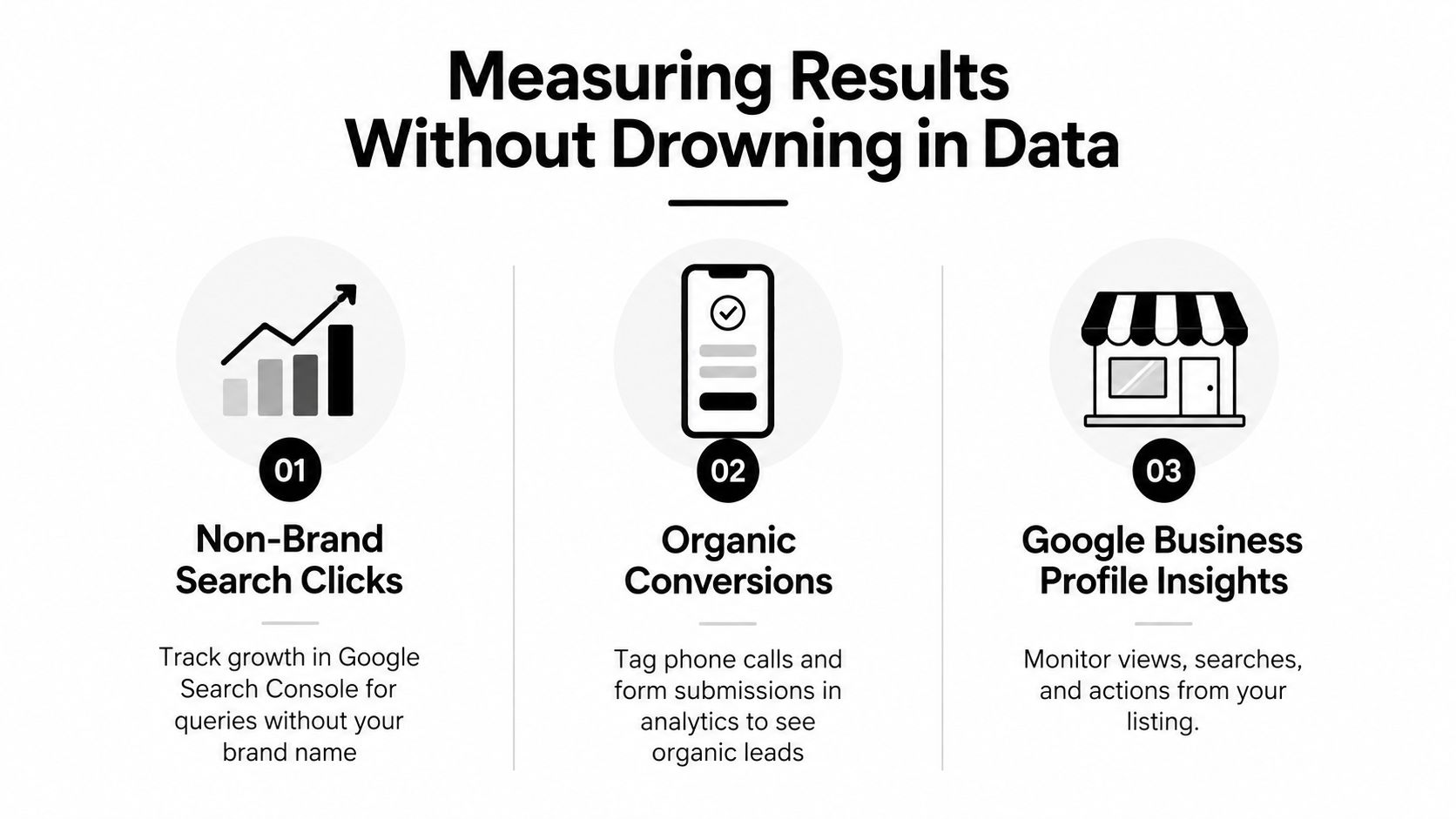
SEO reporting should help you decide what to do next, not give you more charts to ignore. For a small business, focus on three measures: non-brand search clicks, organic enquiries, and Google Business Profile actions.
Non-brand clicks show whether people who don't already know your company are finding you. Organic enquiries tell you whether that visibility creates business value. Profile actions, such as calls, website visits, and direction requests, show whether local searchers are taking practical steps.
A monthly review that takes less than half an hour
Start in Search Console. Filter queries to remove your brand name, review the pages receiving clicks, and compare the current period with the previous quarter. Look for direction rather than a single unusual day. A page that gains relevant non-brand clicks deserves more conversion attention, while a page with impressions but no clicks may need a clearer title or stronger search match.
Then open GA4 and isolate organic sessions with sensible campaign or source tagging. Make sure form submissions, booking completions, and tracked phone actions are recorded as conversions. This guide to whether Google Analytics is free is useful if you're setting up measurement without purchasing software.
Finally, review your Business Profile insights and record the actions that matter to your business. Keep a simple spreadsheet with the date, the three core measures, work completed, and any notable lead quality.
Rankings and impressions are clues. Enquiries and qualified conversations are the evidence.
Ranking position can fluctuate by location, device, personalisation, and search wording. Total impressions can rise because Google shows a page for irrelevant searches. Neither metric tells you whether someone contacted you, requested a quote, or bought something. Use them diagnostically, then judge SEO by the customer actions that follow.
DIY Versus Hiring an Agency
The right SEO arrangement depends on four practical filters: your monthly budget, the hours you can protect each week, your technical confidence, and how quickly you need meaningful results. There's no prize for doing everything yourself if the work never gets finished, and no reason to pay an agency for tasks you can handle in an afternoon.
Option | Typical monthly cost (UK) | Best for | Skip if |
|---|---|---|---|
In-house DIY | £0 to £250 | Owners with time, a simple site, and a local audience | You can't maintain a regular routine |
Freelancer | £300 to £800 | Focused local work, technical fixes, and practical guidance | You need broad strategy across complex teams or markets |
Agency | £500 to £2,000 | Businesses needing coordinated ongoing SEO | Your site has one location and only needs basic improvements |
These ranges reflect commonly reported UK pricing. UK local SEO pricing guidance places local SEO commonly at £300 to £800 per month, while broader campaigns rise with scope and competition. A separate UK SEO cost guide reports that many small businesses pay around £500 to £2,000 per month, with local-only work starting from £300.
DIY works well when the owner understands the customer and can make steady improvements. It usually fails when a penalty needs recovering, a site migration risks losing valuable URLs, or the business operates in a high-authority niche where competitors have established content and links.
Putting It All Together and Next Steps
Affordable SEO works when you sequence it. Don't launch content before fixing the profile that customers use to call you, and don't buy links before your important service pages explain what you offer.
Your first 90 days
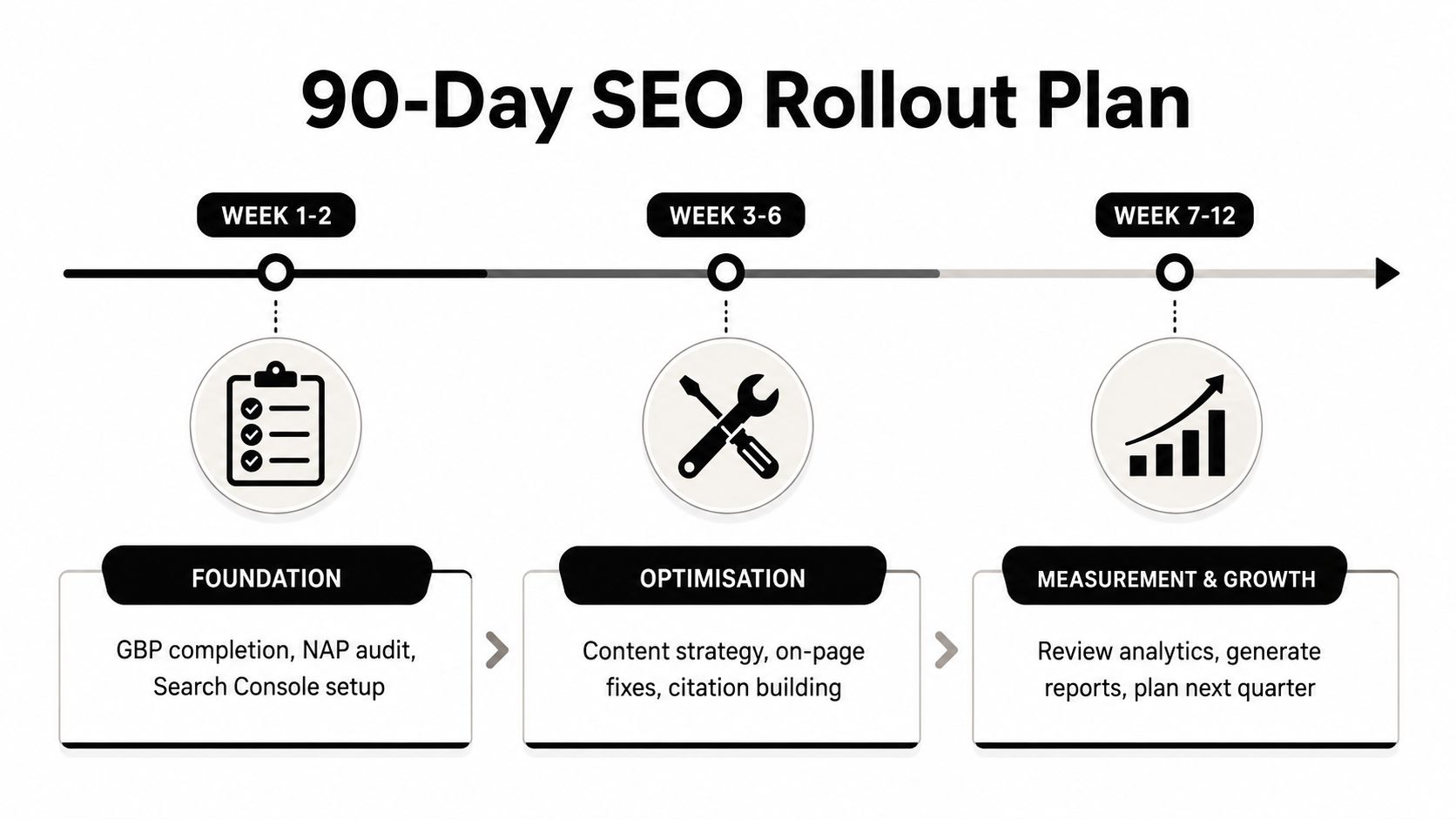
Week one is for foundations. Complete your Google Business Profile, check NAP information across important directories, and connect Google Search Console. Record your starting position for non-brand clicks, organic enquiries, and profile actions.
Weeks two to four should focus on your top five revenue pages. Improve titles, headings, opening copy, internal links, images, calls to action, and location relevance. Fix only the technical issues you can identify and resolve confidently.
Months two and three are for controlled expansion. Publish useful content based on customer questions, correct remaining citation problems, and build a repeatable review request process. In month three, begin relevant link outreach and conduct a performance review rather than signing up for a larger package automatically.
A non-expert owner can usually manage the routine with around six to eight hours a month, provided the work stays focused. Use that time for profile maintenance, one or two page improvements, review follow-up, measurement, and planning. If you spend the entire allocation reading SEO news, you're avoiding the work that creates value.
Bring in outside help when organic leads plateau for two consecutive months despite consistent action, when technical changes require developer access, or when competitors continue outranking you for critical commercial searches. Those are decision triggers, not signs that you've failed.
A UK SME benchmark found that sites with an active content strategy achieved average organic traffic growth of 18% over 12 months, while top-quartile performers reached 45% or more. The same UK SME SEO benchmark report notes that new content commonly takes two to four months to rank on established sites and four to eight months on newer pages. That's why your first gains should come from local and on-page improvements, while content earns its place through patient measurement.
Organic search remains commercially important for UK ecommerce. UK online retail sales reached £127.41 billion in 2024, organic search accounted for 43% of ecommerce traffic, and organic traffic was linked to 23.6% of orders, according to UK ecommerce SEO data from Charle. Don't copy those figures into a forecast for your own business. Use the underlying lesson instead: make mobile performance, product and service clarity, and conversion tracking part of the SEO job.
For broader context, 91% of surveyed UK SMEs considered SEO essential, but only 28% felt confident in their knowledge, while 78% said Google Business Profile optimisation delivered the highest ROI, according to UK SME SEO research from SEO Caddy. The practical takeaway is straightforward. Start with the profile and pages closest to a sale, measure actual leads, and invest in expertise only when the next problem is beyond your time or skill.
Affordable SEO isn't about cutting corners. It's about refusing to fund low-impact work before the basics are producing evidence. Start small, measure accurately, and reinvest early gains into the next priority.
Baslon Digital can help small businesses with Wix website improvements, SEO settings, local visibility, Google Business Profile work, and content designed to turn search visits into enquiries. If you want a practical review of what to fix first, visit Baslon Digital and discuss your next SEO priority with the team.
Comments