A Guide to Brand Identity Design in the UK

Updated: Dec 4, 2025
Brand identity design is the process of building the look, feel, and voice of your business. It’s not just about creating a pretty logo; it's about crafting the entire experience—from the colours on your website to the tone of your emails—that tells your story and makes people remember you.
What Is Brand Identity and Why Does It Matter
Think of your business as a person. Its brand identity is its personal style—the way it dresses, the way it talks, and the vibe it gives off when it walks into a room. This identity takes all your big ideas, values, and your mission and turns them into something tangible that customers can actually see and connect with. Without it, you're just another faceless company in a very crowded market.
To really get it, you need to understand how it fits with a couple of other terms that get thrown around a lot. People often use 'brand,' 'branding,' and 'brand identity' like they're the same thing, but they each have a specific job to do.
Brand vs Branding vs Brand Identity Explained
Let's clear this up once and for all. This quick table breaks down these three interconnected concepts so you can see exactly what each one means.
Concept | Definition | Example |
|---|---|---|
Brand | The big-picture perception. It's the gut feeling or reputation your company has in the public’s mind. | When you think of "Volvo," you immediately think "safety." That feeling is their brand. |
Branding | The active process of shaping that perception through marketing, customer service, and strategic actions. | Volvo running TV adverts showing families safe inside their cars is the act of branding. |
Brand Identity | The collection of tangible, sensory elements you use to communicate the brand (the toolkit). | The Volvo logo, their specific shade of blue, and the font they use are all parts of their brand identity. |
So, brand identity is the set of tools you use in the act of branding to build your brand. Simple, right?
The Power of a First Impression
In the fast-paced UK market, you’ve got milliseconds to make an impression. In fact, research shows that people form an opinion about a brand in just 0.05 seconds. What's even more telling is that a massive 55% of that first impression comes down to what they see.
This stat alone shows just how crucial your brand identity design in the UK is. It’s your first—and sometimes only—chance to grab someone’s attention and show them what you're all about.
A strong brand identity does more than just look good; it builds trust, communicates your values instantly, and sets you apart from competitors. It’s the silent ambassador that works for your business 24/7.
Of course, none of this works if you don't know who you're talking to. A deep understanding of your target audience is the foundation for creating engaging content that actually connects. This knowledge should guide every single design choice, ensuring your visual language speaks directly to the people you want to reach. If you need some inspiration, check out these incredible brand strategy examples.
A well-designed identity keeps everything consistent, from your website and social media profiles to your business cards and packaging. That consistency builds familiarity, which in turn builds trust, helping to turn one-time buyers into loyal fans.
The Building Blocks of a Powerful Brand Identity
Think of your brand identity like a well-built house. It’s not just one thing; it’s a careful combination of different elements—the building blocks—all working together. When these pieces click, they create a memorable experience that tells your brand’s story without you having to say a word.
Each block has a job to do, from grabbing someone's attention right away to building trust over the long haul. Let’s break down what these essential parts are and how they work, both on their own and as a team.
Your Logo: The Visual Cornerstone
Your logo is the first thing people see and remember. It’s the visual handshake you offer every potential customer, showing up on your website, your products, and all your marketing stuff. A great logo isn't just a pretty picture; it's a symbol packed with meaning.
It needs to be simple, memorable, and flexible enough to look good whether it’s on a massive billboard or a tiny social media icon. In the UK, brand identity design is a huge deal for how people connect with a business. In fact, a whopping 75% of consumers recognise a brand by its logo alone, which shows you just how vital it is as your main visual anchor.
Want a deeper dive into what makes a logo really work? Check out our guide on the key principles for strong logo design and branding.
Colour Palette: The Emotional Trigger
Colour is a seriously powerful tool, often working on a subconscious level. The colours you pick for your brand can instantly stir up feelings and shape how people see you. Are you a bold, energetic startup? Or a calm, trustworthy financial advisor? Your colour palette answers these questions in a flash.
Think about the psychology behind the colours:
Blue: Often linked to trust, reliability, and calm. It’s a classic choice for corporate and tech brands for a reason.
Red: Shouts excitement, passion, and urgency. Super effective for brands that want to create a bit of buzz, like in sales or fast-moving goods.
Green: Brings to mind nature, health, and growth. A natural fit for organic products, wellness brands, and even financial services.
Yellow: Communicates optimism, warmth, and clarity. It’s perfect for brands that want to feel friendly and approachable.
Statistics show that around 80% of people think colour is a key part of brand recognition. And with 40% of Fortune 500 companies favouring blue, it's clear that choosing your colours is a big strategic move.
Choosing a colour palette isn't just about picking your favourite shades. It’s a strategic decision that lines up your look and feel with the core emotions and values of your brand.
Typography: The Voice on the Page
If your logo is your brand’s face, then typography is its voice. The fonts you choose say a lot about your personality. A traditional serif font (like Times New Roman) can feel reliable and established, while a clean sans-serif font (like Helvetica) comes across as more modern and straightforward.
The trick is to pick a set of fonts—usually one for headlines and another for body text—that are not just easy to read but also match your brand’s character. Keeping this consistent across your website, marketing materials, and documents reinforces your identity and makes everything you put out there instantly recognisable.
Imagery: The Visual Narrative
The images you use—whether they're photos, illustrations, or icons—are powerful storytellers. They give customers a peek into your world and help them visualise what your brand is all about. A huge part of this is bringing your brand into the real world through things like effective custom signage for businesses.
Your imagery style has to be consistent.
Photography: Are you going for bright, vibrant photos of people, or moody, atmospheric landscapes? The choice should echo your brand’s tone.
Illustration: Custom illustrations can give your brand a unique, ownable style that stock photos just can’t touch.
Iconography: Simple, clear icons can make your website and apps easier to use, adding another layer of consistent visual language.
Tone of Voice: The Brand Personality
Finally, your tone of voice is how your brand speaks. It’s not just what you say, but how you say it. Are you witty and informal? Or authoritative and professional? Your tone should be the same across every single piece of writing, from your website copy to your social media posts and customer service emails.
Defining your tone of voice makes sure that everyone writing for your brand sounds like they’re on the same team, creating a personality that people can connect with and trust.
By carefully mixing and matching these five building blocks, you go from having just a random collection of design bits to a living, breathing brand identity design that truly connects with your audience.
Your Actionable Brand Identity Design Process
Knowing the bits and bobs of a brand identity is one thing, but putting them all together into something that actually works? That’s where the real magic happens.
The brand identity design process isn't some chaotic splash of creativity. It's a structured journey, moving from big, vague ideas to the tiny details that matter. Think of it less like an art project and more like building a house—you need a solid blueprint before you start picking out paint colours. By following a clear roadmap, every decision you make has a purpose and lines up with what you’re trying to achieve with your business.
This process is how you turn fuzzy concepts like "brand values" into tangible things like a logo and colour scheme. It’s a methodical approach that takes the guesswork out of the equation, making sure the final result is not just pretty but strategically sound.
Let's walk through the key phases of bringing your brand identity to life.
This visual breaks down the typical flow of the brand identity design process into three core phases: Discovery, Strategy, and Design.
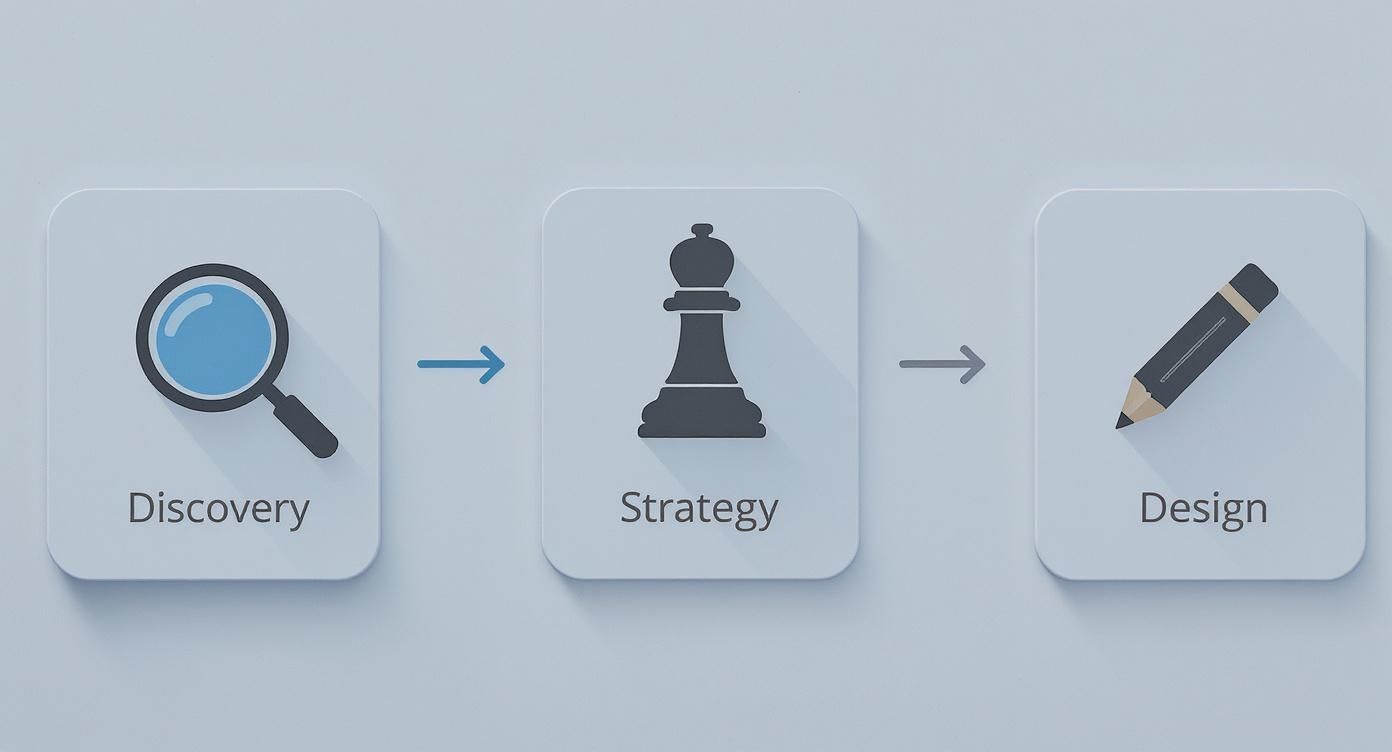
As you can see, each stage builds on the last. You start with foundational research, move into strategic planning, and only then do you start thinking about the visuals. Getting this order right is crucial for developing an identity that feels authentic and actually works in the real world.
Phase 1: Discovery and Research
Before you can decide what your brand should look like, you need to understand the world it lives in. This first phase is all about gathering intel. Put on your detective hat, because you’re looking for clues that will shape every single step that follows.
First, look inward at your own business. What’s your mission? What are your core values? What makes your product or service different? Answering these questions honestly gives you the foundation for a brand that feels genuine.
Next, you turn your focus outward.
Audience Analysis: Who are your ideal customers? And I mean really who are they? Go way beyond basic demographics. Dig into their lifestyles, what they aspire to, and what keeps them up at night. Creating detailed buyer personas helps you design for real people, not just a faceless market segment.
Competitor Analysis: Who’s already in your space? Take a good look at their brand identities. What are they doing well? Where are the gaps you could fill? The goal isn't to copy them but to find a unique corner of the market you can own.
Market Trends: What’s happening in your industry? Getting a feel for current visual trends and consumer expectations helps ensure your brand feels relevant and not like a relic from 2010.
This deep dive ensures your brand identity is built on a solid foundation of data and insight, not just your personal taste.
Phase 2: Strategy and Positioning
With all that research in your back pocket, it's time to build your brand strategy. This is where you translate all those findings into a clear, actionable plan. It’s about defining your brand's personality and deciding how you want people to see you. Honestly, this is probably the most critical part of the entire brand identity design process.
Your main job here is to nail your brand positioning statement. This is a short, sharp statement that explains your unique value to your target audience and clearly separates you from the competition.
A brand positioning statement is your internal North Star. It clarifies who you are, who you serve, and why you're different, guiding all your creative and marketing decisions to ensure consistency.
From this statement, you can start fleshing out the other key strategic bits:
Brand Personality: If your brand walked into a room, what would it be like? Friendly and witty? Or serious and authoritative? Pinpointing a few key personality traits helps shape your tone of voice and visual style.
Brand Messaging: What are the key messages you want to get across? This includes your tagline, your value proposition, and the core story you'll tell everywhere.
This strategic framework becomes the creative brief for the design phase, making sure every visual element has a clear job to do.
Phase 3: Visual Design and Guidelines
Finally, with a rock-solid strategy in place, the creative work begins. This is the fun part, where your brand’s personality starts to take visual form. Designers will explore different creative directions for all those core building blocks we talked about earlier—logo, colour palette, typography, and imagery.
This is a collaborative back-and-forth involving concepts, feedback, and tweaks. The aim is to create a visual system that not only looks fantastic but also perfectly communicates your brand strategy.
Once the final designs get the thumbs-up, the last step is to pull everything into a set of brand guidelines. Think of this document as the instruction manual for your brand. It gives clear rules on how to use your logo, which specific colours to use, what fonts are allowed, and the right style of imagery. This is what keeps your brand looking and feeling consistent everywhere, from your website to your social media and business cards.
A comprehensive brand identity design process means you end up with more than just a logo; you get a complete system for telling the world who you are.
Emerging Trends Shaping Brand Identity in the UK
If you want your brand to connect with people and stick around for the long haul, you’ve got to do more than just follow today's rules. You need to peek around the corner and see what’s coming next. The world of brand identity design never sits still, especially in a market as lively as the UK. Staying on top of these shifts means you can build a brand that feels fresh, relevant, and ready for whatever comes next.
Gone are the days of a static logo and a rigid colour palette being enough. Today, brands need to be more like chameleons—adapting to different platforms and situations without ever forgetting who they are at their core. This forward-thinking approach is what separates a brand that just gets noticed now from one that people will still be talking about in years to come.
Dynamic and Adaptive Branding
One of the biggest changes we’re seeing is the shift towards dynamic branding. Instead of one single, sacred logo, brands are now building flexible visual systems. Picture a logo that can change its colour, shape, or even animate depending on where you see it—a quick flash in a social media story, a banner on a website, or an icon on your phone.
This makes a brand feel alive and interactive. It’s not about throwing consistency out the window; it's about creating a kind of "controlled flexibility." This way, even when the visuals adapt, the brand’s personality is still instantly recognisable, making for a far more engaging and modern experience.
Communicating Sustainability and Values
Let's be honest, people in the UK are making more conscious choices than ever before. They want to spend their money with businesses that actually stand for something, making your ethical and sustainable practices a massive part of your brand’s story. Shouting about your values through your brand identity isn’t just a nice-to-have anymore; it's how you build trust.
And no, this doesn't just mean slapping some green onto your colour palette and calling it a day. It’s about weaving your values into everything you do.
Eco-friendly Packaging: Using materials that show you’re serious about reducing your environmental footprint.
Transparent Messaging: Being upfront and clear in your brand voice about how you source materials or produce your goods.
Purpose-Driven Imagery: Using photos and videos that show the real-world impact you're making.
Branding trends in the UK are moving fast. A massive 78% of UK consumers say they now choose brands that share their personal values over brands that are just cheaper. This stat alone shows how vital authenticity has become. If you want to dig deeper, you can read the full research on UK branding trends.
Multi-Sensory and Immersive Experiences
Brand identity is breaking free from the screen. As technology gives us new ways to connect, brands are starting to think about how they can create experiences that engage more than just our eyes. We're talking sound, touch, and creating a deeper, more memorable connection.
A multi-sensory brand experience moves beyond visual identity to create a complete world around the customer. It’s the difference between seeing a brand and feeling it.
This trend is popping up in some really exciting ways. Immersive digital experiences like augmented reality (AR) now engage 45% of UK consumers, letting brands bring their products right into a customer's living room.
And with 40% of UK households now owning a smart speaker, sonic branding is becoming a must-have. This is all about creating a unique sound—a "sonic logo"—that’s instantly recognisable on Alexa, Spotify, or any other audio platform. By engaging more of the senses, you build a much stronger emotional bond with your audience.
These trends prove that a modern brand identity isn't a static rulebook. It's a living, breathing thing. By embracing dynamic visuals, being loud and proud about your values, and exploring sensory experiences, you can build a brand that isn’t just seen and heard—but one that is truly felt.
Bringing Your Brand Identity to Life on Your Website
Coming up with a powerful brand identity is only half the job. Its real magic is revealed when you apply it consistently, and your website is the main stage for that performance. Think of your site as your digital storefront, your portfolio, and your number one point of contact. It's where your brand identity design stops being an idea and becomes a real, interactive experience for your customers.
If your identity elements are all over the place online, you'll just confuse visitors and chip away at the trust you've worked so hard to build. A cohesive digital presence makes it crystal clear who you are and what you stand for, creating a smooth journey from the first click to the final sale.
Translating Visuals for the Web
Taking your brand’s core visuals and making them work online isn't a simple copy-and-paste job. The digital world has its own rules, and you need to play by them to give users a great experience.
For example, your typography needs to be web-safe and easy to read on screens of all sizes. A font that looks incredible in print might be a headache to read on a phone, which will send visitors running. Likewise, your colour palette needs to be used strategically to guide the eye, highlight key info, and make sure your site is accessible to everyone, including people with visual impairments.
Your website is where your brand’s personality meets functionality. Every design choice, from the colour of a button to the style of an icon, should be a deliberate reflection of your brand identity, guiding users while reinforcing your story.
A Checklist for Brand Consistency Online
Checking your website regularly is key to keeping your brand presence strong and unified. Use this quick checklist to scan your site and catch any inconsistencies that might be weakening your impact.
Logo Usage: Is your logo displayed clearly in the header on every single page? Is it the correct version, with proper spacing and no weird stretching or squishing?
Colour Palette: Are your main brand colours used consistently for things like headings, links, buttons, and backgrounds? Do they match the feeling you want to create and meet accessibility standards?
Typography: Are you sticking to your brand fonts for headings and body text across the site? Is everything legible and sized correctly for both desktop and mobile?
Imagery: Do your photos and graphics all share a similar style, tone, and quality? Do they genuinely reflect your brand’s personality and speak to your ideal customer?
Tone of Voice: Does the language in your headlines, product descriptions, and blog posts sound like it’s coming from the same person? Is the voice consistent across every page?
The secret to managing all this is a solid style guide. You can learn more about what a style guide is and why your brand needs one to keep everything on track. These guidelines ensure that anyone working on your site—now or in the future—knows the rules and can apply your brand identity design perfectly.
Strengthening your brand's online presence is an ongoing process. By making sure every little piece of your website works together, you create a memorable and trustworthy experience that turns casual browsers into loyal fans.
When to Partner with a Professional Design Agency
Look, the DIY route is tempting. We get it. But there’s a tipping point where ‘good enough’ just doesn’t cut it anymore, and that's when professional expertise stops being a cost and starts becoming a serious strategic investment.
Knowing when to call in the cavalry is key to taking your brand from forgettable to iconic. If your business is growing, breaking into a new market, or just feels invisible in a crowded space, it’s probably time to have a chat with the experts.
An agency brings so much more to the table than just fancy design software. They offer a fresh, objective pair of eyes. It’s incredibly easy to be too close to your own business, wearing brand-goggles that blind you to what’s really going on. A professional can spot the market gaps and golden opportunities you’re missing.
They live and breathe the competitive landscape. They can build a brand identity design that isn’t just beautiful, but is surgically positioned to win.
Preparing for a Successful Partnership
To get the absolute most out of working with an agency, you need to do a little homework first. Trust me, a well-prepared client is an agency's dream. It means the project kicks off smoothly and avoids a ton of back-and-forth later.
Before you even book that first meeting, get your thoughts together on a few key things:
Your Mission and Values: What’s the real reason your business exists? What are the non-negotiable principles that guide everything you do?
Target Audience: Who are you actually trying to sell to? Get specific. Think about their daily lives, what keeps them up at night, and what makes them tick.
Competitors: Make a list of your main rivals. What do you love about their branding? What makes you cringe?
Inspiration: Pull together examples of brands you admire. They don’t even have to be in your industry. What about their identity resonates with you?
This isn’t just busy work; this information is the bedrock of your design brief—the roadmap that guides the entire project.
A detailed design brief is the single most important tool for a successful agency partnership. It aligns expectations, minimises revisions, and ensures the final brand identity is a true reflection of your strategic goals.
Working with an agency is a proper collaboration. When you prepare properly and pick the right partner, you're not just buying a logo; you’re investing in a timeless brand that will pay you back for years to come.
Brand Identity Design: Your Questions Answered
Dipping your toes into brand identity design can feel like a new language. To help you get your bearings, we’ve tackled some of the most common questions we hear from business owners across the UK.
How Much Should I Budget for Professional Brand Identity Design in the UK?
Honestly, it varies wildly. The cost depends entirely on the scope of the project and the agency you choose to work with. A small startup might get a basic package for a few thousand pounds, whereas a full corporate identity overhaul for a larger company could easily run into the tens of thousands.
The best thing you can do is write a detailed brief outlining exactly what you need. That way, you can get quotes that are tailored to your business, not just a ballpark figure.
How Long Does the Brand Identity Design Process Actually Take?
You’ll want to brace yourself for this one: a proper brand identity project typically takes anywhere from 4 to 12 weeks. This isn’t something you want to rush.
That timeframe gives a design team enough breathing room for proper research, strategic thinking, creative exploration, your feedback, and pulling it all together into a solid set of brand guidelines. Trying to cram it into a shorter window often leads to a weak, forgettable result. Plan ahead!
It's easy to fixate on one thing, like the logo. But the real magic of a strong brand identity isn’t a single element—it’s consistency. When your logo, colours, fonts, and voice all work together in perfect harmony across every single touchpoint, that's when you build a brand people remember and trust.
Can’t I Just Get a Logo Designed and Call It a Day?
You could, but you’d be selling yourself short. Think of it this way: a logo is like the front door to your house. It’s important, for sure, but it doesn't tell you anything about what's inside.
A full brand identity is the entire home—the colour on the walls, the style of the furniture, the music playing in the background. It’s the complete toolkit of colours, fonts, imagery, and voice that ensures your brand looks and feels the same everywhere. A logo on its own just can't compete with that for building long-term recognition.
Ready to build a brand that doesn’t just blend in, but genuinely connects with the right people? The team at Baslon Digital lives and breathes this stuff. We specialise in turning your vision into a powerful brand identity and a stunning Wix website to match.
Comments